Papal address 'Apostles as Envoys of Christ'
FREE Catholic Classes
"Witnesses of a Person"
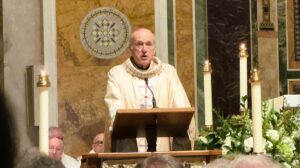
VATICAN CITY, MARCH 23, 2006 (Zenit) - Here is a translation of the address Benedict XVI gave today at the general audience, which he dedicated to the theme "The Apostles, Witnesses and Envoys of Christ."
* * *
Dear Brothers and Sisters,
The Letter to the Ephesians presents the Church as a structure "built upon the foundation of the apostles and prophets, Christ Jesus himself being the cornerstone" (2:20). In [the Book of] Revelation, the role of the apostles, and more specifically of the Twelve, is clarified with the eschatological perspective of the heavenly Jerusalem, presented as a city whose wall has "twelve courses of stones as its foundation, on which were inscribed the twelve names of the twelve apostles of the Lamb" (21:14). The Gospels coincide in narrating that the call of the apostles marked the first steps of Jesus' ministry, after the baptism received by the Baptist in the waters of the Jordan.
According to Mark's (1:16-20) and Matthew's (4:18-22) accounts, the Lake of Galilee is the scene of the call of the first apostles. Jesus had just begun to preach the Kingdom of God, when his gaze turned to two pairs of brothers: Simon and Andrew, James and John. They were fishermen, dedicated to their daily work. They lowered their nets and repaired them. However, another catch was awaiting them. Jesus calls them with determination and they follow him with promptness: Henceforth they will be "fishers of men" (cf. Mark 1:17; Matthew 4:19).
Although he follows the same tradition, Luke gives a more elaborate account (5:1-11). He shows the journey of faith of the first disciples, specifying that the invitation to follow comes to them after having heard Jesus' first sermon, and after having experienced his first miraculous signs. In particular, the miraculous catch constitutes the immediate context and offers the symbol of the mission of fishers of men that was entrusted to them. The destiny of these "called" henceforth will be profoundly linked to Jesus'. An apostle is someone who is sent, but even before that, he is an "expert" on Jesus.
This aspect is emphasized by the Evangelist John from Jesus' first meeting with the future apostles. Here the scene is different. The meeting takes place on the banks of the Jordan. The presence of the future disciples, who like Jesus came from Galilee to live the experience of the baptism administered by John, illuminates their spiritual world. They were men awaiting the Kingdom of God, desirous of knowing the Messiah, whose coming was announced as something imminent.
It was enough that John the Baptist pointed out Jesus as the Lamb of God (cf. John 1:36) for them to want a personal meeting with the Teacher. Jesus' conversation with his two first future apostles is very expressive. To the question: "What do you seek?" they replied with another question: "'Rabbi' -- which means Teacher -- 'where are you staying?'" Jesus' response is an invitation: "Come and see" (cf. John 1:38-39). Come so that you can see.
Thus, the apostles' adventure began as a gathering of persons who open to one another reciprocally. A direct knowledge of the Teacher began for the disciples. They saw where he lived and began to know him. They would not have to be heralds of an idea, but witnesses of a person. Before being sent to evangelize, they would have to "be" with Jesus (cf. Mark 3:14), establishing a personal relationship with him. With this foundation, evangelization is no more than a proclamation of what has been experienced and an invitation to enter into the mystery of communion with Christ (cf. 1 John 13).
To whom will the apostles be sent? In the Gospel, Jesus seems to restrict their mission to Israel: "I was sent only to the lost sheep of the house of Israel" (Matthew 15:24). At the same time, he seems to circumscribe the mission entrusted to the Twelve: "Jesus sent out these twelve after instructing them thus, 'Do not go into pagan territory or enter a Samaritan town. Go rather to the lost sheep of the house of Israel'" (Matthew 10:5). A certain criticism of rationalist inspiration saw in these expressions the lack of a universal consciousness of the Nazarene.
In fact, they must be understood in the light of their special relationship with Israel, community of the Covenant, in continuity with the history of salvation. According to the messianic expectation, the divine promises, made immediately to Israel, would reach their fulfillment when God himself, through his Chosen One, would gather his people as a shepherd does his flock: "I will save my sheep so that they may no longer be despoiled. ... I will appoint one shepherd over them to pasture them, my servant David. ... And my servant David shall be prince among them" ([cf.] Ezekiel 34:22-24).
Jesus is the eschatological shepherd, who gathers the lost sheep of the house of Israel and goes out in search of them, because he knows and loves them (cf. Luke 15:4-7 and Matthew 18:12-14; cf. also the figure of the Good Shepherd in John 10:11 and following). Through this "gathering," the Kingdom of God is proclaimed to all nations. "Thus I will display my glory among the nations, and all the nations shall see the judgment I have executed and the hand I have laid upon them" (Ezekiel 39:21). And Jesus follows precisely this prophetic profile. The first step is the "gathering" of Israel, so that all nations called to gather in communion with the Lord may live and believe.
In this way, the Twelve, called to participate in the same mission of Jesus, cooperate with the Shepherd of the last times, also addressing above all the lost sheep of the house of Israel, namely, the people of the promise, whose gathering is sign of the salvation for all nations, the beginning of the universalization of the Covenant. Far from contradicting the universal opening of the Nazarene's messianic action, the restriction from the beginning of his mission and of that of the Twelve is an effective prophetic sign.
After the passion and resurrection of Christ, this sign was clarified: The universal character of the mission of the apostles would become explicit. Christ would send the apostles "into all the world" (Mark 16:15) and to "all nations" (Matthew 28:19; Luke 24:47) "and to the end of the earth" (Acts 1:8). And this mission continues. The Lord's commandment to gather the nations in the unity of his love always continues. This is our hope and this is also our commandment: to contribute to that universality, to this true unity in the richness of cultures, in communion with our true Lord Jesus Christ.
[At the end of the audience, the Holy Father greeted pilgrims in several languages. In English, he said:]
Dear Brothers and Sisters,
In our catechesis on Christ and the Church, we have seen how the Church is built "on the foundation of the apostles." The Gospels show how Jesus, at the beginning of his public ministry, chose the Twelve to become "fishers of men."
St. John in particular presents the calling of the Apostles as the fruit of a life-changing, personal encounter with the Lord. More than just the proclamation of a message, the preaching of the Gospel is seen as a witness to the person of Jesus Christ and an invitation to enter into communion with him.
Jesus sent his apostles first to the "lost sheep of the house of Israel." This prophetic act should be understood in the light of Israel's messianic expectation, according to which, through his Chosen One, [God himself] would gather his people like a shepherd his flock.
This "gathering" is the sign of the coming of God's Kingdom and the extension of his saving power to every nation and people. After the Resurrection, the universality of the mission entrusted to the apostles would become explicit. The Risen Lord would send them forth to make disciples of every nation, even "to the ends of the earth"!
I offer a warm welcome to the English-speaking pilgrims and visitors present at today's audience, including the various student groups. May your time in Rome strengthen your love of the universal Church and deepen your commitment to witness to the "good news" of Jesus Christ. Upon you and your families I cordially invoke God's abundant blessings of joy and peace.
[Original text in English; adapted]
© Copyright 2006 -- Libreria Editrice Vaticana
Contact
The Vatican
https://www.catholic.org
, VA
Pope Benedict XVI - Bishop of Rome, 661 869-1000
info@yourcatholicvoice.org
Keywords
Pope, Benedict, Christ, Apostles, Address, Person

More Catholic PRWire
Showing 1 - 50 of 4,716
A Recession Antidote
Randy Hain
Monaco & The Vatican: Monaco's Grace Kelly Exhibit to Rome--A Review of Monegasque-Holy See Diplomatic History
Dna. Maria St. Catherine Sharpe, t.o.s.m., T.O.SS.T.
The Why of Jesus' Death: A Pauline Perspective
Jerom Paul
A Royal Betrayal: Catholic Monaco Liberalizes Abortion
Dna. Maria St.Catherine De Grace Sharpe, t.o.s.m., T.O.SS.T.
Embrace every moment as sacred time
Mary Regina Morrell
My Dad
JoMarie Grinkiewicz
Letting go is simple wisdom with divine potential
Mary Regina Morrell
Father Lombardi's Address on Catholic Media
Catholic Online
Pope's Words to Pontifical Latin American College
Catholic Online
Prelate: Genetics Needs a Conscience
Catholic Online
State Aid for Catholic Schools: Help or Hindrance?
Catholic Online
Scorsese Planning Movie on Japanese Martyrs
Catholic Online
2 Nuns Kidnapped in Kenya Set Free
Catholic Online
Holy See-Israel Negotiation Moves Forward
Catholic Online
Franchising to Evangelize
Catholic Online
Catholics Decry Anti-Christianity in Israel
Catholic Online
Pope and Gordon Brown Meet About Development Aid
Catholic Online
Pontiff Backs Latin America's Continental Mission
Catholic Online
Cardinal Warns Against Anti-Catholic Education
Catholic Online
Full Circle
Robert Gieb
Three words to a deeper faith
Paul Sposite
Relections for Lent 2009
chris anthony
Wisdom lies beyond the surface of life
Mary Regina Morrell
World Food Program Director on Lent
Catholic Online
Moral Clarity
DAN SHEA
Pope's Lenten Message for 2009
Catholic Online
A Prayer for Monaco: Remembering the Faith Legacy of Prince Rainier III & Princess Grace and Contemplating the Moral Challenges of Prince Albert II
Dna. Maria St. Catherine Sharpe
Keeping a Lid on Permissiveness
Sally Connolly
Glimpse of Me
Sarah Reinhard
The 3 stages of life
Michele Szekely
Sex and the Married Woman
Cheryl Dickow
A Catholic Woman Returns to the Church
Cheryl Dickow
Modernity & Morality
Dan Shea
Just a Minute
Sarah Reinhard
Catholic identity ... triumphant reemergence!
Hugh McNichol
Edging God Out
Paul Sposite
Burying a St. Joseph Statue
Cheryl Dickow
George Bush Speaks on Papal Visit
Catholic Online
Sometimes moving forward means moving the canoe
Mary Regina Morrell
Action Changes Things: Teaching our Kids about Community Service
Lisa Hendey

Easter... A Way of Life
Paul Spoisite
Papal initiative...peace and harmony!
Hugh McNichol
Proclaim the mysteries of the Resurrection!
Hugh McNichol
Jerusalem Patriarch's Easter Message
Catholic Online
Good Friday Sermon of Father Cantalamessa
Catholic Online
Papal Address at the End of the Way of the Cross
Catholic Online
Cardinal Zen's Meditations for Via Crucis
Catholic Online
Interview With Vatican Aide on Jewish-Catholic Relations
Catholic Online
Pope Benedict XVI On the Easter Triduum
Catholic Online
Holy Saturday...anticipation!
Hugh McNichol

Come Grow With Us
Sign up and walk the Catholic journey with millions around the world.
Receive inspiring emails on saints, daily readings, and free faith-building resources—no cost, ever.
An important update for our readers.
Please Watch
- 7 Morning Prayers
- Mysteries of the Rosary
- Litany of the Bl. Virgin Mary
- Popular Saints
- Popular Prayers
- Female Saints
- Saint Feast Days by Month
- Stations of the Cross
- St. Francis of Assisi
- St. Michael the Archangel
- The Apostles' Creed
- Unfailing Prayer to St. Anthony
- Pray the Rosary







Copyright 2026 Catholic Online. All materials contained on this site, whether written, audible or visual are the exclusive property of Catholic Online and are protected under U.S. and International copyright laws, © Copyright 2026 Catholic Online. Any unauthorized use, without prior written consent of Catholic Online is strictly forbidden and prohibited.
Catholic Online is a Project of Your Catholic Voice Foundation, a Not-for-Profit Corporation. Your Catholic Voice Foundation has been granted a recognition of tax exemption under Section 501(c)(3) of the Internal Revenue Code. Federal Tax Identification Number: 81-0596847. Your gift is tax-deductible as allowed by law.
