We ask you, urgently: don't scroll past this
Dear readers, Catholic Online was de-platformed by Shopify for our pro-life beliefs. They shut down our Catholic Online, Catholic Online School, Prayer Candles, and Catholic Online Learning Resources essential faith tools serving over 1.4 million students and millions of families worldwide. Our founders, now in their 70's, just gave their entire life savings to protect this mission. But fewer than 2% of readers donate. If everyone gave just $5, the cost of a coffee, we could rebuild stronger and keep Catholic education free for all. Stand with us in faith. Thank you.Help Now >
Benedict XVI's Address on Forthcoming Encyclical
FREE Catholic Classes
"I Wished to Show the Humanity of Faith"
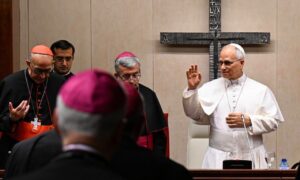
VATICAN CITY, JAN. 24, 2006 (Zenit) - Here is a translation of the address Benedict XVI gave today to the participants in a meeting organized by the Pontifical Council "Cor Unum" on the theme "But the Greatest of These Is Love" (1 Corinthians 13:13).
* * *
The cosmic excursion in which Dante wants to involve the reader in his "Divine Comedy" ends before the everlasting Light that is God himself, before that Light which at the same time is the love "which moves the sun and the other stars ("Paradise" XXXIII, verse 145). Light and love are but one thing. They are the primordial creative power that moves the universe.
If these words of the poet reveal the thought of Aristotle, who saw in the "eros" the power that moves the world, Dante's gaze, however, perceives something totally new and unimaginable for the Greek philosopher.
Eternal Light not only is presented with the three circles of which he speaks with those profound verses that we know: "Eternal Light, You only dwell within Yourself, and only You know You; Self-knowing, Self-known, You love and smile upon Yourself!" ("Paradise," XXXIII, verses 124-126). In reality, the perception of a human face -- the face of Jesus Christ -- which Dante sees in the central circle of light is even more overwhelming than this revelation of God as Trinitarian circle of knowledge and love.
God, infinite Light, whose incommensurable mystery had been intuited by the Greek philosopher, this God has a human face and -- we can add -- a human heart. In this vision of Dante is shown, on one hand, the continuity between the Christian faith in God and the search promoted by reason and by the realm of religions; at the same time, however, in it is also appreciated the novelty that exceeds all human search, the novelty that only God himself could reveal to us: the novelty of a love that has led God to assume a human face, more than that, to assume the flesh and blood, the whole of the human being.
God's "eros" is not only a primordial cosmic force, it is love that has created man and that bends before him, as the Good Samaritan bent before the wounded man, victim of thieves, who was lying on the side of the road that went from Jerusalem to Jericho.
Today the word "love" is so tarnished, so spoiled and so abused, that one is almost afraid to pronounce it with one's lips. And yet it is a primordial word, expression of the primordial reality; we cannot simply abandon it, we must take it up again, purify it and give back to it its original splendor so that it might illuminate our life and lead it on the right path. This awareness led me to choose love as the theme of my first encyclical.
I wished to express to our time and to our existence something of what Dante audaciously recapitulated in his vision. He speaks of his "sight" that "was enriched" when looking at it, changing him interiorly [The textual quotation in English is: "But through the sight, that fortified itself in me by looking, one appearance only to me was ever changing as I changed" (cf. "Paradise," XXXIII, verses 112-114)]. It is precisely this: that faith might become a vision-comprehension that transforms us.
I wished to underline the centrality of faith in God, in that God who has assumed a human face and a human heart. Faith is not a theory that one can take up or lay aside. It is something very concrete: It is the criterion that decides our lifestyle. In an age in which hostility and greed have become superpowers, an age in which we witness the abuse of religion to the point of culminating in hatred, neutral rationality on its own is unable to protect us. We are in need of the living God who has loved us unto death.
Thus, in this encyclical, the subjects "God," "Christ" and "Love" are welded, as the central guide of the Christian faith. I wished to show the humanity of faith, of which "eros" forms part, man's "yes" to his corporeal nature created by God, a "yes" that in the indissoluble marriage between man and woman finds its rooting in creation. And in it, "eros" is transformed into "agape," love for the other that no longer seeks itself but that becomes concern for the other, willingness to sacrifice oneself for him and openness to the gift of a new human life.
The Christian "agape," love for one's neighbor in the following of Christ, is not something foreign, put to one side or something that even goes against the "eros"; on the contrary, with the sacrifice Christ made of himself for man he offered a new dimension, which has developed ever more in the history of the charitable dedication of Christians to the poor and the suffering.
A first reading of the encyclical might perhaps give the impression that it is divided in two parts, that it is not greatly related within itself: a first, theoretical part that talks about the essence of love, and a second part that addresses ecclesial charity, with charitable organizations. However, what interested me was precisely the unity of the two topics, which can only be properly understood if they are seen as only one thing.
Above all, it was necessary to show that man is created to love and that this love, which in the first instance is manifested above all as "eros" between man and woman, must be transformed interiorly later into "agape," in gift of self to the other to respond precisely to the authentic nature of the "eros." With this foundation, it had then to be clarified that the essence of the love of God and of one's neighbor described in the Bible is the center of Christian life, it is the fruit of faith.
Then, it was necessary to underline in a second part that the totally personal act of the "agape" cannot remain as something merely individual, but, on the contrary, it must also become an essential act of the Church as community: that is, an institutional form is also needed that expresses itself in the communal action of the Church. The ecclesial organization of charity is not a form of social assistance that is superimposed by accident on the reality of the Church, an initiative that others could also take.

On the contrary, it forms part of the nature of the Church. Just as to the divine "Logos" corresponds the human announcement, the word of faith, so also to the "Agape," which is God, must correspond the "agape" of the Church, her charitable activity. This activity, in addition to its first very concrete meaning of help to the neighbor, also communicates to others the love of God, which we ourselves have received. In a certain sense, it must make the living God visible. In the charitable organization, God and Christ must not be strange words; in fact, they indicate the original source of ecclesial charity. The strength of "Caritas" depends on the strength of faith of all its members and collaborators.
The spectacle of suffering man touches our heart. But charitable commitment has a meaning that goes well beyond mere philanthropy. God himself pushes us in our interior to alleviate misery. In this way, in a word, we take him to the suffering world. The more we take him consciously and clearly as gift, the more effectively will our love change the world and awaken hope, a hope that goes beyond death.
Contact
The Vatican
https://www.catholic.org
, VA
Pope Benedict XVI - Bishop of Rome, 661 869-1000
info@yourcatholicvoice.org
Keywords
Pope, Benedict, Encyclical, Faith, Love

More Catholic PRWire
Showing 1 - 50 of 4,716
A Recession Antidote
Randy Hain
Monaco & The Vatican: Monaco's Grace Kelly Exhibit to Rome--A Review of Monegasque-Holy See Diplomatic History
Dna. Maria St. Catherine Sharpe, t.o.s.m., T.O.SS.T.
The Why of Jesus' Death: A Pauline Perspective
Jerom Paul
A Royal Betrayal: Catholic Monaco Liberalizes Abortion
Dna. Maria St.Catherine De Grace Sharpe, t.o.s.m., T.O.SS.T.
Embrace every moment as sacred time
Mary Regina Morrell
My Dad
JoMarie Grinkiewicz
Letting go is simple wisdom with divine potential
Mary Regina Morrell
Father Lombardi's Address on Catholic Media
Catholic Online
Pope's Words to Pontifical Latin American College
Catholic Online
Prelate: Genetics Needs a Conscience
Catholic Online
State Aid for Catholic Schools: Help or Hindrance?
Catholic Online
Scorsese Planning Movie on Japanese Martyrs
Catholic Online
2 Nuns Kidnapped in Kenya Set Free
Catholic Online
Holy See-Israel Negotiation Moves Forward
Catholic Online
Franchising to Evangelize
Catholic Online
Catholics Decry Anti-Christianity in Israel
Catholic Online
Pope and Gordon Brown Meet About Development Aid
Catholic Online
Pontiff Backs Latin America's Continental Mission
Catholic Online
Cardinal Warns Against Anti-Catholic Education
Catholic Online
Full Circle
Robert Gieb

Three words to a deeper faith
Paul Sposite
Relections for Lent 2009
chris anthony
Wisdom lies beyond the surface of life
Mary Regina Morrell
World Food Program Director on Lent
Catholic Online
Moral Clarity
DAN SHEA
Pope's Lenten Message for 2009
Catholic Online
A Prayer for Monaco: Remembering the Faith Legacy of Prince Rainier III & Princess Grace and Contemplating the Moral Challenges of Prince Albert II
Dna. Maria St. Catherine Sharpe
Keeping a Lid on Permissiveness
Sally Connolly
Glimpse of Me
Sarah Reinhard
The 3 stages of life
Michele Szekely
Sex and the Married Woman
Cheryl Dickow
A Catholic Woman Returns to the Church
Cheryl Dickow
Modernity & Morality
Dan Shea
Just a Minute
Sarah Reinhard
Catholic identity ... triumphant reemergence!
Hugh McNichol
Edging God Out
Paul Sposite
Burying a St. Joseph Statue
Cheryl Dickow
George Bush Speaks on Papal Visit
Catholic Online
Sometimes moving forward means moving the canoe
Mary Regina Morrell
Action Changes Things: Teaching our Kids about Community Service
Lisa Hendey

Easter... A Way of Life
Paul Spoisite
Papal initiative...peace and harmony!
Hugh McNichol
Proclaim the mysteries of the Resurrection!
Hugh McNichol
Jerusalem Patriarch's Easter Message
Catholic Online
Good Friday Sermon of Father Cantalamessa
Catholic Online
Papal Address at the End of the Way of the Cross
Catholic Online
Cardinal Zen's Meditations for Via Crucis
Catholic Online
Interview With Vatican Aide on Jewish-Catholic Relations
Catholic Online
Pope Benedict XVI On the Easter Triduum
Catholic Online
Holy Saturday...anticipation!
Hugh McNichol

Come Grow With Us
Sign up and walk the Catholic journey with millions around the world.
Receive inspiring emails on saints, daily readings, and free faith-building resources—no cost, ever.
Sister Sara Has One Message for Every Catholic Family This June
- Easter / Lent
- 5 Lenten Prayers
- Ash Wednesday
- 7 Morning Prayers
- Mysteries of the Rosary
- Litany of the Bl. Virgin Mary
- Popular Saints
- Popular Prayers
- Female Saints
- Saint Feast Days by Month
- Stations of the Cross
- St. Francis of Assisi
- St. Michael the Archangel
- The Apostles' Creed
- Unfailing Prayer to St. Anthony
- Pray the Rosary








Copyright 2026 Catholic Online. All materials contained on this site, whether written, audible or visual are the exclusive property of Catholic Online and are protected under U.S. and International copyright laws, © Copyright 2026 Catholic Online. Any unauthorized use, without prior written consent of Catholic Online is strictly forbidden and prohibited.
Catholic Online is a Project of Your Catholic Voice Foundation, a Not-for-Profit Corporation. Your Catholic Voice Foundation has been granted a recognition of tax exemption under Section 501(c)(3) of the Internal Revenue Code. Federal Tax Identification Number: 81-0596847. Your gift is tax-deductible as allowed by law.