 Dear readers, Catholic Online was de-platformed by Shopify for our pro-life beliefs. They shut down our Catholic Online, Catholic Online School, Prayer Candles, and Catholic Online Learning Resources essential faith tools serving over 1.4 million students and millions of families worldwide. Our founders, now in their 70's, just gave their entire life savings to protect this mission. But fewer than 2% of readers donate. If everyone gave just $5, the cost of a coffee, we could rebuild stronger and keep Catholic education free for all. Stand with us in faith. Thank you. Help Now >
Reflections on the Eucharist: 'Same Prayer as the Repentant Thief' (Part 1 of 2)
FREE Catholic Classes
Father Raniero Cantalamessa's 3rd Sermon of Advent
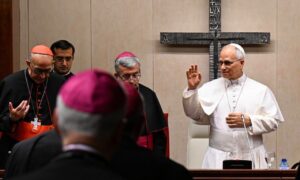
VATICAN CITY, DEC. 19, 2004 (Zenit) - Here is a translation of the third Advent sermon, delivered this morning before the Pope and officials of the Roman Curia, by the Pontifical Household preacher, Father Raniero Cantalamessa.
The Capuchin priest has been offering a series of Eucharistic reflections, in the Redemptoris Mater Chapel, in the light of the hymn "Adoro Te Devote."
Part 2 of this sermon appears Monday.
* * *
Father Raniero Cantalamessa
I make the Same Prayer as the Repentant Thief
Third Sermon of Advent at the Pontifical Household
A laud of Jacopone da Todi, composed around the year 1300, contains a clear allusion to the second stanza of the Adoro Te Devote which we commented on last time: "Visus, tactus gustus ..." In it, Jacopone imagines a sort of contest among the different human senses in regard to the Eucharist: three of them (sight, touch and taste) say that it is only bread, "only the hearing" is opposed, assuring that "under these visible forms, Christ is hidden."1 If not enough to affirm that the hymn is St. Thomas Aquinas', it nevertheless shows that it is older than was thought until now. Certainly the date is not incompatible with an attribution to the Angelic Doctor. If Jacopone can allude to it as the well- known text, it must have been composed at least some 20 years before and therefore have already enjoyed a certain popularity.
1. Contemporaries of the Good Thief
We now turn to the third stanza of the hymn that will accompany us in this meditation:
In cruce latébat sola déitas;
at hic latet simul et humánitas.
Ambo tamen credens atque cĂłnfitens
peto quod petĂvit latro poĂ©nitens.
God only on the Cross lay hid from view
But here lies hid at once the Manhood too;
And I, in both professing my belief,
Make the same prayer as the repentant thief.
Christmas is now approaching. A certain romantic tendency has succeeded in making Christmas a wholly human feast of maternity and childhood, of gifts, and of good sentiments. In Moscow's Tetriakov Gallery, Vladimir's painting of the Virgin of Tenderness, which depicts her pressing the Baby Jesus to herself, bore the caption "Maternity" during the Communist regime. However, experts know what is signified in the image of the Mother's worried look, tinged with sadness, as if wishing to protect the child from impending danger, announcing the passion of the Son that Simeon made her perceive in the presentation in the temple.
Christian art has expressed this connection between the birth and death of Christ in a thousand ways. In some pictures by famous painters, the Child Jesus sleeps on his Mother's knees stretched out on a cloth, in the exact position in which he is usually represented in the deposition from the Cross; the bound lamb that is often seen in the representations of the Nativity alludes to the immolated lamb. In a 15th-century painting, one of the Wise Men gives the Child the gift of a chalice with coins in it, sign of the price of the ransom that he has come to pay for sins. (The Child is in the act of taking one of the coins and handing it to the one who offers it to him, a sign that he will die for him also!)2
In this way, the artists express a profound theological truth. "The Word became flesh," writes St. Augustine, "to be able to die for us."3 He is born to be able to die. In the Gospels themselves the accounts of the childhood are a preamble to the accounts of the Passion.
We are not drawn away therefore from the meaning of Christmas if, following the line of this stanza of the hymn, we meditate on the relationship between the Eucharist and the cross. The Year of the Eucharist helps us to appreciate the most profound aspect of Christmas. The true and living memory of Christmas is not the crib but, precisely, the Eucharist. The Pope writes in "Ecclesia de Eucharistia" that "The Eucharist, while commemorating the passion and resurrection, is also in continuity with the incarnation. At the Annunciation Mary conceived the Son of God in the physical reality of his body and blood, thus anticipating within herself what to some degree happens sacramentally in every believer who receives, under the signs of bread and wine, the Lord's body and blood."4
In the third stanza of the Adoro Te Devote the author goes spiritually to Calvary. In a subsequent stanza, that which begins with the words "O memoriale mortis Domini," he contemplates the intrinsic and objective relationship between the Eucharist and the cross, the relationship, that is, which exists between the event and the sacrament. Here, rather, is expressed the subjective relationship between that which occurred in those who were present at the Lord's death and that which must occur in one who is present at the Eucharist; the relationship between the one who lived the event and the one who celebrates the sacrament.
It is an invitation to become "contemporaries" of the event commemorated in the intense and existential sense of the term. To consider Christ's death not in the light of hindsight, but to identify with those who lived, in all its rawness, the "scandal" of the cross leaving out of consideration, at least for a moment, the aura of glory that the Resurrection has conferred on it.
Among all those present at Calvary, the author chooses one in particular, the good thief, with whom to identify. A profound and genuine sentiment of humility and contrition pervades the whole stanza, which the singer is invited to make his own. In the allusive style of the hymn, the whole episode of the good thief and all the words he pronounces on the cross are evoked by the author, not only the final prayer: "Jesus, remember me when you come into your Kingdom."
He first of all rebukes his companion who insults Jesus: "Do you not fear God, since you are under the same sentence of condemnation? And we indeed justly; for we are receiving the due reward of our deeds; but this man has done nothing wrong" (Luke 23:40 f.). The good thief makes a complete confession of sin. His repentance is of the purest biblical quality. True repentance consists in accusing oneself and exonerating God, attributing to oneself the responsibility of evil and proclaiming that "God is innocent." The constant formula of repentance in the Bible is: "You are just in all that you have done, straight are your ways and just your judgments, we have sinned" (cfr. Daniel 3:28 ff; cf. Deuteronomy 32:4 ff).
"He has done nothing wrong": The good thief (or, in any case, the Holy Spirit who inspired these words) shows himself to be an excellent theologian. Only God, in fact, suffers as innocent; every other being who suffers must say: "I suffer justly," because, even if he is not responsible for the action that is imputed to him, he is never altogether without fault. Only the pain of innocent children is like that of God and that is why it is so mysterious and so precious.

There is a profound analogy between the good thief and the one who approaches the Eucharist with faith. The good thief on the cross saw a man, what is more, a man condemned to death, and he believed that he was God, acknowledging his power to remember him in his Kingdom. From a certain point of view, the Christian is called to make an even more difficult act of faith. "In cruce latébat sola déitas; at hic latet simul et humánitas": on the cross the divinity was hidden, here, however, even the humanity is hidden.
The one praying does not hesitate an instant; he rises to the height of the good thief's faith and proclaims that he believes in both the divinity and humanity of Christ: "Ambo tamen credens atque cĂłnfitens": I firmly believe and profess both. Two verbs: credo, confiteor, I believe and I profess. It is not a repetition. St. Paul has illustrated the difference between believing and confessing: "For man believes with the heart and so is justified, and he confesses with his lips and so is saved" (Romans 10:10).
It is not enough to believe in the depth of one's heart; it is also necessary to profess one's faith publicly. At the time our hymn was written, the Church had just instituted the feast of Corpus Domini precisely with this objective. After all, the memory of the institution of the Eucharist on Holy Thursday already existed. If this new feast was instituted, it was not so much to commemorate the event as it was to proclaim publicly one's faith in the real presence of Christ in the Eucharist. And, as a matter of fact, with the extraordinary solemnity that it assumed and the manifestations that characterized it in Christian piety (processions, floral decorations ...), the feast precisely fulfilled this objective.5
2. Body, Blood, Soul and Divinity
The central theological truth in this stanza (every stanza, we noted, has one) is that in the Eucharist Christ is really present with his divinity and humanity, "in body, blood, soul and divinity," according to the traditional formula. It is worthwhile to reflect on this formula and its assumptions, because, in this regard, modern biblical theology has contributed some novelties which must be taken into account.
Scholastic theology affirmed that by the words "This is my body" only the body of Christ -- namely his flesh, composed of bones, nerves, etc. -- is made present on the altar by the power of the sacrament (here sacraments), while his blood and soul are present only by dint of the principle of "natural concomitance," because, where there is a living body, there is necessarily also blood and soul. Similarly, by the words "This is my blood," by the power of the sacrament only his blood is made present, while the body and soul are there by natural concomitance.6

All these problems are due to the fact that "body" is understood as interpreted in Greek anthropology, namely, as that part of man that, united to the soul and the intelligence, forms the complete man. The progress of biblical sciences, however, has made us aware that in biblical language, which is that of Jesus and Paul, "body" does not indicate, as for us today, a third of man, but the whole man in as much as he lives in a bodily dimension.
In Eucharistic contexts, "body" has the same meaning that the word "flesh" has in John. We know what John means when he says that the Word was made "flesh": not that he was made "flesh, bones, nerves," but that he was made man. The liberating conclusion is that the soul of Christ is not present in the Eucharist, somewhat indirectly, only by natural concomitance with the body, but directly, by the power of the sacrament, being included in what Jesus understood when speaking of his body.
If one understands "body" in the Greek philosophical sense, it becomes difficult to refute the objection: What need was there to consecrate the blood separately, from the moment that it is but a part of the body, the same as the bones, nerves, and the other organs? The answer once given to this objection was the following: "Because in the passion of Christ, of which the sacrament is a memorial, no other component was separated from his body except the blood."7 But can this explanation still satisfy?
A much simpler explanation is that, in the Bible, the blood is the seat of life and the effusion of blood is, therefore, the eloquent sign of death. The consecration of the blood is explained taking into account that the sacraments are sacred signs and Jesus chose such a sign to leave a living "memorial of his passion." To say that the Eucharist is the sacrament of the body and blood of Christ means that it is the sacrament of the life and death of Christ, in their ontological reality and in their historical development. For our consolation, body, blood and soul, all, therefore, are present in the Eucharist by the power of the very words of Christ, not by some collateral effect of theirs.
In our hymn all these problems are absent and all is soberly reduced to the presence of the humanity and divinity of Christ in the Eucharist. The presence of the divinity, whether in the body or the blood of Christ, is assured by the indissoluble union -- "hypostatic," in theological language -- realized between the Word and humanity in the Incarnation. Therefore, the Eucharist cannot be explained other than in the light of the Incarnation. It is, so to speak, its sacramental prolongation.8

[Monday Part 2: One believes with the heart]
________________________
1 Jacopone da Todi, Laude XLVI: "Li quattro sensi dicono: / Questo si è vero pane. /Solo audito resistelo, / Ciascun de lor fuor remane. / So' queste visibil forme / Cristo occultato ce stane" ("The four senses say: This is but bread. Only the hearing is opposed and constrains them to withdraw. Under these visible forms, Christ is hidden). Cf. F.J.E. Raby, The Date and Authorship of the Poem Adoro te devote, in "Speculum", 20, 1945, pp. 236-238. The text would confirm the lesson "quae sub his formis," instead of "quae sub his figuris," in the first stanza.
2 The pictures with this theme have constituted a session of the exhibition entitled "Seeing Salvation," held in London in the year 2000 and reproduced in part in the exhibition's catalogue: cfr. The Images of Christ, London, 2000, pp. 62-73.
3 St. Augustine, Sermo 23, 3 (CCL 41, 322); Gregory of Nyssa affirms the same, Or. cat., 32 (PG 45, 80).
4 "Ecclesia de Eucharistia," 55
5 Cfr. M. Righetti, "Storia liturgica," II, Milan 1969, pp.329-339
6 Cfr. S.Th. III, q. 76, a. 1. The principle of natural concomitance is taken up by the Council of Trent (Denzinger, 1640) which, however, on this point does no more than quote St. Thomas, without giving this explanation dogmatic value.
7 S. Th. III, q.76. a.2, ad 2.
8 It is the point on which M.J. Scheeben bases all his treatment of the Eucharist, "I misteri del cristianesimo," Chapter 6, Morcelliana, Brescia 1960, pp. 458-526.
Contact
Catholic Online
https://www.catholic.org
CA, VA
Catholic Online - Publisher, 661 869-1000
info@yourcatholicvoice.org
Keywords
Eucharist, Advent, Sermon, Catholic, Christmas, Soul, Truth, Mass

More Catholic PRWire
Showing 1 - 50 of 4,716
A Recession Antidote
Randy Hain
Monaco & The Vatican: Monaco's Grace Kelly Exhibit to Rome--A Review of Monegasque-Holy See Diplomatic History
Dna. Maria St. Catherine Sharpe, t.o.s.m., T.O.SS.T.
The Why of Jesus' Death: A Pauline Perspective
Jerom Paul
A Royal Betrayal: Catholic Monaco Liberalizes Abortion
Dna. Maria St.Catherine De Grace Sharpe, t.o.s.m., T.O.SS.T.
Embrace every moment as sacred time
Mary Regina Morrell
My Dad
JoMarie Grinkiewicz
Letting go is simple wisdom with divine potential
Mary Regina Morrell
Father Lombardi's Address on Catholic Media
Catholic Online
Pope's Words to Pontifical Latin American College
Catholic Online
Prelate: Genetics Needs a Conscience
Catholic Online
State Aid for Catholic Schools: Help or Hindrance?
Catholic Online
Scorsese Planning Movie on Japanese Martyrs
Catholic Online
2 Nuns Kidnapped in Kenya Set Free
Catholic Online
Holy See-Israel Negotiation Moves Forward
Catholic Online
Franchising to Evangelize
Catholic Online
Catholics Decry Anti-Christianity in Israel
Catholic Online
Pope and Gordon Brown Meet About Development Aid
Catholic Online
Pontiff Backs Latin America's Continental Mission
Catholic Online
Cardinal Warns Against Anti-Catholic Education
Catholic Online
Full Circle
Robert Gieb

Three words to a deeper faith
Paul Sposite
Relections for Lent 2009
chris anthony
Wisdom lies beyond the surface of life
Mary Regina Morrell
World Food Program Director on Lent
Catholic Online
Moral Clarity
DAN SHEA
Pope's Lenten Message for 2009
Catholic Online
A Prayer for Monaco: Remembering the Faith Legacy of Prince Rainier III & Princess Grace and Contemplating the Moral Challenges of Prince Albert II
Dna. Maria St. Catherine Sharpe
Keeping a Lid on Permissiveness
Sally Connolly
Glimpse of Me
Sarah Reinhard
The 3 stages of life
Michele Szekely
Sex and the Married Woman
Cheryl Dickow
A Catholic Woman Returns to the Church
Cheryl Dickow
Modernity & Morality
Dan Shea
Just a Minute
Sarah Reinhard
Catholic identity ... triumphant reemergence!
Hugh McNichol
Edging God Out
Paul Sposite
Burying a St. Joseph Statue
Cheryl Dickow
George Bush Speaks on Papal Visit
Catholic Online
Sometimes moving forward means moving the canoe
Mary Regina Morrell
Action Changes Things: Teaching our Kids about Community Service
Lisa Hendey

Easter... A Way of Life
Paul Spoisite
Papal initiative...peace and harmony!
Hugh McNichol
Proclaim the mysteries of the Resurrection!
Hugh McNichol
Jerusalem Patriarch's Easter Message
Catholic Online
Good Friday Sermon of Father Cantalamessa
Catholic Online
Papal Address at the End of the Way of the Cross
Catholic Online
Cardinal Zen's Meditations for Via Crucis
Catholic Online
Interview With Vatican Aide on Jewish-Catholic Relations
Catholic Online
Pope Benedict XVI On the Easter Triduum
Catholic Online
Holy Saturday...anticipation!
Hugh McNichol

Come Grow With Us
Sign up and walk the Catholic journey with millions around the world.
Receive inspiring emails on saints, daily readings, and free faith-building resources—no cost, ever.
Sister Sara Has One Message for Every Catholic Family This June
- Easter / Lent
- 5 Lenten Prayers
- Ash Wednesday
- 7 Morning Prayers
- Mysteries of the Rosary
- Litany of the Bl. Virgin Mary
- Popular Saints
- Popular Prayers
- Female Saints
- Saint Feast Days by Month
- Stations of the Cross
- St. Francis of Assisi
- St. Michael the Archangel
- The Apostles' Creed
- Unfailing Prayer to St. Anthony
- Pray the Rosary







Copyright 2026 Catholic Online. All materials contained on this site, whether written, audible or visual are the exclusive property of Catholic Online and are protected under U.S. and International copyright laws, © Copyright 2026 Catholic Online. Any unauthorized use, without prior written consent of Catholic Online is strictly forbidden and prohibited.
Catholic Online is a Project of Your Catholic Voice Foundation, a Not-for-Profit Corporation. Your Catholic Voice Foundation has been granted a recognition of tax exemption under Section 501(c)(3) of the Internal Revenue Code. Federal Tax Identification Number: 81-0596847. Your gift is tax-deductible as allowed by law.