We ask you, urgently: don't scroll past this
Dear readers, Catholic Online was de-platformed by Shopify for our pro-life beliefs. They shut down our Catholic Online, Catholic Online School, Prayer Candles, and Catholic Online Learning Resources essential faith tools serving over 1.4 million students and millions of families worldwide. Our founders, now in their 70's, just gave their entire life savings to protect this mission. But fewer than 2% of readers donate. If everyone gave just $5, the cost of a coffee, we could rebuild stronger and keep Catholic education free for all. Stand with us in faith. Thank you.Help Now >
Reflection on Canticle in Ephesians 1:3-10
FREE Catholic Classes
On Redemption Through the Blood of Christ
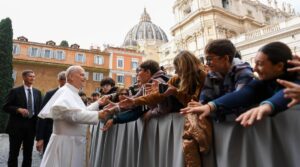
VATICAN CITY, OCT. 14, 2004 (Zenit) - Here is a translation of the address John Paul II gave Wednesday at the general audience, which he dedicated to comment on the canticle in the Letter to the Ephesians (1:3-10).
* * *
1. We are before the solemn hymn of blessing that opens the Letter to the Ephesians, a page of great theological and spiritual depth, wonderful expression of the faith and perhaps of the liturgy of the Church in apostolic times.
The hymn is proposed four times, during all the weeks in which the Liturgy of Vespers is divided, so that the faithful may contemplate and appreciate this grandiose image of Christ, heart of spirituality and Christian worship, as well as principle of unity and of the meaning of the universe and of the whole of history. The blessing rises from humanity to the Father, who is in the heavens (see verse 3), moved by the salvific work of the Son.
2. It begins with the eternal divine plan, which Christ is called to accomplish. In this plan shines out, first of all, the fact that we are elected to be "holy and blameless" not so much at the ritual level -- as these adjectives, used in the Old Testament for the sacrificial worship, would seem to suggest -- but rather "in love" (see verse 4). Therefore, it is a question of holiness and of moral, existential, inner purity.
For us, however, the Father has a further end in mind: Through Christ he destines us to receive the gift of that filial dignity, becoming sons in the Son and brothers of Jesus (see Romans 8:15,23; 9:4; Galatians 4:5). This gift of grace is poured out through "the Beloved Son," the Only-Begotten par excellence (see verses 5-6).
3. In this way the Father works a radical transformation in us: a full liberation from evil, "redemption through the blood" of Christ, "the forgiveness of our trespasses" through "the riches of his grace" (see verse 7). Christ's immolation on the cross, supreme act of love and solidarity, sheds over us a superabundant ray of light, of "wisdom and insight" (see verse 8). We are transfigured creatures: Our sin canceled, we know the Lord in fullness. And given that in biblical language knowledge is an expression of love, the latter introduces us more profoundly in the "mystery" of the divine will (see verse 9).
4. A "mystery," namely, a transcendent and perfect plan, which has as its object a wonderful salvific plan: "to unite all things in him, things in heaven and things on earth" (verse 10). The Greek text suggests that Christ became the "kefalaion," namely the cardinal point, the central axis toward which the whole of created being converges and acquires meaning. The same Greek vocabulary makes reference to another term particularly cherished in the Letters to the Ephesians and the Colossians: "kefale," or head, which indicates the function fulfilled by Christ in the body of the Church.
Now the view becomes larger and cosmic, comprising as well the more specific ecclesial dimension of the work of Christ. He has reconciled to himself all things, whether on earth or in heaven, making peace by the blood of his cross" (Colossians 1:20).
5. Let us conclude our reflection with a prayer of praise and gratitude for the redemption wrought by Christ in us. We do so with the words of a text conserved in an ancient papyrus of the fourth century.
"We invoke you, Lord God. You know everything, nothing escapes you, Teacher of truth. You have created the universe and watch over all beings. You guide on the path of truth those who were in the darkness and shadow of death. You desire to save all men and make them know the truth. All together we offer you praise and hymns of thanksgiving."
The prayer continues: "You have redeemed us, with the precious and immaculate blood of your only Son, from every corruption and slavery. You have liberated us from the devil and have granted us glory and freedom. We were dead and you made us be reborn, soul and body, in the Spirit. We were defiled and you have purified us. We pray, therefore, Father of mercies and God of all consolations: Confirm us in our vocation, in adoration and in faithfulness."
The prayer ends with the invocation: "Strengthen us, O Benevolent Lord, with your strength. Illuminate our soul with your consolation. ... Grant us to see, seek and contemplate the goods of heaven and not those of earth. Thus, with the strength of your grace, glory will be rendered to the omnipotent, most holy, almighty power worthy of all praise, in Christ Jesus, the Beloved Son, with the Holy Spirit forever and ever. Amen" (A. Hamman, "Preghiere dei Primi Cristiani," [Early Christian Prayers], Milan, 1955, pp. 92-94).
[At the end of the audience, a papal aide read the following summary in English:]
Dear Brothers and Sisters,
The canticle which opens the Letter to the Ephesians is sung each week in the Liturgy of the Hours. It is a magnificent expression of the faith and spirituality of the Church in the apostolic age.
The canticle is a hymn of thanksgiving and praise to the Father for the blessings bestowed on us through his beloved Son. By the blood of Christ, we have been reconciled to the Father, made holy in his sight, and granted the grace of becoming his adoptive sons and daughters.
Through the mystery of the cross, we have been given the wisdom to understand God's eternal plan to unite, in Christ, all things in heaven and on earth. The glorified Lord thus appears not only as the head of the Mystical Body which is the Church, but as the source and center of the world reconciled and renewed.
[The Holy Father then greeted pilgrims in several languages. In English, he said:]
I greet the Franciscan Sisters of the Poor and I offer the assurance of my prayers for their general chapter. I also welcome the diocesan pilgrimage groups from Indonesia and Scotland, and the American military chaplains. Upon all the English-speaking visitors, especially those from England, Denmark and the United States, I invoke God's blessings of joy and peace.
Contact
The Vatican
https://www.catholic.org
, VA
Pope John Paul II - Bishop of Rome, 661 869-1000
info@yourcatholicvoice.org
Keywords
Pope, Ephesians, Canticle, Hymn
More Catholic PRWire
Showing 1 - 50 of 4,716
A Recession Antidote
Randy Hain
Monaco & The Vatican: Monaco's Grace Kelly Exhibit to Rome--A Review of Monegasque-Holy See Diplomatic History
Dna. Maria St. Catherine Sharpe, t.o.s.m., T.O.SS.T.
The Why of Jesus' Death: A Pauline Perspective
Jerom Paul
A Royal Betrayal: Catholic Monaco Liberalizes Abortion
Dna. Maria St.Catherine De Grace Sharpe, t.o.s.m., T.O.SS.T.
Embrace every moment as sacred time
Mary Regina Morrell
My Dad
JoMarie Grinkiewicz
Letting go is simple wisdom with divine potential
Mary Regina Morrell
Father Lombardi's Address on Catholic Media
Catholic Online
Pope's Words to Pontifical Latin American College
Catholic Online
Prelate: Genetics Needs a Conscience
Catholic Online
State Aid for Catholic Schools: Help or Hindrance?
Catholic Online
Scorsese Planning Movie on Japanese Martyrs
Catholic Online
2 Nuns Kidnapped in Kenya Set Free
Catholic Online
Holy See-Israel Negotiation Moves Forward
Catholic Online
Franchising to Evangelize
Catholic Online
Catholics Decry Anti-Christianity in Israel
Catholic Online
Pope and Gordon Brown Meet About Development Aid
Catholic Online
Pontiff Backs Latin America's Continental Mission
Catholic Online
Cardinal Warns Against Anti-Catholic Education
Catholic Online
Full Circle
Robert Gieb
Three words to a deeper faith
Paul Sposite
Relections for Lent 2009
chris anthony
Wisdom lies beyond the surface of life
Mary Regina Morrell
World Food Program Director on Lent
Catholic Online
Moral Clarity
DAN SHEA
Pope's Lenten Message for 2009
Catholic Online
A Prayer for Monaco: Remembering the Faith Legacy of Prince Rainier III & Princess Grace and Contemplating the Moral Challenges of Prince Albert II
Dna. Maria St. Catherine Sharpe
Keeping a Lid on Permissiveness
Sally Connolly
Glimpse of Me
Sarah Reinhard
The 3 stages of life
Michele Szekely
Sex and the Married Woman
Cheryl Dickow
A Catholic Woman Returns to the Church
Cheryl Dickow
Modernity & Morality
Dan Shea
Just a Minute
Sarah Reinhard
Catholic identity ... triumphant reemergence!
Hugh McNichol
Edging God Out
Paul Sposite
Burying a St. Joseph Statue
Cheryl Dickow
George Bush Speaks on Papal Visit
Catholic Online
Sometimes moving forward means moving the canoe
Mary Regina Morrell
Action Changes Things: Teaching our Kids about Community Service
Lisa Hendey
Easter... A Way of Life
Paul Spoisite
Papal initiative...peace and harmony!
Hugh McNichol
Proclaim the mysteries of the Resurrection!
Hugh McNichol
Jerusalem Patriarch's Easter Message
Catholic Online
Good Friday Sermon of Father Cantalamessa
Catholic Online
Papal Address at the End of the Way of the Cross
Catholic Online
Cardinal Zen's Meditations for Via Crucis
Catholic Online
Interview With Vatican Aide on Jewish-Catholic Relations
Catholic Online
Pope Benedict XVI On the Easter Triduum
Catholic Online
Holy Saturday...anticipation!
Hugh McNichol

Come Grow With Us
Sign up and walk the Catholic journey with millions around the world.
Receive inspiring emails on saints, daily readings, and free faith-building resources—no cost, ever.
Sister Sara just dropped the truth about the future of Catholic education… and It’s Not What You Think
- Easter / Lent
- 5 Lenten Prayers
- Ash Wednesday
- 7 Morning Prayers
- Mysteries of the Rosary
- Litany of the Bl. Virgin Mary
- Popular Saints
- Popular Prayers
- Female Saints
- Saint Feast Days by Month
- Stations of the Cross
- St. Francis of Assisi
- St. Michael the Archangel
- The Apostles' Creed
- Unfailing Prayer to St. Anthony
- Pray the Rosary








Copyright 2026 Catholic Online. All materials contained on this site, whether written, audible or visual are the exclusive property of Catholic Online and are protected under U.S. and International copyright laws, © Copyright 2026 Catholic Online. Any unauthorized use, without prior written consent of Catholic Online is strictly forbidden and prohibited.
Catholic Online is a Project of Your Catholic Voice Foundation, a Not-for-Profit Corporation. Your Catholic Voice Foundation has been granted a recognition of tax exemption under Section 501(c)(3) of the Internal Revenue Code. Federal Tax Identification Number: 81-0596847. Your gift is tax-deductible as allowed by law.
