We ask you, humbly: don't scroll away.
Hi readers, it seems you use Catholic Online a lot; that's great! It's a little awkward to ask, but we need your help. If you have already donated, we sincerely thank you. We're not salespeople, but we depend on donations averaging $14.76 and fewer than 1% of readers give. If you donate just $5.00, the price of your coffee, Catholic Online School could keep thriving. Thank you.Help Now >
Monomotapa
FREE Catholic Classes
Whatever may be the etymological meaning of the word Monomotapa , the origin of which is much disputed, it is certain, at any rate, that the Portuguese of the sixteenth century employed it to denote the paramount chief of the Makaranga, a powerful South African tribe dwelling between the Zambesi and Limpopo rivers and extending westward from the Indian Ocean probably as far as the twenty-fifth parallel of east longitude.
"Some interest" says Mr. Theal, "is attached to this word Monomotapa, inasmuch as it was placed on maps of the day as if it were the name of a territory, not the title of a ruler, and soon it was applied to the entire region from the Zambesi to the mouth of the Fish River. Geographers, who knew nothing of the country, wrote the word upon their charts and one copied another until the belief became general that a people far advanced in civilization, and governed by a mighty emperor, occupied the whole of southeastern Africa. . . . Such an empire never existed. The foundation upon which imagination constructed it is nothing more than a Bantu tribe."
The empire of Monomotapa was called Mokaranga. In the fifteenth century it was united and powerful, but, when the Portuguese arrived in 1505 it was in a state of disruption, as the reigning Monomotapa, Makomba by name, had delegated his authority over the more distant part of his dominions to members of his family who soon asserted their independence. The Makaranga still live scattered in different parts of Rhodesia over a territory which was once their own. In the matter of civilization they never had much to lose, but their warlike qualities have disappeared, so that the word Makaranga is used by their neighbours as a term of reproach and a synonym for coward. The word Monomotapa is no longer known among them. They are, at any rate, more intelligent and docile than their neighbours, while their features and many of their customs point to an infusion of Semitic blood. The theory has lately obtained in some quarters, that they built the Great Zimbabwe and other ruins scattered over their country. It is far more probable, however, that these, as well as the numerous rock mines found in the gold area of Rhodesia and Portuguese East Africa, were the work of some Semitic people who occupied the country as gold seekers long before the arrival of the Bantu. The Makaranga were evangelized in 1561 by the Ven. Father Gonçalo da Silveira, S.J., who baptized the Monomotapa and many of his people. But within three months of his arrival the converted chief, instigated by some Mohammedan refugees from Mozambique, turned against the missionary and had him strangled on 16 March, 1561.


 Hi readers, it seems you use Catholic Online a lot; that's great! It's a little awkward to ask, but we need your help. If you have already donated, we sincerely thank you. We're not salespeople, but we depend on donations averaging $14.76 and fewer than 1% of readers give. If you donate just $5.00, the price of your coffee, Catholic Online School could keep thriving. Thank you. Help Now >
Join the Movement
When you sign up below, you don't just join an email list - you're joining an entire movement for Free world class Catholic education.


-

-
Mysteries of the Rosary
-
St. Faustina Kowalska
-
Litany of the Blessed Virgin Mary
-
Saint of the Day for Wednesday, Oct 4th, 2023
-
Popular Saints
-
St. Francis of Assisi
-
Bible
-
Female / Women Saints
-
7 Morning Prayers you need to get your day started with God
-
Litany of the Blessed Virgin Mary


Sacrifices of Faith: The Pro-Life Legacies of St. Gianna and Jessica Hanna
-
How to love God by caring for our bodies
-
Pope Francis calls for negotiations to End Russia-Ukraine War
-
Pope Francis Contemplates Return to U.S. for United Nations Assembly Address
-
Pope Francis Calls on Faithful to Embrace Faith, Hope, and Charity in New Teaching Series


Daily Catholic
- Daily Readings for Monday, April 29, 2024
- St. Catherine of Siena: Saint of the Day for Monday, April 29, 2024
- Prayer for the Dead # 3: Prayer of the Day for Monday, April 29, 2024
- Daily Readings for Sunday, April 28, 2024
- St. Peter Chanel: Saint of the Day for Sunday, April 28, 2024
- Prayer before a Crucifix: Prayer of the Day for Sunday, April 28, 2024
 Daily Readings for Monday, April 29, 2024
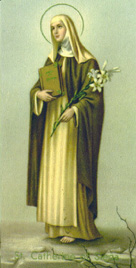 St. Catherine of Siena: Saint of the Day for Monday, April 29, 2024
 Prayer for the Dead # 3: Prayer of the Day for Monday, April 29, 2024
We ask you, humbly: don't scroll away.
Hi readers, it seems you use Catholic Online a lot; that's great! It's a little awkward to ask, but we need your help. If you have already donated, we sincerely thank you. We're not salespeople, but we depend on donations averaging $14.76 and fewer than 1% of readers give. If you donate just $5.00, the price of your coffee, Catholic Online School could keep thriving. Thank you.Help Now >
We ask you, humbly: don't scroll away.
Hi readers, it seems you use Catholic Online a lot; that's great! It's a little awkward to ask, but we need your help. If you have already donated, we sincerely thank you. We're not salespeople, but we depend on donations averaging $14.76 and fewer than 1% of readers give. If you donate just $5.00, the price of your coffee, Catholic Online School could keep thriving. Thank you.Help Now >

Copyright 2024 Catholic Online. All materials contained on this site, whether written, audible or visual are the exclusive property of Catholic Online and are protected under U.S. and International copyright laws, © Copyright 2024 Catholic Online. Any unauthorized use, without prior written consent of Catholic Online is strictly forbidden and prohibited.
Catholic Online is a Project of Your Catholic Voice Foundation, a Not-for-Profit Corporation. Your Catholic Voice Foundation has been granted a recognition of tax exemption under Section 501(c)(3) of the Internal Revenue Code. Federal Tax Identification Number: 81-0596847. Your gift is tax-deductible as allowed by law.