Pope Benedict XVI's Sinks His Teeth Into the Pontifical Catholic University of Peru
FREE Catholic Classes
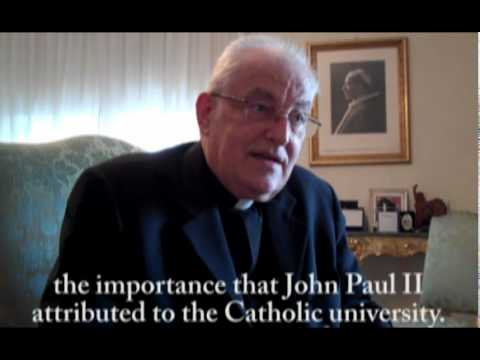
The university has not understood its Catholic and Pontifical duties. It has turned its back on the Catholic and Magisterial light, sadly necessitating what is an unprecedented move in the history of the Church. Though long in coming, it shows that Pope Benedict XVI has teeth.

Highlights
Catholic Online (https://www.catholic.org)
7/24/2012 (1 decade ago)
Published in College & University
Keywords: Cardinal Bertone, Ex Corde Ecclesiae, Pontifical Catholic University of Peru
CORPUS CHRISTI, TX (Catholic Online) - Drawing from the beautiful First Chapter of the Gospel of John, the motto of the former Pontifical Catholic University of Peru is Et lux in tenebris lucet--and the light shines in the darkness. (John 1:5) It appears, however, that the university has not been true to its motto and the darkness has won out, at least for now.
After more than 20 years of unsuccessful yet patient efforts on the part of the Roman curia to have the Pontifical Catholic University of Peru abide by the norms of the Apostolic Constitution Ex Cordis Ecclesiae issued in 1990, Pope Benedict XVI has finally been compelled by an intransigent institution to issue a significant sanction. As of July 21, 2012, Secretary of State Tarcisio Cardinal Bertone, under mandate received from Pope Benedict XVI, decreed that the university may no longer call itself Pontifical and may no longer call itself Catholic. The decree was delivered to the current rector of the university, Marcial Rubio Correo.
It is one of those unpleasant but necessary disciplines.
There is a certain irony in the university's motto. The university has been a hotbed of so-called Liberation Theology, including among its teachers at one time the infamous Gustavo Gutierrez, the priest frequently considered the founder of the Liberation Theology movement. As it seems to have moved from orthodoxy and settled into heterodoxy, it has moved from light into dark, and its motto seems to have moved with it. From et lux in tenebris lucet--and the light shines in the darkness--it has moved to the next words of St. John's Gospel: et tenebrae eam non comprehenderunt-and the darkness did not understand it. (John 1:5)
The university has not understood its Catholic and Pontifical duties. It has turned its back on the Catholic and Magisterial light, sadly necessitating what is an unprecedented move in the history of the Church. Though long in coming, it shows that Pope Benedict XVI has teeth.
The university is one of the most prestigious educational institutions in Latin America. It was founded in 1917 with the ecclesiastical approval of the then Archbishop of Lima, Pedro Manuel GarcĂa y Naranjo. In 1942, the university was given canonical status under the Code of Canon Law, thereby subjecting itself to the jurisdiction of the Roman curia.
Since 1967, however, the university has changed its internal statutes in ways that were inconsistent with its mission as a Catholic institution. Since the late 1960s, the administration of the university has gotten progressively more recalcitrant. It has rejected guidance of the Church, has been the hotbed of Liberation Theology, and it has actually worked against the interests of the Church and her Magisterium.
To say the least, it is highly inconsistent--even deceptive--for an institution to call itself "Pontifical" and "Catholic" and work against the Catholic Church and her Pontiff. In this regard, Pope Benedict XVI's move is welcome.
Pope Benedict XVI's recent act is an implementation of reforms put in place by his predecessor, Blessed John Paul II. Faced with Catholic universities that were progressively untrue to their founding purpose and progressively inimical to the Catholic Church which gave them birth, Pope John Paul II decided to do something about it.
On August 15, 1990, the Holy See issued the Apostolic Constitution Ex Corde Ecclesiae, which required that all Catholic universities that were subject to canonical legislation adapt their internal statutes to the norms of that Apostolic Constitution. "It is the honor and responsibility of a Catholic University," Ex Corde Ecclesiae said, "to consecrate itself without reserve to the cause of truth." ECE, 4. Ex Corde Ecclesiae was a "sort of 'magna carta'" whose purpose it was to provide basic principles of what should be the vision of a Catholic University.
Ex Corde Ecclesiae identified four characteristics of an authentically Catholic university: (1) it must be of Christian inspiration, (2) it must continually reflect on the treasury of human knowledge "in the light of the Catholic faith," (3) it must be faithful "to the Christian message as it comes to us through the Church," and (4) it must be institutionally committed "to the service of the people of God and of the human family in their pilgrimage to the transcendent goal which gives meaning to life." ECE, 13. To the end of assuring these characteristics, the Apostolic Constitution issued some general norms that were enforceable under canon law.
Since the promulgation of Ex Corde Ecclesiae, the history of relations between the Holy See and the Pontifical Catholic University of Peru has been one of chronic disobedience by the governing authorities of that educational institution. Its governing bodies have been unfaithful to the original foundation and to the vision of the donors, and they have steered that institution to one that actively works against, and not in service to, the faith and morals of the Catholic Church.
Under current statutes of the university, the local Archbishop of Lima, Juan Luis Cipriani Thorne, is the Grand Chancellor of the institution. When he tried to exercise his authority over the institution, he was sharply rebuffed, necessitating the involvement of the Roman Curia.
Over the last decades, the university's governing bodies have been equally deaf to the overtures of the Roman curia. Most recently, the university's governing assembly refused to recognize the warnings sent from the Vatican's Congregation for Catholic Education. In 2011, the Congregation sent a letter to Rector Marcial Rubio outlining the various ways that the university's statutes had to be changed to conform to the Apostolic Constitution Ex Corde Ecclesiae. The internal governing body of the university, the University Assembly, refused to conform to the requests.

The Secretary of State for the Vatican then became involved. Despite an apostolic visit and audit handled by Peter Cardinal Erdö on behalf of the Vatican Secretary of State, and despite numerous efforts to reach an amicable agreement, no reconciliation seemed possible. A final deadline for the university to conform itself to the requirements of canon law passed on April 8, 2012. Subsequent warnings went unheeded by the university.
Instead--based upon a false understanding of academic freedom--the Peruvian university showed its intent to act against the mission of the Church and to guide "its institutional initiatives according to criteria that are incompatible with the discipline and morals of the Church," said the decree issued by Cardinal Bertone.
So, after a series of decades-long efforts on the part of Church authorities--rebuffed each time by the university officials--the Church had no choice but to issue its sanctions.
So ends the history of the Pontifical Catholic University of Peru. Not with a bang, but a whimper.
While the institution cannot use the titles Pontifical or Catholic, the Secretary of State insisted that the Church still retained jurisdiction over the structure and institution itself. We hope that there may still be the possibility of reconciliation.
It would behoove the university officials to read the opening chapter of Thomas a Kempis's Imitation of Christ which begins with reference to the same chapter in the Gospel of John referred to in the university's motto:
"'He who follows Me, walks not in darkness,' says the Lord (John 8:12). By these words of Christ we are advised to imitate His life and habits, if we wish to be truly enlightened and free from all blindness of heart. Let our chief effort, therefore, be to study the life of Jesus Christ."
"The teaching of Christ is more excellent than all the advice of the saints, and he who has His spirit will find in it a hidden manna. Now, there are many who hear the Gospel often but care little for it because they have not the spirit of Christ. Yet whoever wishes to understand fully the words of Christ must try to pattern his whole life on that of Christ."
"What good does it do to speak learnedly about the Trinity if, lacking humility, you displease the Trinity? Indeed it is not learning that makes a man holy and just, but a virtuous life makes him pleasing to God. I would rather feel compunction than know how to define it. For what would it profit us to know the whole Bible by heart and the principles of all the philosophers if we live without grace and the love of God? Vanity of vanities and all is vanity, except to love God and serve Him alone."

-----
Andrew M. Greenwell is an attorney licensed to practice law in Texas, practicing in Corpus Christi, Texas. He is married with three children. He maintains a blog entirely devoted to the natural law called Lex Christianorum. You can contact Andrew at agreenwell@harris-greenwell.com.
---
'Help Give every Student and Teacher FREE resources for a world-class Moral Catholic Education'
Copyright 2021 - Distributed by Catholic Online

Come Grow With Us
Sign up and walk the Catholic journey with millions around the world.
Receive inspiring emails on saints, daily readings, and free faith-building resources—no cost, ever.
Catholic Online Is Free. But We Need Your Help.
Please Watch

- 7 Morning Prayers
- Mysteries of the Rosary
- Litany of the Bl. Virgin Mary
- Popular Saints
- Popular Prayers
- Female Saints
- Saint Feast Days by Month
- Stations of the Cross
- St. Francis of Assisi
- St. Michael the Archangel
- The Apostles' Creed
- Unfailing Prayer to St. Anthony
- Pray the Rosary









Copyright 2026 Catholic Online. All materials contained on this site, whether written, audible or visual are the exclusive property of Catholic Online and are protected under U.S. and International copyright laws, © Copyright 2026 Catholic Online. Any unauthorized use, without prior written consent of Catholic Online is strictly forbidden and prohibited.
Catholic Online is a Project of Your Catholic Voice Foundation, a Not-for-Profit Corporation. Your Catholic Voice Foundation has been granted a recognition of tax exemption under Section 501(c)(3) of the Internal Revenue Code. Federal Tax Identification Number: 81-0596847. Your gift is tax-deductible as allowed by law.