 Dear readers, Catholic Online was de-platformed by Shopify for our pro-life beliefs. They shut down our Catholic Online, Catholic Online School, Prayer Candles, and Catholic Online Learning Resources essential faith tools serving over 1.4 million students and millions of families worldwide. Our founders, now in their 70's, just gave their entire life savings to protect this mission. But fewer than 2% of readers donate. If everyone gave just $5, the cost of a coffee, we could rebuild stronger and keep Catholic education free for all. Stand with us in faith. Thank you. Help Now >
Pope's Address to Assembly of Catholic Universities
FREE Catholic Classes
It is important for everyone, professors and students, never to lose sight of the end pursued -- to be an instrument of the evangelical proclamation.
Highlights
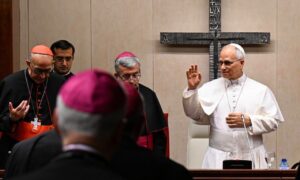
VATICAN CITY (Zenit.org) - Here is a translation of the address Benedict XVI delivered today to the participants in the 23rd general assembly of the International Federation of Catholic Universities. The audience took place in the Paul VI Hall.
* * *
Cardinals,
Venerated Brothers in the Episcopate and in the Priesthood,
Illustrious Rectors, Academic Authorities and Professors,
Dear Students, Brothers and Sisters,
I receive you with joy and thank you for having come "ad Petri Sedem," to be confirmed in your important and committed duty of teaching, study and research at the service of the Church and of the whole of society. I cordially thank Cardinal Zenon Grocholewski for the words he addressed to me on presenting this meeting, in which we recall two particular anniversaries, the 30th of the apostolic constitution "Sapientia Christiana," promulgated on April 15, 1979, by the Servant of God John Paul II, and the 60th anniversary of the recognition by the Holy See of the Statute of the Federation Internationale des Universites Catholiques (FIUC).
I am happy to recall with you these significant anniversaries, which offer me the possibility to manifest once again the indispensable role of ecclesiastical faculties and Catholic universities in the Church and in society. The Second Vatican Council underlined it clearly in the declaration "Gravissimum Educationis" when it exhorted ecclesiastical faculties to deepen their knowledge in the various sectors of the sacred sciences, to have an ever more profound knowledge of revelation, to explore the treasure of Christian wisdom, foster ecumenical and interreligious dialogue, and respond to the problems that are arising in the cultural realm (cfr No. 11).
The same conciliar document recommend the promotion of Catholic universities, distributing them in the various regions of the world and, above all, taking care of their qualitative level to form persons versed in learning, prepared to give witness to their faith in the world and to carry out tasks of responsibility in society (cfr No. 10).
The council's invitation found a vast echo in the Church. Today there are, in fact, more than 1,300 Catholic universities and almost 400 ecclesiastical faculties, spread over the five continents, many of which have arisen in the last decades, in testimony of a growing attention of local Churches to the formation of ecclesiastics and laity in culture and research.
The apostolic constitution "Sapientia Christiana," from its first expressions, shows the urgency, still present, to overcome the existing breach between faith and culture, inviting to a greater commitment of evangelization, in the firm conviction that Christian revelation is a transforming force, destined to permeate ways of thinking, criteria of judgment, and norms of behavior. It is able to illumine, purify and renew the customs of men and their cultures (cfr Proemio, I), and must constitute the central point of teaching and research, in addition to the horizon that illumines nature and the objects of every ecclesiastical faculty.
From this perspective, while underlining the duty of the cultivators of the sacred disciplines to attain, with theological research, a more profound knowledge of the truth revealed, encouraged at the same time are contacts with the other fields of learning for a fruitful dialogue, above all for the purpose of offering a precious contribution to the mission that the Church is called to carry out in the world.
After 30 years, the basic lines of the apostolic constitution "Sapientia Christiana" still keep all their current importance. What is more, in today's society, where knowledge is increasingly specialized and sectorial, but which is increasingly marked by relativism, it is even more necessary to be open to the wisdom that comes from the Gospel. Man, in fact, is incapable of understanding himself fully and the world without Jesus Christ: Only he illumines his true dignity, his vocation, his ultimate destiny and opens the heart to a solid and lasting hope.
Dear friends, your commitment to serve the truth that God has revealed shares in the evangelizing mission of the Church: It is an ecclesial service. "Sapientia Christiana" quotes, in this regard, the conclusion of the Gospel according to Matthew: "Go therefore and make disciples of all nations, baptizing them in the name of the Father and of the Son and of the Holy Spirit, teaching them to observe all that I have commanded you" (Matthew 28:19-20).
It is important for everyone, professors and students, never to lose sight of the end pursued -- to be an instrument of the evangelical proclamation. The years of the higher ecclesiastical studies can be compared with the experience that the apostles lived with Jesus: Being with him, they learned the truth, to become later heralds everywhere.
At the same time it is important to remember that the study of the sacred sciences must never be separated from prayer, from union with God, from contemplation -- as I reminded in the recent catechesis on Medieval monastic theology -- otherwise reflections on divine mysteries run the risk of becoming a vain intellectual exercise. Every sacred science, in the end, appeals to the "science of the saints," to their intuition of the mysteries of the living God, to wisdom, which is a gift of the Holy Spirit and which is the soul of "fides quaerens intellectum" (cfr general audience, Oct. 21, 2009).
The International Federation of Catholic Universities (FIUC) was born in 1924 by the initiative of some rectors and was recognized 25 years later by the Holy See. Dear rectors of Catholic universities, the 60th anniversary of the canonical erection of your federation is a most propitious occasion to evaluate the activity carried out and to outline future commitments.

To celebrate an anniversary is to thank God who has guided our steps, but it is also to take from one's own history a further impetus to renew the will to serve the Church. In this connection, your motto is also a program for the future of the federation: "Sciat ut Serviat" -- to know in order to serve.
In a culture that manifests a "lack of wisdom, of reflection, of thought capable of operating a guiding synthesis" ("Caritas in Veritate," 31), Catholic universities, faithful to their own identity that considers Christian inspiration as valid, are called to promote a "new humanistic synthesis" (ibid., 21), a learning that is "wisdom capable of guiding man in the light of its first principles and of its ultimate ends" (ibid., 30), a learning illumined by faith.
Dear friends, the service you carry out is valuable for the mission of the Church. While I express to all of you sincere wishes for the academic year initiated a short while ago and for the full success of the FIUC's Congress, I entrust each one of you and the institutions you represent to the maternal protection of Mary Most Holy, Seat of Wisdom, and am pleased to impart to all the apostolic blessing.
[Translation by ZENIT]
Come Grow With Us
Sign up and walk the Catholic journey with millions around the world.
Receive inspiring emails on saints, daily readings, and free faith-building resources—no cost, ever.
Sister Sara Has One Message for Every Catholic Family This June
- Easter / Lent
- 5 Lenten Prayers
- Ash Wednesday
- 7 Morning Prayers
- Mysteries of the Rosary
- Litany of the Bl. Virgin Mary
- Popular Saints
- Popular Prayers
- Female Saints
- Saint Feast Days by Month
- Stations of the Cross
- St. Francis of Assisi
- St. Michael the Archangel
- The Apostles' Creed
- Unfailing Prayer to St. Anthony
- Pray the Rosary








Copyright 2026 Catholic Online. All materials contained on this site, whether written, audible or visual are the exclusive property of Catholic Online and are protected under U.S. and International copyright laws, © Copyright 2026 Catholic Online. Any unauthorized use, without prior written consent of Catholic Online is strictly forbidden and prohibited.
Catholic Online is a Project of Your Catholic Voice Foundation, a Not-for-Profit Corporation. Your Catholic Voice Foundation has been granted a recognition of tax exemption under Section 501(c)(3) of the Internal Revenue Code. Federal Tax Identification Number: 81-0596847. Your gift is tax-deductible as allowed by law.