 Dear readers, Catholic Online was de-platformed by Shopify for our pro-life beliefs. They shut down our Catholic Online, Catholic Online School, Prayer Candles, and Catholic Online Learning Resources essential faith tools serving over 1.4 million students and millions of families worldwide. Our founders, now in their 70's, just gave their entire life savings to protect this mission. But fewer than 2% of readers donate. If everyone gave just $5, the cost of a coffee, we could rebuild stronger and keep Catholic education free for all. Stand with us in faith. Thank you. Help Now >
The Pope Speaks to Catholic Universities in America: Full Text
FREE Catholic Classes
It is a question of conviction - do we really believe that only in the mystery of the Word made flesh does the mystery of man truly become clear.
Highlights
Catholic Online (https://www.catholic.org)
4/18/2009 (1 decade ago)
Published in College & University
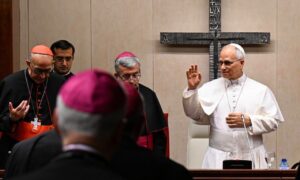
WASHINGTON, D.C. (Catholic Online) - As the response to the decision by the President of Notre Dame University to have President Obama address the graduating seniors and receive an Honorary Doctor of Law degree continues. As reflection upon the Administration of Georgetown University agreeing, at the request of the Administration, to cover over the backdrop where the President spoke because it contained a cross and a Christian Symbol proclaiming the identity of Jesus Christ continues. Catholics throughout the US are reflecting on the nature and purpose of Catholic education.We present the address of our Holy Father Pope Benedict XVI, the great educator, given one year ago when he honored us with his apostolic visit to the United States:
MEETING WITH CATHOLIC EDUCATORS, ADDRESS OF HIS HOLINESS BENEDICT XVI, Conference Hall of the Catholic University of America in Washington, D.C.
Thursday, 17 April 2008
Your Eminences,
Dear Brother Bishops,
Distinguished Professors, Teachers and Educators,
"How beautiful are the footsteps of those who bring good news" (Rom 10:15-17). With these words of Isaiah quoted by Saint Paul, I warmly greet each of you - bearers of wisdom - and through you the staff, students and families of the many and varied institutions of learning that you represent. It is my great pleasure to meet you and to share with you some thoughts regarding the nature and identity of Catholic education today. I especially wish to thank Father David O'Connell, President and Rector of the Catholic University of America. Your kind words of welcome are much appreciated. Please extend my heartfelt gratitude to the entire community - faculty, staff and students - of this University.
Education is integral to the mission of the Church to proclaim the Good News. First and foremost every Catholic educational institution is a place to encounter the living God who in Jesus Christ reveals his transforming love and truth (cf. Spe Salvi, 4). This relationship elicits a desire to grow in the knowledge and understanding of Christ and his teaching. In this way those who meet him are drawn by the very power of the Gospel to lead a new life characterized by all that is beautiful, good, and true; a life of Christian witness nurtured and strengthened within the community of our Lord's disciples, the Church.
The dynamic between personal encounter, knowledge and Christian witness is integral to the diakonia of truth which the Church exercises in the midst of humanity. God's revelation offers every generation the opportunity to discover the ultimate truth about its own life and the goal of history. This task is never easy; it involves the entire Christian community and motivates each generation of Christian educators to ensure that the power of God's truth permeates every dimension of the institutions they serve. In this way, Christ's Good News is set to work, guiding both teacher and student towards the objective truth which, in transcending the particular and the subjective, points to the universal and absolute that enables us to proclaim with confidence the hope which does not disappoint (cf. Rom 5:5). Set against personal struggles, moral confusion and fragmentation of knowledge, the noble goals of scholarship and education, founded on the unity of truth and in service of the person and the community, become an especially powerful instrument of hope.
Dear friends, the history of this nation includes many examples of the Church's commitment in this regard. The Catholic community here has in fact made education one of its highest priorities. This undertaking has not come without great sacrifice. Towering figures, like Saint Elizabeth Ann Seton and other founders and foundresses, with great tenacity and foresight, laid the foundations of what is today a remarkable network of parochial schools contributing to the spiritual well-being of the Church and the nation. Some, like Saint Katharine Drexel, devoted their lives to educating those whom others had neglected - in her case, African Americans and Native Americans. Countless dedicated Religious Sisters, Brothers, and Priests together with selfless parents have, through Catholic schools, helped generations of immigrants to rise from poverty and take their place in mainstream society.
This sacrifice continues today. It is an outstanding apostolate of hope, seeking to address the material, intellectual and spiritual needs of over three million children and students. It also provides a highly commendable opportunity for the entire Catholic community to contribute generously to the financial needs of our institutions. Their long-term sustainability must be assured. Indeed, everything possible must be done, in cooperation with the wider community, to ensure that they are accessible to people of all social and economic strata. No child should be denied his or her right to an education in faith, which in turn nurtures the soul of a nation.
Some today question the Church's involvement in education, wondering whether her resources might be better placed elsewhere. Certainly in a nation such as this, the State provides ample opportunities for education and attracts committed and generous men and women to this honorable profession. It is timely, then, to reflect on what is particular to our Catholic institutions. How do they contribute to the good of society through the Church's primary mission of evangelization?
All the Church's activities stem from her awareness that she is the bearer of a message which has its origin in God himself: in his goodness and wisdom, God chose to reveal himself and to make known the hidden purpose of his will (cf. Eph 1:9; Dei Verbum, 2). God's desire to make himself known, and the innate desire of all human beings to know the truth, provide the context for human inquiry into the meaning of life. This unique encounter is sustained within our Christian community: the one who seeks the truth becomes the one who lives by faith (cf. Fides et Ratio, 31). It can be described as a move from "I" to "we", leading the individual to be numbered among God's people.

This same dynamic of communal identity - to whom do I belong? - vivifies the ethos of our Catholic institutions. A university or school's Catholic identity is not simply a question of the number of Catholic students. It is a question of conviction - do we really believe that only in the mystery of the Word made flesh does the mystery of man truly become clear (cf. Gaudium et Spes, 22)? Are we ready to commit our entire self - intellect and will, mind and heart - to God? Do we accept the truth Christ reveals? Is the faith tangible in our universities and schools? Is it given fervent expression liturgically, sacramentally, through prayer, acts of charity, a concern for justice, and respect for God's creation? Only in this way do we really bear witness to the meaning of who we are and what we uphold.
From this perspective one can recognize that the contemporary "crisis of truth" is rooted in a "crisis of faith". Only through faith can we freely give our assent to God's testimony and acknowledge him as the transcendent guarantor of the truth he reveals. Again, we see why fostering personal intimacy with Jesus Christ and communal witness to his loving truth is indispensable in Catholic institutions of learning. Yet we all know, and observe with concern, the difficulty or reluctance many people have today in entrusting themselves to God. It is a complex phenomenon and one which I ponder continually. While we have sought diligently to engage the intellect of our young, perhaps we have neglected the will. Subsequently we observe, with distress, the notion of freedom being distorted. Freedom is not an opting out. It is an opting in - a participation in Being itself. Hence authentic freedom can never be attained by turning away from God. Such a choice would ultimately disregard the very truth we need in order to understand ourselves. A particular responsibility therefore for each of you, and your colleagues, is to evoke among the young the desire for the act of faith, encouraging them to commit themselves to the ecclesial life that follows from this belief. It is here that freedom reaches the certainty of truth. In choosing to live by that truth, we embrace the fullness of the life of faith which is given to us in the Church.
Clearly, then, Catholic identity is not dependent upon statistics. Neither can it be equated simply with orthodoxy of course content. It demands and inspires much more: namely that each and every aspect of your learning communities reverberates within the ecclesial life of faith. Only in faith can truth become incarnate and reason truly human, capable of directing the will along the path of freedom (cf. Spe Salvi, 23). In this way our institutions make a vital contribution to the mission of the Church and truly serve society. They become places in which God's active presence in human affairs is recognized and in which every young person discovers the joy of entering into Christ's "being for others" (cf. ibid., 28).
The Church's primary mission of evangelization, in which educational institutions play a crucial role, is consonant with a nation's fundamental aspiration to develop a society truly worthy of the human person's dignity. At times, however, the value of the Church's contribution to the public forum is questioned. It is important therefore to recall that the truths of faith and of reason never contradict one another (cf. First Vatican Ecumenical Council, Dogmatic Constitution on the Catholic Faith Dei Filius, IV: DS 3017; St. Augustine, Contra Academicos, III, 20, 43). The Church's mission, in fact, involves her in humanity's struggle to arrive at truth. In articulating revealed truth she serves all members of society by purifying reason, ensuring that it remains open to the consideration of ultimate truths. Drawing upon divine wisdom, she sheds light on the foundation of human morality and ethics, and reminds all groups in society that it is not praxis that creates truth but truth that should serve as the basis of praxis. Far from undermining the tolerance of legitimate diversity, such a contribution illuminates the very truth which makes consensus attainable, and helps to keep public debate rational, honest and accountable. Similarly the Church never tires of upholding the essential moral categories of right and wrong, without which hope could only wither, giving way to cold pragmatic calculations of utility which render the person little more than a pawn on some ideological chess-board.
With regard to the educational forum, the diakonia of truth takes on a heightened significance in societies where secularist ideology drives a wedge between truth and faith. This division has led to a tendency to equate truth with knowledge and to adopt a positivistic mentality which, in rejecting metaphysics, denies the foundations of faith and rejects the need for a moral vision. Truth means more than knowledge: knowing the truth leads us to discover the good. Truth speaks to the individual in his or her entirety, inviting us to respond with our whole being. This optimistic vision is found in our Christian faith because such faith has been granted the vision of the Logos, God's creative Reason, which in the Incarnation, is revealed as Goodness itself. Far from being just a communication of factual data - "informative" - the loving truth of the Gospel is creative and life-changing - "performative" (cf. Spe Salvi, 2). With confidence, Christian educators can liberate the young from the limits of positivism and awaken receptivity to the truth, to God and his goodness. In this way you will also help to form their conscience which, enriched by faith, opens a sure path to inner peace and to respect for others.

It comes as no surprise, then, that not just our own ecclesial communities but society in general has high expectations of Catholic educators. This places upon you a responsibility and offers an opportunity. More and more people - parents in particular - recognize the need for excellence in the human formation of their children. As Mater et Magistra, the Church shares their concern. When nothing beyond the individual is recognized as definitive, the ultimate criterion of judgment becomes the self and the satisfaction of the individual's immediate wishes. The objectivity and perspective, which can only come through a recognition of the essential transcendent dimension of the human person, can be lost. Within such a relativistic horizon the goals of education are inevitably curtailed. Slowly, a lowering of standards occurs. We observe today a timidity in the face of the category of the good and an aimless pursuit of novelty parading as the realization of freedom. We witness an assumption that every experience is of equal worth and a reluctance to admit imperfection and mistakes. And particularly disturbing, is the reduction of the precious and delicate area of education in sexuality to management of 'risk', bereft of any reference to the beauty of conjugal love.
How might Christian educators respond? These harmful developments point to the particular urgency of what we might call "intellectual charity". This aspect of charity calls the educator to recognize that the profound responsibility to lead the young to truth is nothing less than an act of love. Indeed, the dignity of education lies in fostering the true perfection and happiness of those to be educated. In practice "intellectual charity" upholds the essential unity of knowledge against the fragmentation which ensues when reason is detached from the pursuit of truth. It guides the young towards the deep satisfaction of exercising freedom in relation to truth, and it strives to articulate the relationship between faith and all aspects of family and civic life. Once their passion for the fullness and unity of truth has been awakened, young people will surely relish the discovery that the question of what they can know opens up the vast adventure of what they ought to do. Here they will experience "in what" and "in whom" it is possible to hope, and be inspired to contribute to society in a way that engenders hope in others.
Dear friends, I wish to conclude by focusing our attention specifically on the paramount importance of your own professionalism and witness within our Catholic universities and schools. First, let me thank you for your dedication and generosity. I know from my own days as a professor, and I have heard from your Bishops and officials of the Congregation for Catholic Education, that the reputation of Catholic institutes of learning in this country is largely due to yourselves and your predecessors. Your selfless contributions - from outstanding research to the dedication of those working in inner-city schools - serve both your country and the Church. For this I express my profound gratitude.
In regard to faculty members at Catholic colleges universities, I wish to reaffirm the great value of academic freedom. In virtue of this freedom you are called to search for the truth wherever careful analysis of evidence leads you. Yet it is also the case that any appeal to the principle of academic freedom in order to justify positions that contradict the faith and the teaching of the Church would obstruct or even betray the university's identity and mission; a mission at the heart of the Church's munus docendi and not somehow autonomous or independent of it.
Teachers and administrators, whether in universities or schools, have the duty and privilege to ensure that students receive instruction in Catholic doctrine and practice. This requires that public witness to the way of Christ, as found in the Gospel and upheld by the Church's Magisterium, shapes all aspects of an institution's life, both inside and outside the classroom. Divergence from this vision weakens Catholic identity and, far from advancing freedom, inevitably leads to confusion, whether moral, intellectual or spiritual.
I wish also to express a particular word of encouragement to both lay and Religious teachers of catechesis who strive to ensure that young people become daily more appreciative of the gift of faith. Religious education is a challenging apostolate, yet there are many signs of a desire among young people to learn about the faith and practice it with vigor. If this awakening is to grow, teachers require a clear and precise understanding of the specific nature and role of Catholic education. They must also be ready to lead the commitment made by the entire school community to assist our young people, and their families, to experience the harmony between faith, life and culture.
Here I wish to make a special appeal to Religious Brothers, Sisters and Priests: do not abandon the school apostolate; indeed, renew your commitment to schools especially those in poorer areas. In places where there are many hollow promises which lure young people away from the path of truth and genuine freedom, the consecrated person's witness to the evangelical counsels is an irreplaceable gift. I encourage the Religious present to bring renewed enthusiasm to the promotion of vocations. Know that your witness to the ideal of consecration and mission among the young is a source of great inspiration in faith for them and their families.
To all of you I say: bear witness to hope. Nourish your witness with prayer. Account for the hope that characterizes your lives (cf. 1 Pet 3:15) by living the truth which you propose to your students. Help them to know and love the One you have encountered, whose truth and goodness you have experienced with joy. With Saint Augustine, let us say: "we who speak and you who listen acknowledge ourselves as fellow disciples of a single teacher" (Sermons, 23:2). With these sentiments of communion, I gladly impart to you, your colleagues and students, and to your families, my Apostolic Blessing.
---
'Help Give every Student and Teacher FREE resources for a world-class Moral Catholic Education'
Copyright 2021 - Distributed by Catholic Online
Come Grow With Us
Sign up and walk the Catholic journey with millions around the world.
Receive inspiring emails on saints, daily readings, and free faith-building resources—no cost, ever.
Sister Sara Has One Message for Every Catholic Family This June
- Easter / Lent
- 5 Lenten Prayers
- Ash Wednesday
- 7 Morning Prayers
- Mysteries of the Rosary
- Litany of the Bl. Virgin Mary
- Popular Saints
- Popular Prayers
- Female Saints
- Saint Feast Days by Month
- Stations of the Cross
- St. Francis of Assisi
- St. Michael the Archangel
- The Apostles' Creed
- Unfailing Prayer to St. Anthony
- Pray the Rosary









Copyright 2026 Catholic Online. All materials contained on this site, whether written, audible or visual are the exclusive property of Catholic Online and are protected under U.S. and International copyright laws, © Copyright 2026 Catholic Online. Any unauthorized use, without prior written consent of Catholic Online is strictly forbidden and prohibited.
Catholic Online is a Project of Your Catholic Voice Foundation, a Not-for-Profit Corporation. Your Catholic Voice Foundation has been granted a recognition of tax exemption under Section 501(c)(3) of the Internal Revenue Code. Federal Tax Identification Number: 81-0596847. Your gift is tax-deductible as allowed by law.