We ask you, humbly: don't scroll away.
Hi readers, it seems you use Catholic Online a lot; that's great! It's a little awkward to ask, but we need your help. If you have already donated, we sincerely thank you. We're not salespeople, but we depend on donations averaging $14.76 and fewer than 1% of readers give. If you donate just $5.00, the price of your coffee, Catholic Online School could keep thriving. Thank you.Help Now >
Pope: St. Joseph, Model for Priests, all Christians
FREE Catholic Classes
To be a father means above all to be at the service of life and growth. Saint Joseph gave proof of great devotion.
Highlights
Catholic Online (https://www.catholic.org)
3/19/2010 (1 decade ago)
Published in Vocations
YAOUNDE (Catholic Online) - We present Vatican radio's translation of the inspired words spoken by the Vicar of Christ, Pope Benedict XVI upon the Vespers Vigil Service for the Feast of St. Joseph as he undertook his apostolic visit to Africa:
Dear Brother Cardinals and Bishops,Priests and Deacons,
Consecrated Brothers and Sisters,Friends from other Christian Confessions,Dear Brothers and Sisters! It is a great joy to meet here to give thanks to God in this Basilica of Marie Reine des Apôtres in Mvolyé, raised on the site of the first church built by the Missionaries of the Holy Spirit who came to bring the Good News to Cameroon. Reflecting the apostolic fervour of those men whose hearts embraced the whole of your country, this place symbolically contains every portion of your land. And so, dear brothers and sisters, in deep spiritual closeness to all the Christian communities where you render service, we raise our prayer of praise this evening to the Father of lights. In the presence of the representatives of other Christian confessions, to whom I extend my respectful and fraternal greetings, I wish to reflect on the figure of Saint Joseph, setting out from the words of Scripture offered to us in this evening´s liturgy.
Speaking to the crowd and to his disciples, Jesus declared: "You have only one Father" (Mt 23:9). There is but one fatherhood, that of God the Father, the one Creator of the world, "of all that is seen and unseen". Yet man, created in the image of God, has been granted a share in this one paternity of God (cf. Eph 3:15). Saint Joseph is a striking case of this, since he is a father, without fatherhood according to the flesh. He is not the biological father of Jesus, whose Father is God alone, and yet he lives his fatherhood fully and completely. To be a father means above all to be at the service of life and growth. Saint Joseph, in this sense, gave proof of great devotion. For the sake of Christ he experienced persecution, exile and the poverty which this entails. He had to settle far from his native town. His only reward was to be with Christ. His readiness to do all these things illustrates the words of Saint Paul: "It is Christ the Lord whom you serve" (Col 3:24).
What is important is not to be a useless servant, but rather a "faithful and wise servant". The pairing of the two adjectives is not by chance. It suggests that understanding without fidelity, and fidelity without wisdom, are insufficient. One quality alone, without the other, would not enable us to assume fully the responsibility which God entrusts to us.
Dear brother priests, you are called to live out this fatherhood in the daily tasks of your ministry. In the words of the conciliar Constitution Lumen Gentium: "As their fathers in Christ, priests should care for the faithful whom they have spiritually begotten by Baptism and instruction" (No. 28). If this is the case, how can we not continually return to the very foundation of our priesthood, the Lord Jesus Christ? Our personal relationship with Jesus is constitutive of the way we wish to live our lives. He has called us his friends because everything which he learned from the Father he has made known to us (cf. Jn 15:15).
In living out this deep friendship with Christ you will discover true freedom and deep joy. The ministerial priesthood entails a profound relationship with Christ who is given to us in the Eucharist. Let the celebration of the Eucharist be truly the centre of your priestly lives; in this way it will also be the centre of your ecclesial mission. Throughout our lives Christ calls us to share in his mission, to be his witnesses, so that his word may be proclaimed to all. In celebrating this sacrament in the Lord´s name and in his person, the person of the priest cannot occupy centre stage; he is a servant, a humble instrument pointing to Christ, who offers himself in sacrifice for the salvation of the world. As Jesus teaches us, "the leader must become as one who serves" (Lk 22:26).
Origen writes that "Joseph understood that Jesus was superior to him even as he submitted to him, and, knowing the superiority of his charge, he commanded him with respect and moderation. Everyone should reflect on this: frequently a lesser man is placed over people who are greater, and it happens at times that an inferior is more worthy than the one who appears to be set above him. If a person of greater dignity understands this, then he will not be puffed up with pride because of his higher rank; he will know that his inferior may well be superior to him, even as Jesus was subject to Joseph" (Homily on Saint Luke XX, 5; S.C. p. 287).
Dear brothers in the priesthood, your pastoral ministry demands many sacrifices, yet it is also a source of great joy. Trusting in your Bishops, united fraternally to the whole presbyterate and supported by the portion of the People of God commended to your care, you will be able to respond faithfully to the Lord who has called you, just as he called Joseph to watch over Mary and the Child Jesus! May you always remain faithful, dear priests, to the promises that you made to God before your Bishop and in the presence of the whole community. The Successor of Peter thanks you for your generous devotion to the service of the Church, and he urges you not to be troubled by the difficulties you encounter along the way. To the young men who are preparing to join you, and to those still discerning a priestly vocation, I hold out once more the joy that comes from giving oneself completely to the service of God and the Church. Be courageous, then, and generously say "yes" to Christ!
 Hi readers, it seems you use Catholic Online a lot; that's great! It's a little awkward to ask, but we need your help. If you have already donated, we sincerely thank you. We're not salespeople, but we depend on donations averaging $14.76 and fewer than 1% of readers give. If you donate just $5.00, the price of your coffee, Catholic Online School could keep thriving. Thank you. Help Now >
Dear brothers and sisters who live out your commitment in the consecrated life or in ecclesial movements, I also encourage you to look to Saint Joseph. When Mary received the visit of the angel at the Annunciation, she was already betrothed to Joseph. In addressing Mary personally, the Lord already closely associates Joseph to the mystery of the Incarnation. Joseph agreed to be part of the great events which God was beginning to bring about in the womb of his spouse. He took Mary into his home. He welcomed the mystery that was in Mary and the mystery that was Mary herself. He loved her with great respect, which is the mark of all authentic love. Joseph teaches us that it is possible to love without possessing.
In contemplating Joseph, all men and women can, by God´s grace, come to experience healing from their emotional wounds, if only they embrace the plan that God has begun to bring about in those close to him, just as Joseph entered into the work of redemption through Mary and as a result of what God had already done in her. Dear brothers and sisters from the ecclesial movements, may you be attentive to those around you, and may you reveal the loving face of God to the poor, especially by your works of mercy, your human and Christian education of young people, your programmes for the advancement of women, and in so many other ways!
The spiritual contribution offered by consecrated persons is likewise significant and indispensable for the life of the Church. This call to follow Christ is a gift for the whole People of God. According to your vocation, that of imitating Christ, chaste, poor and obedient, totally consecrated to the glory of his Father and the love of his brothers and sisters, you have the mission of bearing much-needed witness before our world to the primacy of God and of eternal life (cf. Vita Consecrata, 85). By your unreserved fidelity to your commitments, you are for the Church a sapling of life, springing up to serve the coming of God´s Kingdom. At all times, and especially whenever your fidelity is put to the test, Saint Joseph reminds you of the value and meaning of your promises. The consecrated life is a radical imitation of Christ. Hence the way you live ought to show clearly what inspires you, and your actions must not conceal your deepest identity. Do not be afraid of living to the full the self-offering that you have made to God, bearing authentic witness to it wherever you find yourselves. One particular example that can encourage you to strive for holiness of life is that of Father Simon Mpeke, known as Baba Simon. All of you know how this "barefooted missionary" spent all his energies with selfless humility in the loving service of souls, heedless of the cares and sufferings involved in the material service of others.

Dear brothers and sisters, our meditation on the human and spiritual journey of Saint Joseph invites us to ponder his vocation in all its richness, and to see him as a constant model for all those who have devoted their lives to Christ in the priesthood, in the consecrated life or in the different forms of lay engagement. Joseph was caught up at every moment by the mystery of the Incarnation. Not only physically, but in his heart as well, Joseph reveals to us the secret of a humanity which dwells in the presence of mystery and is open to that mystery at every moment of everyday life. In Joseph, faith is not separated from action. His faith had a decisive effect on his actions. Paradoxically, it was by acting, by carrying out his responsibilities, that he stepped aside and left God free to act, placing no obstacles in his way. Joseph is a "just man" (Mt 1:19) because his existence is "ad-justed" to the word of God.
The life of Saint Joseph, lived in obedience to God´s word, is an eloquent sign for all the disciples of Jesus who seek the unity of the Church. His example helps us to understand that it is only by complete submission to the will of God that we become effective workers in the service of his plan to gather together all mankind into one family, one assembly, one "ecclesia". Dear friends from other Christian confessions, this quest for unity among the disciples of Christ represents a great challenge for us. It leads us first of all to be converted to the Person of Christ, to let ourselves be drawn more and more to him. In him, we are called to acknowledge one another as brothers and sisters, children of the same Father. During this year dedicated to the Apostle Paul, the great herald of Jesus Christ and the Apostle of the Nations, let us all turn towards him so as to hear and learn "the faith and truth" which are the deepest reasons for the unity of Christ´s disciples.
In conclusion, let us now turn to the spouse of Saint Joseph, the Virgin Mary, "Queen of Apostles", for under this title she is invoked as Patroness of Cameroon. To her I commend the consecration which each of you has received, as well as your desire to respond ever more faithfully to your calling and to the mission entrusted to you. Finally, I invoke her intercession for your beautiful country. Amen.
---'Help Give every Student and Teacher FREE resources for a world-class Moral Catholic Education'
Copyright 2021 - Distributed by Catholic Online
Join the Movement
When you sign up below, you don't just join an email list - you're joining an entire movement for Free world class Catholic education.



 Daily Readings for Friday, April 19, 2024
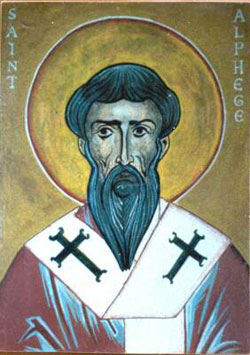 St. Alphege: Saint of the Day for Friday, April 19, 2024
 Stewardship Prayer: Prayer of the Day for Friday, April 19, 2024