 Dear readers, Catholic Online was de-platformed by Shopify for our pro-life beliefs. They shut down our Catholic Online, Catholic Online School, Prayer Candles, and Catholic Online Learning Resources essential faith tools serving over 1.4 million students and millions of families worldwide. Our founders, now in their 70's, just gave their entire life savings to protect this mission. But fewer than 2% of readers donate. If everyone gave just $5, the cost of a coffee, we could rebuild stronger and keep Catholic education free for all. Stand with us in faith. Thank you. Help Now >
Living Six Months with St. Augustine
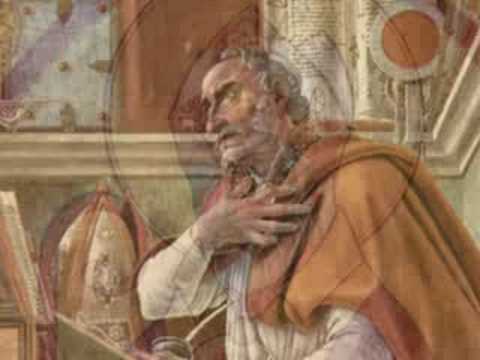
It's perhaps not common to take a bishop to bed with you in the evening, to share a cup of coffee with him in the morning, to write about him in your journal, sit on a couch with him in the evenings with a glass of wine, lie down with him on a hammock on a sultry Saturday afternoon while smoking a cigar, or to introduce your new ancient friend to all your old new friends on Facebook. But one thing I learned during my six month venture with St. Augustine: wherever and whenever you read his sermons, St. Augustine is there.

Highlights
Catholic Online (https://www.catholic.org)
9/4/2012 (1 decade ago)
Published in Christian Saints & Heroes
Keywords: St. Augustine, sermons, interior life, prayer, City of God, Augustine of Hippo, Faith and works, Andrew M. Greenwell, Esq.
CORPUS CHRISTI, TX (Catholic Online) - Six months or so ago I made a vow to read all of St. Augustine's sermons. Now, this is not a vow to be taken lightly: in the new translation by Fr. Edmund Hill, O.P. published by the New City Press, these sermons occupy 11 bound volumes. It's a burden constituting thousands of pages.
The sermons, however, are a resounding witness to St. Augustine's dedication to the ministry of the Word and to the love of his flock. He viewed his duty to preach the Gospel in season and out of season seriously. Often in his sermons he expresses the view that he had an obligation to his flock in the form of a debt, a debt to which he was accountable to them and to God. As a result of this debt, St. Augustine stated that his flock is owed the truth of God to be preached to them unfailingly and unflaggingly, and to the best of his abilities with the grace of God and the guidance of the Holy Spirit. Even today we are the beneficiaries of his heroic pastoral efforts.
The sermons span St. Augustine's long life first as a priest and then later as Bishop of Hippo. Most are addressed to his flock, but on occasion these sermons were made when visiting other sees, for example at Carthage, or at shrines of martyrs and saints. They span all liturgical seasons. They touch on all sorts of historical events, and so they are colored with real-life issue that confronted the civil society and the Church in Augustine's time.
So we have him dealing with the bizarre shenanigans of the Donatist thugs called circumcellions and pleading for mercy when some of them were caught and tried. We see him dedicated constantly to the efforts of the Catholic Church to reconcile with the heretical Donatists, and these efforts contain both his pleas to understanding and his grudging assent to the use of the force of law against them ("love and do what you will").
There are some dealing with the discipline of his fellow clergy, and making sure they conform to the rule of poverty. There are several where he harangues the laymen in his congregation who suffered to think--in some sort of hubristic male chauvinism which was part of social convention--that the laws of adultery applied to women, but not to them. In one sermon, he speaks poignantly of the fall of Rome, and the problem with the barbarians, the destruction of culture, and the appropriate Christian response.
There is really no way to summarize my romp through the product of the consummate rhetorical, homiletical, exegetical, theological, and pastoral skills of one of Christianity's great teaching, preaching, and saintly bishops. St. Augustine is a Christian colossus. His footprint is found in every Christian age. If Western philosophy is nothing but a series of footnotes on Plato as A. N. Whitehead quipped in his book Process and Reality, theology, at least in the Western Church, may be said to be nothing but a series of footnotes on Augustine. And indeed this is what Jaroslav Pelikan in his History of Christian Tradition suggested.
He is under any measure a huge figure. Even Protestants cannot avoid him. And if you ever want to disabuse a Protestant of the notion that the Catholic Church is not a "Bible Church," just show him the plethora of Scripture quoted, cited, paraphrased, referred to, or intimated at by St. Augustine in even one his simplest sermons. St. Augustine's sermons drip with Scripture. The Scriptures were so much a part of him, it was as if he drank them in with his mother's milk. Wring the Bible passages out of a sermon of St. Augustine, and you will have very little, if anything at all, left in your hands.
The corpus of St. Augustine's written works is, of course, unbelievably vast. He was, to understate the problem, unbelievably prolific. St. Isidore of Seville famously stated that he who claimed to have read all of St. Augustine' works was--presumably because of their quantity, though perhaps also because of their lack of availability--manifestly a liar.
The sermons are but a small part of his vast literary corpus. Even those works in the 11 volumes entitled "Sermons," however, do not include all his sermons. Some of these sermons--where they methodically treated certain books or topics, e.g., the Psalms, or the Gospel of St. John, or the Sermon on the Mount, are called "expositions" or enarrationes or "homilies" or tractatus, and bound separately. So though these other works are sermons, they are not traditionally categorized as such. Moreover, those sermons that have been preserved as said to represent perhaps only 10% of his preaching.
Those sermons of St. Augustine that have been preserved as the result of the practice of having an amanuensis present in the Church--a sort of ancient stenographer or clerk called notarius ecclesiae--who wrote things down as St. Augustine spoke them. We must be thankful for this foresight, as it is in St. Augustine's sermons where he is perhaps most accessible, least guarded, and certainly most personal and pastoral. In reading these sermons, we are beneficiaries to St Augustine's great humanity as well as his great spiritual gifts.

It is impossible to condense to a short article the veritable treasures that are contained in these sermons. I have preserved about 30 pages worth of worthwhile quotes. So the best one can do is to highlight some of this saint's great broad themes.
First, St. Augustine uses Scripture in the free style of analogical or allegorical interpretation to find its spiritual sense; however, he always insists that Scripture is, at heart, witness to actual historical events. For St. Augustine, everything in Scripture is anchored in a historical event, an event that actually happened. "We believe," he tells his flock in one sermon for example dealing with the ten plagues of Egypt, "that they [the plagues] happened just as we read that they did; at the same time, however, we know from the teaching of the apostle that these happenings were foreshadowing of things to come." (Sermon 8.2) Hence we always have more than one sense to Scripture, but in each and every case, the historical one is presupposed. Indeed, to remove the historical base of scripture is to build castles in the air. (Sermon 2.7)
Second, St. Augustine insists that the Old Testament must always be interpreted in light of the New Testament, specifically, in the light of Jesus Christ, for the Old Testament points to, and finds its fulfillment in, Christ Jesus, the Word of God made flesh. (e.g., Sermon 300.3, 5) Jesus Christ is what gives Scripture its unity. It is because of their witness to Jesus Christ that all the books of scripture, both Old and New, are "as if they formed a single reading, because they all proceeding from a single mouth." (Sermon 170.1) This single mouth, of course, is the mouth of Christ the Word.
There is no question of St. Augustine's dedication to the Scriptures. St. Augustine saw himself as a servant to the Word of God and in no way its master. "We are servants of the word, not our own word, of course, but the word of God and of our Lord." (Sermon 114.1)
That Scriptures all were to be understood as a witness to the Word of God also mean that Scripture had to understood within Christian tradition, that is, within the Church and her teaching office, and never apart from it. The Bible saw birth in the Church, and it is in the arms of the Church that the Bible must be nursed, coddled, and nourished. Else, one might find himself with the heretics--Arians, Donatists, Manicheans, Pelagians and the like--who--wresting the Scriptures away from the Church--invariably get it wrong, using Scripture as it were to hang and damn themselves.
St. Augustine's focus on Jesus the Incarnate Word of God is intensely scrupulous and scrupulously intense. Not only are we to focus on the words of Jesus, but also on his deeds. Everything that the Lord said or did has revelational significance. "Christ is the Word of God," St. Augustine says, "who speaks to human beings not only in the sound of words, but also in deeds." (Sermon 252.1)
Third, St. Augustine is as passionately devoted to the Church as he is to Christ. The references in his sermons of the Church as the body of Christ, with Jesus as the head are simply legion. It was inconceivable to him that one could claim to follow Jesus and not be in communion with the Church Jesus founded. It would be akin to lopping of the head from a body and claiming that way better to be able to love the head.
For St. Augustine, the whole Christ (Christus totus) is found only in the entirety of the Church, that is both head and body, a Church which traverses time and indeed is even out of time and into eternity. (Sermon 341.1, 11) Love is what binds the Christian to Jesus, the head, the Christian to the Church, Christ's body, and the members of the body to each other. "We have no union with this head except by love." (Sermon 162A.5) While God is our Father, the Church is "our true Mother, and the true bride of Christ." (Sermon 213.7) The Church is the heavenly Jerusalem, Mount Zion, the "holy city of God," the "church of the living God, the pillar and bulwark of the truth." (Sermon 214.11)
Fourth, St. Augustine--for all his dedication to the ministry of the Word--does not in anyway minimize the importance of liturgical worship or of the Sacramental life. The Sacraments are everything to him because they put us in contact with God's salvific grace. Particularly the Sacraments of Baptism, the Eucharist, Confession, Marriage, and the Priesthood are often themes of life in Christ as St. Augustine portrays it. However, all of these must be practiced within the life of the Church, and, again, never outside of it.
Baptisms outside the Church, though they may be valid, result in spiritual stillbirth (Sermon 269.2) As to the Eucharist, St. Augustine obviously understands it in the manner of the Catholic Church: "The bread which you see on the altar and which has been sanctified by the word of God is the body of Christ. The cup, or rather what the cup contains, has also been sanctified by the word of God and is the blood of Christ . . . the blood he shed for the forgiveness of sins." (Sermon 234.2)
Fifth, and I suppose what most surprised me, is that St. Augustine is always concerned with the interior life of his flock. Not only must the preacher listen to the Word of God within himself and interiorize it, he expects also his congregation to interiorize it as it is read in Church and exposited in his sermons. Indeed, this custody of the soul, this custodia animi, is an imperative of fundamental importance, for there is no such thing as a Christian who is a Christian only externally, ritually. Pharisees we ought never to be.
Christianity is more than skin-deep repair. It is not makeup. It cleanses man from the inside out, as it were. It is therefore something that must enter and live in one's center core.
The moment one centers on something outside of the soul, one becomes imbalanced in the spiritual life. "You see now that you are outside yourself. You have begun to love yourself; remain within yourself, if you would succeed. . . . When the love of human being shifts from themselves to things outside of them, they begin to empty themselves out in empty things." (Sermon 94.2)
So the focus of one's life must not be upon external goods, but the good of the soul, and the grace of the love of God which is to be found there. This is done by taking custody of the interior life. The interior life was not gained all at once. It was more akin to a journey, and it required constant introspection, constant self-scrutiny, constant growth to advance. "We are on a journey," St. Augustine tell his flock. "To put it very briefly: to 'journey' means to advance." "If you say, 'Enough!' you are lost." The only means to towards salvation is to advance, and this requires Christians to "examine yourselves constantly without self-deception, without self-flattery, without self-blandishment. . . . There is indeed someone there," namely God, "but he is one who is pleased by humility. Seek his approval." (Sermon 169.18)
Time must be set apart for this interior life. "Let us leave a little room for reflection too; and let us allot some time to silence. Enter into yourself again and try to separate yourself from all the noise. Look within you and see if you can find a sweet, secret cell within your consciousness, where you need make no sound . . . . Perhaps you will come to the point of saying: 'You will grant me to hear the sounds of joy and gladness, and my bones shall rejoice,' but only if they are bones which have been 'humbled' rather than exalted." (Sermon 52.22)

Which brings us to another important Augustinian theme: humility. Humility was required both to have faith and to learn love. Faith, of course, was for St. Augustine always the beginning of any adventure in understanding. One of his favorite citations is Isaiah 7:9: "If you do not believe, you will not understand." This reference is peppered through numerous of his sermons. Believe that you may understand is at the heart of the Augustinian program.
Faith requires humility. Humility is the virtue which, tied to faith, obtains access to God. "He is exalted indeed. Are you looking for a ladder? Look for the wood of humility, and you will attain your goal." (Sermon 70A.2) "Do you want to reach God in his sublime heights? Begin by practicing the humility of God . . . Practice the humility of Christ, learn to be humble and not proud." (Sermon 117.7)
Humility is but the beginning of the Christian life and not the end-all, for the road in which the Christian travels is the royal road of love. This, is the golden thread in Scripture, for "at whatever page the scriptures are opened, the echo of love is heard." (Sermon 350A.1) What is absolutely central is to look at what we love, for what we love is what we become. "Love God; regard nothing else as better than he. . . . Love Christ! Long for the light that is Christ!" (Sermon 349.2) This love of God does not rest happy in God alone, as it also spills over into love of neighbor which is inseparable from it, and it includes even one's enemies.
It's perhaps not common to take a bishop to bed with you in the evening, to share a cup of coffee with him in the morning, to write a few words about him in your journal, to sit on a couch with him in the evenings with a glass of wine or perhaps two, to lie down with him on a hammock on a sultry Saturday while smoking a cigar, or to introduce your new ancient friend to all your old new friends on Facebook through a daily posting of quotes. But one thing I learned--from many other things--during my six month venture with St. Augustine: wherever and whenever you read his sermons, St. Augustine is there. The Communion of Saints . . . it's something for real.
Pray for us, my dear and noble friend. Pray for us, St. Augustine. Or in words you would have understood while on earth: Sancte Pater Augustine, ora pro nobis.
----
Andrew M. Greenwell is an attorney licensed to practice law in Texas, practicing in Corpus Christi, Texas. He is married with three children. He maintains a blog entirely devoted to the natural law called Lex Christianorum. You can contact Andrew at agreenwell@harris-greenwell.com.
---
'Help Give every Student and Teacher FREE resources for a world-class Moral Catholic Education'
Copyright 2021 - Distributed by Catholic Online

Come Grow With Us
Sign up and walk the Catholic journey with millions around the world.
Receive inspiring emails on saints, daily readings, and free faith-building resources—no cost, ever.
Sister Sara Has One Message for Every Catholic Family This June
- Easter / Lent
- 5 Lenten Prayers
- Ash Wednesday
- 7 Morning Prayers
- Mysteries of the Rosary
- Litany of the Bl. Virgin Mary
- Popular Saints
- Popular Prayers
- Female Saints
- Saint Feast Days by Month
- Stations of the Cross
- St. Francis of Assisi
- St. Michael the Archangel
- The Apostles' Creed
- Unfailing Prayer to St. Anthony
- Pray the Rosary









Copyright 2026 Catholic Online. All materials contained on this site, whether written, audible or visual are the exclusive property of Catholic Online and are protected under U.S. and International copyright laws, © Copyright 2026 Catholic Online. Any unauthorized use, without prior written consent of Catholic Online is strictly forbidden and prohibited.
Catholic Online is a Project of Your Catholic Voice Foundation, a Not-for-Profit Corporation. Your Catholic Voice Foundation has been granted a recognition of tax exemption under Section 501(c)(3) of the Internal Revenue Code. Federal Tax Identification Number: 81-0596847. Your gift is tax-deductible as allowed by law.