St. Agnes of Assisi
Facts
Death: 1253
Author and Publisher - Catholic Online
Printable Catholic Saints PDFs
Shop St. Agnes of Assisi
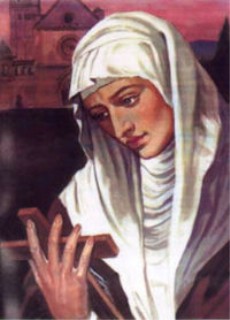
Abbess and miracle worker, the younger sister of St. Clare of Assisi. Born in Assisi, Agnes was the youngest daughter of Count Favorino Scifi and Countess Hortulana (now Blessed). On March 18, 1212, Clare renounced her inheritance and family and founded the Poor Clares, the Franciscan cloistered Order. Agnes joined her sixteen days later at the Benedictine cloister of St. Angelo in Panso, where they received their initial training. Her father, Count Favorino, sent armed men to carry Agnes away. She was badly beaten but was not taken back to her father because of the miraculous efforts of Clare. Agnes was accepted by St. Francis and placed in St. Damian's. She and Clare were soon joined by other noblewomen of Assisi, and there Agnes achieved perfection as a religious at a young age. She was eventually named abbess, and in 1219, was sent by St. Francis to direct the Poor Clares at Monticelli, near Florence. Agnes wrote a letter to Clare, and this surviving document clearly demonstrates her love of poverty and her loyalty to Clare's ideals. Agnes also established Poor Clares in Mantua, Padua, and Venice. In 1253, she was summoned to Clare's deathbed and assisted at her funeral. Agnes followed quickly as Clare had predicted, dying three months later, on November 16 of the same year. Her mother, Hortulana, and a younger sister, Beatrice, had already died, and Agnes was buried near them in the Church of St. Clare of Assisi.

Come Grow With Us
Sign up and walk the Catholic journey with millions around the world.
Receive inspiring emails on saints, daily readings, and free faith-building resources—no cost, ever.
Sister Sara Has One Message for Every Catholic Family This June
- Easter / Lent
- 5 Lenten Prayers
- Ash Wednesday
- 7 Morning Prayers
- Mysteries of the Rosary
- Litany of the Bl. Virgin Mary
- Popular Saints
- Popular Prayers
- Female Saints
- Saint Feast Days by Month
- Stations of the Cross
- St. Francis of Assisi
- St. Michael the Archangel
- The Apostles' Creed
- Unfailing Prayer to St. Anthony
- Pray the Rosary







Copyright 2026 Catholic Online. All materials contained on this site, whether written, audible or visual are the exclusive property of Catholic Online and are protected under U.S. and International copyright laws, © Copyright 2026 Catholic Online. Any unauthorized use, without prior written consent of Catholic Online is strictly forbidden and prohibited.
Catholic Online is a Project of Your Catholic Voice Foundation, a Not-for-Profit Corporation. Your Catholic Voice Foundation has been granted a recognition of tax exemption under Section 501(c)(3) of the Internal Revenue Code. Federal Tax Identification Number: 81-0596847. Your gift is tax-deductible as allowed by law.