 Dear readers, Catholic Online was de-platformed by Shopify for our pro-life beliefs. They shut down our Catholic Online, Catholic Online School, Prayer Candles, and Catholic Online Learning Resources essential faith tools serving over 1.4 million students and millions of families worldwide. Our founders, now in their 70's, just gave their entire life savings to protect this mission. But fewer than 2% of readers donate. If everyone gave just $5, the cost of a coffee, we could rebuild stronger and keep Catholic education free for all. Stand with us in faith. Thank you. Help Now >
Papal Address to Turkey's Religious Affairs Director
FREE Catholic Classes
We "Belong to the Family of Those Who Believe in the One God"
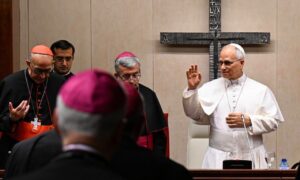
ANKARA, Turkey, NOV. 30, 2006 (Zenit) - Here is the address Benedict XVI delivered during his meeting today with Ali Bardakoglu, chief of Turkey's Religious Affairs Directories.
The meeting was attended by representatives of the Muslim community, among whom were the grand muftis of Ankara and Istanbul, as well as cardinals and bishops who are part of the papal entourage.
* * *
I am grateful for the opportunity to visit this land, so rich in history and culture, to admire its natural beauty, to witness for myself the creativity of the Turkish people, and to appreciate your ancient culture and long history, both civil and religious.
As soon as I arrived in Turkey, I was graciously received by the President of the Republic and the Government Representative. It was for me also a great pleasure to greet and meet his Excellency the Prime Minister Erdogan at the airport. In greeting them, I was pleased to express my profound esteem for all the people of this great country and to pay my respects at the tomb of the founder of modern Turkey, Mustafa Kemal AtatĂĽrk.
I now have the joy of meeting you, the President of the Religious Affairs Directorate. I offer you my sentiments of respect, in recognition of your great responsibilities, and I extend my greetings to all the religious leaders of Turkey, especially the Grand Muftis of Ankara and Istanbul. In your person, Mr President, I greet all the Muslims in Turkey with particular esteem and affectionate regard.
Your country is very dear to Christians: many of the earliest Church communities were founded here and grew to maturity, inspired by the preaching of the Apostles, particularly Saint Paul and Saint John. The tradition has come down to us that Mary, the Mother of Jesus, lived at Ephesus, in the home of the Apostle Saint John.
This noble land has also seen a remarkable flowering of Islamic civilization in the most diverse fields, including its literature and art, as well as its institutions.
There are so many Christian and Muslim monuments that bear witness to Turkey's glorious past. You rightly take pride in these, preserving them for the admiration of the ever increasing number of visitors who flock here.
I have set out upon my visit to Turkey with the same sentiments as those expressed by my predecessor Blessed John XXIII, when he came here as Archbishop Giuseppe Roncalli, to fulfill the office of Papal Representative in Istanbul: "I am fond of the Turks, to whom the Lord has sent me ... I love the Turks, I appreciate the natural qualities of these people who have their own place reserved in the march of civilization" (Journal of a Soul, pp. 228, 233-4).
For my own part, I also wish to highlight the qualities of the Turkish population. Here I make my own the words of my immediate predecessor, Pope John Paul II of blessed memory, who said on the occasion of his visit in 1979: "I wonder if it is not urgent, precisely today when Christians and Muslims have entered a new period of history, to recognize and develop the spiritual bonds that unite us, in order to preserve and promote together, for the benefit of all men, 'peace, liberty, social justice and moral values'" (Address to the Catholic Community in Ankara, 28 November 1979).
These questions have continued to present themselves throughout the intervening years; indeed, as I indicated at the very beginning of my Pontificate, they impel us to carry forward our dialogue as a sincere exchange between friends. When I had the joy of meeting members of Muslim communities last year in Cologne, on the occasion of World Youth Day, I reiterated the need to approach our interreligious and intercultural dialogue with optimism and hope. It cannot be reduced to an optional extra: on the contrary, it is "a vital necessity, on which in large measure our future depends" (Address to representatives of some Muslim Communities, Cologne, 20 August 2005).
Christians and Muslims, following their respective religions, point to the truth of the sacred character and dignity of the person. This is the basis of our mutual respect and esteem, this is the basis for cooperation in the service of peace between nations and peoples, the dearest wish of all believers and all people of good will.
For more than forty years, the teaching of the Second Vatican Council has inspired and guided the approach taken by the Holy See and by local Churches throughout the world to relations with the followers of other religions. Following the Biblical tradition, the Council teaches that the entire human race shares a common origin and a common destiny: God, our Creator and the goal of our earthly pilgrimage. Christians and Muslims belong to the family of those who believe in the one God and who, according to their respective traditions, trace their ancestry to Abraham (cf. Second Vatican Council, Declaration on the Relation of the Church to Non-Christian Religions "Nostra Aetate" 1, 3). This human and spiritual unity in our origins and our destiny impels us to seek a common path as we play our part in the quest for fundamental values so characteristic of the people of our time. As men and women of religion, we are challenged by the widespread longing for justice, development, solidarity, freedom, security, peace, defense of life, protection of the environment and of the resources of the earth. This is because we too, while respecting the legitimate autonomy of temporal affairs, have a specific contribution to offer in the search for proper solutions to these pressing questions.
Above all, we can offer a credible response to the question which emerges clearly from today's society, even if it is often brushed aside, the question about the meaning and purpose of life, for each individual and for humanity as a whole. We are called to work together, so as to help society to open itself to the transcendent, giving Almighty God his rightful place. The best way forward is via authentic dialogue between Christians and Muslims, based on truth and inspired by a sincere wish to know one another better, respecting differences and recognizing what we have in common. This will lead to an authentic respect for the responsible choices that each person makes, especially those pertaining to fundamental values and to personal religious convictions.
As an illustration of the fraternal respect with which Christians and Muslims can work together, I would like to quote some words addressed by Pope Gregory VII in 1076 to a Muslim prince in North Africa who had acted with great benevolence toward the Christians under his jurisdiction. Pope Gregory spoke of the particular charity that Christians and Muslims owe to one another "because we believe in one God, albeit in a different manner, and because we praise him and worship him every day as the Creator and Ruler of the world."
Freedom of religion, institutionally guaranteed and effectively respected in practice, both for individuals and communities, constitutes for all believers the necessary condition for their loyal contribution to the building up of society, in an attitude of authentic service, especially toward the most vulnerable and the poor.
Mr President, I should like to finish by praising the Almighty and merciful God for this happy occasion that brings us together in his name. I pray that it may be a sign of our joint commitment to dialogue between Christians and Muslims, and an encouragement to persevere along that path, in respect and friendship. May we come to know one another better, strengthening the bonds of affection between us in our common wish to live together in harmony, peace and mutual trust. As believers, we draw from our prayer the strength that is needed to overcome all traces of prejudice and to bear joint witness to our firm faith in God. May his blessing be ever upon us!
[Original text: English]
© Copyright 2006 -- Libreria Editrice Vaticana
Contact
Catholic Online
https://www.catholic.org
CA, US
Catholic Online - Publisher, 661 869-1000
info@yourcatholicvoice.org
Keywords
Benedict, Orthodox, Catholic, Turkey, Baradakoglu
More Catholic PRWire
Showing 1 - 50 of 4,716
A Recession Antidote
Randy Hain
Monaco & The Vatican: Monaco's Grace Kelly Exhibit to Rome--A Review of Monegasque-Holy See Diplomatic History
Dna. Maria St. Catherine Sharpe, t.o.s.m., T.O.SS.T.
The Why of Jesus' Death: A Pauline Perspective
Jerom Paul
A Royal Betrayal: Catholic Monaco Liberalizes Abortion
Dna. Maria St.Catherine De Grace Sharpe, t.o.s.m., T.O.SS.T.
Embrace every moment as sacred time
Mary Regina Morrell
My Dad
JoMarie Grinkiewicz
Letting go is simple wisdom with divine potential
Mary Regina Morrell
Father Lombardi's Address on Catholic Media
Catholic Online
Pope's Words to Pontifical Latin American College
Catholic Online
Prelate: Genetics Needs a Conscience
Catholic Online
State Aid for Catholic Schools: Help or Hindrance?
Catholic Online
Scorsese Planning Movie on Japanese Martyrs
Catholic Online
2 Nuns Kidnapped in Kenya Set Free
Catholic Online
Holy See-Israel Negotiation Moves Forward
Catholic Online
Franchising to Evangelize
Catholic Online
Catholics Decry Anti-Christianity in Israel
Catholic Online
Pope and Gordon Brown Meet About Development Aid
Catholic Online
Pontiff Backs Latin America's Continental Mission
Catholic Online
Cardinal Warns Against Anti-Catholic Education
Catholic Online
Full Circle
Robert Gieb

Three words to a deeper faith
Paul Sposite
Relections for Lent 2009
chris anthony
Wisdom lies beyond the surface of life
Mary Regina Morrell
World Food Program Director on Lent
Catholic Online
Moral Clarity
DAN SHEA
Pope's Lenten Message for 2009
Catholic Online
A Prayer for Monaco: Remembering the Faith Legacy of Prince Rainier III & Princess Grace and Contemplating the Moral Challenges of Prince Albert II
Dna. Maria St. Catherine Sharpe
Keeping a Lid on Permissiveness
Sally Connolly
Glimpse of Me
Sarah Reinhard
The 3 stages of life
Michele Szekely
Sex and the Married Woman
Cheryl Dickow
A Catholic Woman Returns to the Church
Cheryl Dickow
Modernity & Morality
Dan Shea
Just a Minute
Sarah Reinhard
Catholic identity ... triumphant reemergence!
Hugh McNichol
Edging God Out
Paul Sposite
Burying a St. Joseph Statue
Cheryl Dickow
George Bush Speaks on Papal Visit
Catholic Online
Sometimes moving forward means moving the canoe
Mary Regina Morrell
Action Changes Things: Teaching our Kids about Community Service
Lisa Hendey
Easter... A Way of Life
Paul Spoisite
Papal initiative...peace and harmony!
Hugh McNichol
Proclaim the mysteries of the Resurrection!
Hugh McNichol
Jerusalem Patriarch's Easter Message
Catholic Online
Good Friday Sermon of Father Cantalamessa
Catholic Online
Papal Address at the End of the Way of the Cross
Catholic Online
Cardinal Zen's Meditations for Via Crucis
Catholic Online
Interview With Vatican Aide on Jewish-Catholic Relations
Catholic Online
Pope Benedict XVI On the Easter Triduum
Catholic Online
Holy Saturday...anticipation!
Hugh McNichol
Come Grow With Us
Sign up and walk the Catholic journey with millions around the world.
Receive inspiring emails on saints, daily readings, and free faith-building resources—no cost, ever.
Sister Sara Has One Message for Every Catholic Family This June
- Easter / Lent
- 5 Lenten Prayers
- Ash Wednesday
- 7 Morning Prayers
- Mysteries of the Rosary
- Litany of the Bl. Virgin Mary
- Popular Saints
- Popular Prayers
- Female Saints
- Saint Feast Days by Month
- Stations of the Cross
- St. Francis of Assisi
- St. Michael the Archangel
- The Apostles' Creed
- Unfailing Prayer to St. Anthony
- Pray the Rosary






Copyright 2026 Catholic Online. All materials contained on this site, whether written, audible or visual are the exclusive property of Catholic Online and are protected under U.S. and International copyright laws, © Copyright 2026 Catholic Online. Any unauthorized use, without prior written consent of Catholic Online is strictly forbidden and prohibited.
Catholic Online is a Project of Your Catholic Voice Foundation, a Not-for-Profit Corporation. Your Catholic Voice Foundation has been granted a recognition of tax exemption under Section 501(c)(3) of the Internal Revenue Code. Federal Tax Identification Number: 81-0596847. Your gift is tax-deductible as allowed by law.