We ask you, humbly: don't scroll away.
Hi readers, it seems you use Catholic Online a lot; that's great! It's a little awkward to ask, but we need your help. If you have already donated, we sincerely thank you. We're not salespeople, but we depend on donations averaging $14.76 and fewer than 1% of readers give. If you donate just $5.00, the price of your coffee, Catholic Online School could keep thriving. Thank you.Help Now >
'Deus Caritas Est' and C.S. Lewis 'Four Loves'
FREE Catholic Classes
Interview With Andrea Monda
ROME, MARCH 7, 2006 (Zenit) - In Benedict XVI's first encyclical it is possible to find affinities with "The Four Loves" of C.S. Lewis, says journalist Andrea Monda.
St. Paul's has published two of Monda's works on the British author: "Invito alla lettera di C.S. Lewis" (2000) and, with Paolo Gulisano, "Il Mondo di Narnia" (2005).
Clive Staples Lewis was born in Belfast, Northern Ireland, on Nov. 29, 1898. He was educated at Oxford, where he was a tutor and member of the governing council of Magdalen Collage from 1925 to 1954, the year in which he was appointed professor of medieval and Renaissance literature in Cambridge. He died on Nov. 22, 1963.
An atheist for many years, Lewis described his conversion to Christianity in "Surprised by Joy." His works of fiction include "The Chronicles of Narnia" series.
Monda spoke to us about the similarities of Lewis' "Four Loves" with Benedict XVI's encyclical, "Deus Caritas Est."
Q: What are the affinities between Pope Benedict XVI and the British writer?
Monda: It is known that the then Cardinal Joseph Ratzinger read and appreciated several works of the writer C.S. Lewis ... and every now and then traces of that experience also appear in the texts of Pope Benedict XVI, including in the encyclical "Deus Caritas Est."

Q: In what passages in particular?
Monda: Above all in the decision to place love at the center of his reflection, essence of Christian doctrine and, especially, in having dedicated the first part of the encyclical to the comparison and distinction between "eros" and "agape," with a brief allusion to "philia."
It is quite likely that the Supreme Pontiff recalled Lewis' splendid 1960 essay on "The Four Loves," in which the writer analyzes four kinds of love: affection; friendship -- "philia"; and, specifically, eros and charity -- "agape."
But it is not just in structure where a harmony is perceived, but also in the contents: Lewis' sharp intelligence goes to the core of the Christian faith with the same capacity of penetration of the German Pontiff, and with the same ability to illuminate, explain and give to the reader's attention.
Q: Can you give an example?
Monda: Lewis writes, for example, speaking of charity, that "natural love-gift is always directed to objects that the one in love considers in a certain sense intrinsically worthy of love. ... But divine love-gift in man enables him also to love what is not naturally worthy of love: lepers, criminals, enemies, the mentally retarded, the embittered, the proud and the scornful."
Further on, he continues to affirm: "We want to be loved for our intelligence, beauty, generosity, honesty, efficiency. In noticing, however, that someone is not offering supreme love -- charity --this makes a terrible impact on us. ... In a similar way, receiving is harder and perhaps more meritorious than giving. ... All those who have good parents, wives, husbands or children can be sure that sometimes -- and perhaps always, in regard to some specific feature or habit -- they are receiving charity, that they are not loved because they are lovable, but because Love itself is in those who love them."
It is quite likely that the Holy Father remembered this page of Lewis when, in point 17 of the encyclical, he wrote that "He has loved us first and he continues to do so; we too, then, can respond with love. God does not demand of us a feeling which we ourselves are incapable of producing. He loves us, he makes us see and experience his love, and since he has 'loved us first,' love can also blossom as a response within us."
And in the following point, he continues affirming that "Love of neighbor is thus shown to be possible in the way proclaimed by the Bible, by Jesus. It consists in the very fact that, in God and with God, I love even the person whom I do not like or even know. This can only take place on the basis of an intimate encounter with God, an encounter which has become a communion of will, even affecting my feelings. Then I learn to look on this other person not simply with my eyes and my feelings, but from the perspective of Jesus Christ. His friend is my friend. Going beyond exterior appearances, I perceive in others an interior desire for a sign of love, of concern. This I can offer them not only through the organizations intended for such purposes, accepting it perhaps as a political necessity. Seeing with the eyes of Christ, I can give to others much more than their outward necessities; I can give them the look of love which they crave."

Q: How can love, literature and spirituality coexist?
Monda: It is true that the Spirit blows where it will: A philologist-writer of fantasies, layman and Anglican -- even if he was very close to Catholicism -- and a German Catholic theologian, today Universal Shepherd of the Catholic Church, meet, are reunited in thought and word, united by the Spirit of Love.
What comes to mind is that English writer Gilbert Keith Chesterton, read and loved by Lewis and Ratzinger, was right when he wrote that the Church is the place where all truths meet.
Contact
Catholic Online
https://www.catholic.org
CA, US
Catholic Online - Publisher, 661 869-1000
info@yourcatholicvoice.org
Keywords
Monda, C.S. Lewis, Narnia, Pope, Benedict, Encyclical
We ask you, humbly: don't scroll away.
Hi readers, it seems you use Catholic Online a lot; that's great! It's a little awkward to ask, but we need your help. If you have already donated, we sincerely thank you. We're not salespeople, but we depend on donations averaging $14.76 and fewer than 1% of readers give. If you donate just $5.00, the price of your coffee, Catholic Online School could keep thriving. Thank you.Help Now >
More Catholic PRWire
Showing 1 - 50 of 4,716
A Recession Antidote
Randy Hain
Monaco & The Vatican: Monaco's Grace Kelly Exhibit to Rome--A Review of Monegasque-Holy See Diplomatic History
Dna. Maria St. Catherine Sharpe, t.o.s.m., T.O.SS.T.
The Why of Jesus' Death: A Pauline Perspective
Jerom Paul
A Royal Betrayal: Catholic Monaco Liberalizes Abortion
Dna. Maria St.Catherine De Grace Sharpe, t.o.s.m., T.O.SS.T.
Embrace every moment as sacred time
Mary Regina Morrell
My Dad
JoMarie Grinkiewicz
Letting go is simple wisdom with divine potential
Mary Regina Morrell
Father Lombardi's Address on Catholic Media
Catholic Online
Pope's Words to Pontifical Latin American College
Catholic Online
Prelate: Genetics Needs a Conscience
Catholic Online
State Aid for Catholic Schools: Help or Hindrance?
Catholic Online
Scorsese Planning Movie on Japanese Martyrs
Catholic Online
2 Nuns Kidnapped in Kenya Set Free
Catholic Online
Holy See-Israel Negotiation Moves Forward
Catholic Online
Franchising to Evangelize
Catholic Online
Catholics Decry Anti-Christianity in Israel
Catholic Online
Pope and Gordon Brown Meet About Development Aid
Catholic Online
Pontiff Backs Latin America's Continental Mission
Catholic Online
Cardinal Warns Against Anti-Catholic Education
Catholic Online
Full Circle
Robert Gieb

Three words to a deeper faith
Paul Sposite
Relections for Lent 2009
chris anthony
Wisdom lies beyond the surface of life
Mary Regina Morrell
World Food Program Director on Lent
Catholic Online
Moral Clarity
DAN SHEA
Pope's Lenten Message for 2009
Catholic Online
A Prayer for Monaco: Remembering the Faith Legacy of Prince Rainier III & Princess Grace and Contemplating the Moral Challenges of Prince Albert II
Dna. Maria St. Catherine Sharpe
Keeping a Lid on Permissiveness
Sally Connolly
Glimpse of Me
Sarah Reinhard
The 3 stages of life
Michele Szekely
Sex and the Married Woman
Cheryl Dickow
A Catholic Woman Returns to the Church
Cheryl Dickow
Modernity & Morality
Dan Shea
Just a Minute
Sarah Reinhard
Catholic identity ... triumphant reemergence!
Hugh McNichol
Edging God Out
Paul Sposite
Burying a St. Joseph Statue
Cheryl Dickow
George Bush Speaks on Papal Visit
Catholic Online
Sometimes moving forward means moving the canoe
Mary Regina Morrell
Action Changes Things: Teaching our Kids about Community Service
Lisa Hendey

Easter... A Way of Life
Paul Spoisite
Papal initiative...peace and harmony!
Hugh McNichol
Proclaim the mysteries of the Resurrection!
Hugh McNichol
Jerusalem Patriarch's Easter Message
Catholic Online
Good Friday Sermon of Father Cantalamessa
Catholic Online
Papal Address at the End of the Way of the Cross
Catholic Online
Cardinal Zen's Meditations for Via Crucis
Catholic Online
Interview With Vatican Aide on Jewish-Catholic Relations
Catholic Online
Pope Benedict XVI On the Easter Triduum
Catholic Online
Holy Saturday...anticipation!
Hugh McNichol
We ask you, humbly: don't scroll away.
Hi readers, it seems you use Catholic Online a lot; that's great! It's a little awkward to ask, but we need your help. If you have already donated, we sincerely thank you. We're not salespeople, but we depend on donations averaging $14.76 and fewer than 1% of readers give. If you donate just $5.00, the price of your coffee, Catholic Online School could keep thriving. Thank you.Help Now >
Join the Movement
When you sign up below, you don't just join an email list - you're joining an entire movement for Free world class Catholic education.





 Daily Readings for Friday, April 26, 2024
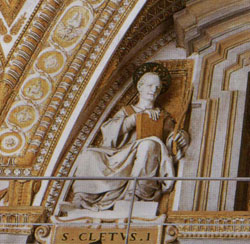 St. Cletus: Saint of the Day for Friday, April 26, 2024
 Prayer before the Closing of the Day: Prayer of the Day for Friday, April 26, 2024