 Dear readers, Catholic Online was de-platformed by Shopify for our pro-life beliefs. They shut down our Catholic Online, Catholic Online School, Prayer Candles, and Catholic Online Learning Resources essential faith tools serving over 1.4 million students and millions of families worldwide. Our founders, now in their 70's, just gave their entire life savings to protect this mission. But fewer than 2% of readers donate. If everyone gave just $5, the cost of a coffee, we could rebuild stronger and keep Catholic education free for all. Stand with us in faith. Thank you. Help Now >
Report by General Relator of Synod
FREE Catholic Classes
On Eucharistic Amazement
VATICAN CITY, OCT. 7, 2005 (Zenit) - Here is a translation of the "report before the discussion" given Monday by the general relator of the Synod of Bishops, Cardinal Angelo Scola, patriarch of Venice, Italy.
* * *
INTRODUCTION
Eucharist: the freedom of God encounters the freedom of man
I. Eucharistic amazement
When they celebrate the Eucharist, the faithful can relive in some way the experience of the two disciples of Emmaus: and their eyes opened and they recognized him" (Lk 24:31)"[1]. This is why John Paul II asserts that the Eucharistic action incites amazement [2]. Amazement is the immediate answer of man to the reality calling upon him. It expresses the recognition that reality is a friend to him, it is a positive that encounters his constitutive expectations. Saint Paul, writing to the Romans, explains the reason for this: reality safeguards the good plan of the Creator. To such a point that the Apostle could say of men who in their injustice hold back the truth" who have no excuse" because for what can be known about God is perfectly plain to them" -- because ever since the creation of the world, the invisible existence of God and his everlasting power have been clearly seen by the mind's understanding of created things" -- they knew God and yet they did not honor him as God or give thanks to him" (cf. Rom 1:19-21). Uncertainty and fear, instead, can come into it at a later time in the experience of man when, because of the finite and evil, fear makes its way within him and the positivity of reality does not remain.
Thus, on one hand, Eucharistic action, like the rest of entire Christianity inasmuch as source of amazement[3], is inscribed in human experience as such. However, on the other hand, this is manifested as an unexpected and completely free event. In the Eucharist that God's Plan is a plan of love is revealed. In this, the Deus Trinitas, which in itself is love (cf. 1Jn 4:7-8), lowers into the given Body and Blood poured by Jesus Christ, becoming food and drink that nurture man's life (cf. Lk 22:14-20; 1Cor 11:23-26).
Like the two of Emmaus, regenerated by Eucharistic amazement, they took up their path again (cf. Lk 24:32-33) thus, the people of God, abandoning themselves to the force of the sacrament, is urged to share the history of all men.
John Paul II, with great insight, immediately also made his by Benedict XVI, wished to prolong the beneficial fruits of the Great Jubilee in the special Year of the Eucharist[4], establishing that this XI Ordinary General Assembly of the Synod of Bishops be dedicated to The Eucharist: Source and Summit of the Life and Mission of the Church. The solemn concelebration we began this with yesterday in the Basilica of Saint Peter's, objectively opened us to that attitude of amazement, if opportunely seconded during our workings, which will contribute to making us rediscover the centrality and the beauty of the Eucharist of the Church spread throughout the entire world.
Why is the Eucharist the fascinating heart of the life of the people of God destined to the salvation of all of humanity? Because it reveals and makes present today the history of Jesus Christ as the achieved meaning of human existence in all of its personal and community dimensions[5], and documents it on an anthropological, cosmological and social level. The truth is that only in the mystery of the incarnate Word does the mystery of man take on light"[6]: in the Eucharist, this central conciliar assertion reveals all its realism. In the bread and wine, the fruits of the earth and labor, the total offering that man makes of himself, one of soul and of body[7], of his sentiments and his work is reasserted; his relationship of permanent interaction with the universe is expressed and, at the same time, his original solidarity with all his brethren, from the family and the closest communities to reach the extreme boundaries of the earth, is documented.
In the Eucharistic gift, the believer is allowed access to the living and personal Truth, which indeed makes free" (cf. Jn 8:36). In the Eucharist, the invitation from Jesus if you wish to be perfect" (Mt 19:21) takes on its full meaning. Man is provoked to come out of himself towards others and all of reality, to satisfy the desire of happiness he bears in his own heart [8]. In the Eucharist, Jesus truly becomes the Way to the Truth that gives Life (cf. Jn 14:6)[9].In this, the Church, personal and social reality at the same time, concretely becomes a people of peoples, that admirable sui generis ethnic entity Paul VI spoke of[10].
Source and summit of the life and the mission of the Church is the whole Triduum Paschale, but this is as it were gathered up, foreshadowed and concentrated forever in the gift of the Eucharist" inasmuch as it activates a mysterious oneness in time" between that Triduum and the passage of the centuries"[11]. For this, for the past two thousand years, the holy people of God, whatever the generation, status, race or culture they belong to, convenes every Sunday in the ecclesia eucaristica, publicly professing their own faith. In fact, the Eucharist, in itself and in its connection with the seven day sacramental, reveals the entire breadth of the mystery of the faith[12]. This concretely explains the reason for which even during the times and places of greatest trials the Church, supported by the Spirit, never weakened. To oppose this, the millennial practice[13] of placing Sunday Eucharistic action contributed greatly.
These are, in the extreme synthesis, the reasons that can incite Eucharistic amazement in the men and women of all times and all places. The present Relatio ante disceptationem intends to show this in some way. In the preparatory framework of the Lineamenta first and the Instrumentum laboris later, without the pretense of being complete, but also without avoiding the main problems, this has the only goal of opening up the dialogue between the Synodal Fathers. I will anticipate the points to facilitate our work. After having referred to Eucharistic amazement, the Introduction (Eucharist: the freedom of God encounters the freedom of man) emphasizes the connection between the Eucharist with evangelization and with the ratio sacramentalis proper in Revelation. In the First Chapter (The novum in Christian worship) I will try to highlight the new things in Christian worship. The Second Chapter (Eucharistic action) will deal with Eucharistic action and its distinctive elements and in the necessary connection between ars celebrandi and actuosa participatio. A Third Chapter (Anthropological, cosmological and social dimensions of the Eucharist) will try to show how the Eucharist intrinsically contains an anthropological, cosmological and social dimension. The Conclusion (Eucharistic existence in contemporary trials) will offer a synthetic summary of the matters worked upon to end with a brief wish on our workings.
II. The Eucharist implies evangelization
The data gathered by the Instrumentum laboris prepared in view of this Synodal Assembly of ours show that the Eucharistic practice is very varied in the large areas of the globe. This certainly has a lot to do with their significant cultural differences, which are expressed in an evident way also in the quality of participation in the Eucharist, which, in turn, is connected to the authenticity of the ars celebrandi.
However, a general overview is needed. The decrease in Eucharistic amazement depends, in a final analysis, on the finitude and on the sin of the subject. Often however, this finds fertile terrain in the fact that the Christian community that celebrates the Eucharist is distant from reality. It lives in abstractions. It no longer speaks to the concrete man, to his sentiments, his work, his rest, his needs for unity, truth, goodness, beauty. And thus the Eucharistic action, separated from daily existence no longer accompanies the believer in the process of maturing of one's self and in his relationship with the universe and with society.
The Synodal Assembly will need to look into this state of matters carefully and suggest some possible remedies. It cannot limit itself to re-emphasize the centrality of the Eucharist and the dies Domini. Objectively this is out of the discussion, but the difficulties lie in how to rekindle amazement, generated by the Eucharist, in the many non-practicing baptized persons (in some European countries this can be more than 80%). Before men can come to the liturgy they must be called to faith and to conversion" [14] -- we must not forget this. Therefore, the announcement and the personal and community testimony of Jesus Christ to all men are necessary to inciting vital and open Christian communities. Also, the life of these communities demands a systematic formation in the mind of Christ" (1 Cor 2:16) (catechesis -- in a very particular way that concerning Christian initiation of children and adults, culture). This happens through education in the free giving (charity, commitment to social sharing). This requires a universal communication of the new life in Christ (mission). In a word, the constitutional factors of evangelization and of new evangelization are essential implications in Eucharistic action.
III. The Eucharist and the ratio sacramentalis of Revelation
Vatican Council II, especially in the Dogmatic Constitution Dei Verbum, placed emphasis on the characteristic as event proper to Revelation. Thus it offered a solid doctrinal basis to Eucharistic realism that can only guarantee the contemporaneity between the saving Triduum of Easter and the man of all times. The Constitution delves into the teachings of Vatican I in a Christocentric key. Revelation is achieved and completed in the Person and in the history of Jesus Christ, true man and true God. Crucified, died and resurrected for us men and for our salvation [15]. In His work for salvation He reveals the merciful face of the Father who, through the power of the Risen Spirit, makes us sons in the Son (cf. Eph 1:5). Nomen Trinitatis publicando"[16] Jesus Christ, through the total donation of His innocent life, unravels the enigma of man and, in this way, gives worth to his freedom enabling him to decide for himself. In fact, Jesus Christ asks the freedom of each man to welcome, through obedience to faith, this gift of His in every action of one's existence (cf. Rev 3:20). This welcoming implies, in turn, the total giving of one's self on man's part (cf. Mt 19:21). Thus the exclusion of any magical concept of the sacrament in general and the Eucharist in particular.

Christ himself anticipated the unique and unrepeatable event of the Paschal Triduum in the Supper with His Apostles, which He strongly wished for (cf. Lk 22:15). Sitting at the table with the apostles at the Last Supper, Jesus instituted the Eucharist. Through the gift of the Holy Spirit which makes possible the effective realization of the command do this in memory of me" (Lk 22:19; 1Cor 11:25), He opens the believer of all times to the possibility of taking part in salvation. Therefore, in the Eucharistic action, the freedom of God effectively encounters the freedom of man. From this encounter with freedom the Christian, marked by the recognition of the gift of God and the communion with Him and his brothers, is prone to give his entire life a Eucharistic form [17]. And this because in the Eucharist is expressed in an eminent way what the Fides et ratio calls the ratio sacramentalis of revelation"[18]. This allows the faithful to discover that, through all the circumstances and all the relationships that objectively make up human existence, the event of Jesus Christ calls his liberty to a progressive involvement with the life of the Trinity. Accompanying him in this experience is Jesus himself: I am with you always; yes, to the end of time" (Mt 28:20). For this He assures His loving presence to the Christian community: for where two or three meet in my name, I am there among them" (Mt 18:20). This is how the primitive community lived from the beginning: These remained faithful to the teaching of the apostles, to the brotherhood, to the breaking of bread and to the prayers" (Acts 2:42). And on the life of the people of God who through history throws a blinding light on the eschatological perspective in which Jesus placed, from its institution, Eucharistic action: I tell you, I shall never again drink wine until the day I drink the new wine with you in the kingdom of my Father" (Mt 26:29; Mk 14:25; Lk 22:18).
The ratio sacramentalis implicated in the mystery of the incarnation, death and resurrection of Jesus Christ, shows that the life of every man is objectively vocation. Every state of life [19] -- marriage, ministerial priesthood, consecrated virginity -- receives the final root of its own form from the Eucharistic mystery. Therefore, in the Eucharistic convocation, each believer finds the origin and the meaning of one's own vocation, which impresses a Eucharistic form to his existence.
CHAPTER ONE
The novum of Christian worship
The imposing fact of the two thousand years of practice of the Sunday Eucharistic celebration, decisive for the genesis and the growth of the Christian communities of every time and place, is not insignificant. This primate of the Eucharist as action is exhaustively explained from the ratio sacramentalis of revelation from which the Eucharistic form of Christian existence flows. For this we must place with decisiveness at the center of our workings on the Eucharist, source and summit of the life and the mission of the Church, the deeper knowledge of the Eucharistic action itself. This choice allows the overcoming of every false opposition between theology and liturgy.
I. The "logikē latreĂa" (Rom 12:1)
While recognizing with the researchers a certain differentiated anthropological continuity with the rites proper to the various religious forms, in a particular way the sacrificial rites of the Ancient Near East, with the Hellenistic and in particular with the sacred meals of Judaism during the Hellenistic era, today is recognized by all that the Eucharist of Jesus in the Last Supper gave life to a novum. The institution of the Eucharist is inserted in a ritual supper, whose Paschal context has already been ascertained (cf. Mt 26:9-20; Mk 16:18; Lk 22:13-14; Jn 13:1-2)[20], like the singular action by which Jesus associates His own to His hour and mission anticipating the sacrifice of His Easter, definitive way to establish the Kingdom. Eating His Body and drinking His Blood, the disciples are incorporated into Christ: in this way communion is activated, which constitutes the Church. In the Last Supper, Jesus Christ, speaks to the disciples in words that sum up the whole of the Law and the Prophets"[21], offering Himself as the sole victim proportionate to the Father (cf. Mt 26:26-28; Mk 14:22-24; Lk 22:19-20; 1Cor 11:23 et seg.). In this act He involves also His disciples, not through a formal and sad remembrance of His person and His action, but for the permanent and active participation in His offering of the disciples until the end of time: do this in memory of me" (Lk 22:19).
Thus emerges the indissoluble tie that binds the Eucharist to the Church and the Church to the Eucharist. It is not by chance that ecclesia is the technical term that, from the beginning, indicates the action of Eucharistic reunion of the Christians (cf. 1Cor 11, 18; 14, 4-5.19.28). From the very beginning, the Church has drawn her life from the Eucharist. This sacrament is the reason for her existence, the inexhaustible source of her holiness, the power of her unity, the bond of her communion, the source of her dynamism in preaching the Gospel, the principle of her evangelizing activity, the font of charity, the heart of human promotion and the anticipation of her glory in the Eternal Banquet at the Wedding Feast of the Lamb (cf. Rev 19:7-9)"[22]. From what has been said, Eucharistic activity emerges in all its strength as source and summit of the ecclesial existence of the Christian, because it expresses, at the same time, the genesis and the achievement of the new and definitive worship, the logiken latreĂan: I urge you, then, brother, remembering the mercies of God, to offer your bodies as a living sacrifice, dedicated and acceptable to God; that is the kind of worship for you, as sensible people (logiken latreĂan)" (Rom 12:1). This Pauline vision of the new worship as a total offering of one's person -- May he make us an everlasting gift to You"[23], has definitely overcome any separation between the sacred and the profane. Christian worship is not a parenthesis within an existence lived in a profane horizon. Neither is it a purely sacrificial and reparatory act to the offenses or distancing from the eyes of God. New Christian worship becomes the expression of all renewed existence: whatever you eat, then, or drink, and whatever else you do, you do it all for the glory of God" (Cor. 10:31). Every act of freedom by the Christian is thus called to being an act of worship. The intrinsically Eucharistic nature of Christian spirituality takes its form from this.

Inasmuch as it assumes the human being in all its historical depth, the Eucharist, the summit of sacramental life [24], makes possible, day after day, the progressive transfiguration of the predestined man called by grace to being the image of the Son Himself (cf. Eph 1:4-5). Think about the extraordinary efficiency of Baptism: we discover that the children, incorporated in Christ in the Church, are ours because they are the sons of our Father who is in heaven. Confirmation unveils to those receiving it, called to witness, that the sentiments and work receive real truth from the Spirit of the died and risen Jesus Christ, through the sacrament the determining experience of sentimental life, Matrimony, is entrusted to the Church by the Lord. He alone is able to achieve the forever" of love that every spouse, when truly in love, has in their heart. And perhaps is this not the most human and delicate attentiveness to freedom -- often hurt by sin -- what the Church offers us by inviting us to reconciliation with God and with the brothers in the sacrament of Penance? Then when man is hurt in his own flesh by the inevitable trial of illness, the Anointment of the Sick expresses the special closeness of Jesus who suffered so much, died and was resurrected for us. An altogether particular closeness if accompanied by the regular possibility offered to the sick of receiving Communion and, when necessary, the Holy Viaticum. And this that we may promptly heal and, in any case, not lose hope of resurrecting with Him and thus to meet Him once again and our brothers in our real bodies. Some, though, not because of their merits but through the initiative of the Spirit of Jesus, are taken into the service of the people of God as ordained ministers (sacrament of Holy Orders).
This way the liturgical life of our communities testifies how in the concrete development of human existence -- birth, relationships, love, suffering, death, life after death -- Jesus is made present to all men every day, in every situation [25]. In the framework traced, once again the force of the ratio sacramentalis of the Catholic genius emerges.
II. The value of the Eucharistic rite
With this vision inaugurated by Christian Eucharist not only worship but also the rite begins to take on a radically new physiognomy. That of the action of Christ Himself who, with the gift of His Spirit, admits His own into the presence of the Father to accomplish the priestly service"[26].
For its nature as the source of logiken latreĂan the ritual Eucharistic action becomes objectively also the most essential and decisive of all human actions. In the Eucharistic rite, in fact, the accomplished meaning of history and thereby its truth erupts, at a precise moment in time. In this way, the Eucharistic rite creates a discontinuity in the development of the daily events of man, but it is in this open space, open to this discontinuity, that man learns to decide for himself for the truth objectively given to him by the rite itself. This choice comes about within faith: one can confront oneself to the given truth only in total entrusting of oneself. Therefore the Eucharistic action is the source and summit of Christian ecclesial existence, due to the celebration of the rite itself that, in all its substantial fullness, adequately expresses the faith lived by the Christian people. Inserted temporally and spatially in the weave of daily existence, but at the same time coming from above" as a sacrament, that is to say efficient sign and instrument of Divine grace, the ritual Eucharistic action becomes a paradigm of the entire existence of man [27]. The Eucharistic rite is not accidental with respect to personal and social existence, nor intrinsic to the inevitable being of man in the world, but it is the center of the real life of the new creature (cf. 2 Cor 5:17; Gal 6:15). His existence is completely human therefore historical, but at the same time, due to the Eucharistic memory of the Body given and the Blood poured of the Risen Cross, it already lives in the eternal perspective of resurrection (cf. Cor. 15:19-22)[28]. In Eucharistic action the earthly liturgy is intimately bound with the celestial one [29]. The exchange of communion between the living and the dead that the Masses in suffrage of the dead are important expressions, constituting a permanent witness of the faith of the Church in the inseparable bond between earthly life and eternal life [30].
This Unitarian vision of the Eucharistic action as the heart of all of Christian existence has always been present in ecclesial conscience. From putting oneself in the action made by Jesus as maintained by the Biblical canon, to the traditio that in its unceasing rhythm of transmission and reception ensures it through time and space; from the various liturgical forms of the first centuries, which still today shine in the liturgical rites of the ancient Eastern Churches, to the predominant fixation of the Roman rite; from the precise indications at the Council of Trent and the Missal of Pius V to the liturgical reform of Vatican II: each step in the life of the Church confirms the fact that Eucharistic action, source and summit of Christian ecclesial existence, coincides with the sacramental rite that generates and accomplishes new and definitive worship (logiken latreĂan). Consideration of the rite in all its fullness allows avoiding any fragmentation and juxtaposition between Eucharistic action and the needs of new evangelization, which go from the proclamation to the necessary anthropological, cosmological and social implications that the Eucharist objectively places in the field. It also allows the Christian community to simultaneously follow an accurate faithfulness to the liturgical notes and an attentive ability to adapt in the instances of inculturation.

III. The Eucharistic celebration makes the Church
The Eucharistic amazement of the two disciples of Emmaus echoes in the marvel of the liturgical action of the Eucharistic celebration. This is the act of worship called to express the unique Paschal event in an eminent way. During the Last Supper Jesus clearly manifested with His gestures and His words the intrinsic bond between the advent of the kingdom of the Father and His personal destiny (cf. Mt 26:29; Ml 14:25, Lk 22:15-16; Jn 12:23-24). In the transforming identification of the bread and wine with the Body and Blood of Christ (real presence [31]), the Last Supper sacramentally anticipates the sacrifice of the new Easter as the form through which the Father accomplishes, in the Son and with the work of the Holy Spirit, His redemptive plan of salvation: Then he took bread, and when he had given thanks, he broke it and gave it to them, saying, "This is my body given for you; do this in remembrance of me". He did the same with the cup after supper, and said, "This cup is the new covenant in my blood poured out for you" (Lk 22:19-20). Everyone can see the difficulty that the sacrificial language, used in Scriptures and by the tradition of the Church [32], encounters in today's culture [33]. However, if one wishes to respect the full weight of the unconditional gift Jesus Christ gives of Himself, it would seem urgent today to rediscover the Eucharist as sacrifice. Jesus Christ calls upon His disciples to that integral form of worship (logiken latreĂan) which is the offering of one's whole life, in which the Christian is progressively molded through the full, acknowledged and active participation in the Eucharistic celebration [34].
The invitation to eat His Body and to drink His Blood (communion) constitutes the sure way to salvation (cf. Jn 6:47-58)[35]. Therefore, the memorial in continuity with the Jewish Passover (cf. Deut 16:1 et seg.), possesses the physical concreteness of the assumption of the Eucharistic species, safeguarded from any intellectual limitation of faith. The fruit of this action is the sacramental communion with Christ (cf. Cor. 10:16), made possible by the love with which the Spirit glorifies the flesh of the Risen. The same Spirit that moves Christ to the total giving of Himself moves His disciples to welcome Him in obedience to faith, moves them to remain in Him and to thus receive life as He receives it from the Father (cf. Jn 14:26; 16:13).
This sacrament is given for the communion of men in Christ. For Paul, the koinonia is the fruit of the Eucharist through which Christians, incorporated in Christ, become one body and participate of one Spirit (cf. Cor. 10:16-17)[36]. They are the new people of God who, guided by the successors of the apostles cum et sub the successor of Peter, go through history with the sure hope that the Risen Jesus constitutes the beginning of their personal resurrection (cf. Cor. 15:17-20).
Outside of this Eucharistic and sacramental communion the Church is not fully constituted[37]: The Eucharist makes the Church. The new people of God (ecclesial body) is configured by the Eucharistic Body of Christ which makes sacramentally present the Body of Jesus born of the Most Holy Virgin Mary [38]. The ecclesial body thus becomes truly molded like the Body of Christ present in time and in history, due to the bond that ties it to the Eucharistic Body of Christ[39]. In the ritual celebration of the Eucharist the Church realizes the form itself of its identity as people gathered by the love of God.
1. A first confirmation: the Bishop, liturgist par excellence
This becomes even clearer if one looks at the venerable tradition, which has always recognized the Bishop as the liturgist par excellence and the administrator of the sacraments [40]. The Bishop does not preside the Eucharist, due to a merely juridical reason, because he is the head" of the local church, but in remaining faithful to the commandment of the Lord who entrusted the memorial of his Paschal event to Peter and the apostles. He made them the faithful dispensers of His mysteries and, due to this, the first ones responsible for evangelical announcement to the whole world. For this reason the diocesan Bishop is the guide, the promoter and the custodian of all liturgical life. In the celebrations done under his presidency, especially the Eucharist, celebrated with the participation of the priest, the deacons and the people, the mystery of the Church is manifested"[41]. This is especially evident in the ordained Eucharistic concelebration which adequately manifests the unity of the priesthood"[42]. Communion with the Bishop is the condition for legitimizing the Eucharistic celebration in favor of the people of God. Once more the fruitfulness of the ratio sacramentalis of revelation comes to light: the ecclesial subject (personal or community) does not participate fully in redemption if he does not embrace the sacramental modalities that constitute the form that Jesus chose to remain within human events.

2. A second confirmation: the nature of the Christian temple
A second confirmation of how the Eucharistic celebration concretely makes the Church is the radical differences between the Christian temple, the pagan temple and the Judaic one. While the pagan temple and the Judaic one were characterized by the presence of the divinity and because of this presence were considered sacred and sacralized, the place" of Christian worship, in a certain sense, consists in the action itself of the celebration of the mystery. The word ecclesia indicates the action of Christian uniting. Only as a consequence it came to indicate the place itself, for this reunion, where divine presence is realized.
Also, while in the pagan temple and, in a certain sense, even the Judaic temple, the encounter of the faithful is in some way casual, in the place for Christian worship this is the constitutive element of the temple itself. Each and every faithful is the living stone of the temple (cf. 1Pt 2:5). The Spirit is the cement that unifies them (cf. Eph 2:22). This explains the care with which the Church unceasingly offers indications about the architecture and sacred art [43]. In fact, the temples should be modeled upon the liturgical assembly in actu celebrationis, as epiphany" of the communio hierarchica that is the Church.
3. A third confirmation: Intercommunion?
A rather delicate pastoral problem, tied to the ecumenical field, allows for ulterior verification of the fact that, within the inseparable connection between the Eucharist and the Church, the causality of the Eucharist over the Church (the Eucharist makes the Church) is essential and a priority with respect to that of the Church over the Eucharist (the Church makes the Eucharist)[44]. This fact leads to underlining the decisive weight of the Eucharist in ecumenical practice.
The many developments in this matter are well known [45]. They are, at the same time, the consequence and cause of the intense ecumenical work of the Twentieth Century. First of all, one must underline the substantial communion of faith between the Catholic Church and the Orthodox Church on the theme of the Eucharist and the priesthood [46], communion that, through a major mutual study of the Eucharistic Celebration and Divine Liturgy, is destined to grow [47]. We should also welcome positively the new climate on the Eucharist in the ecclesial communities born at the time of the Reform. In different degrees and with few exceptions even these communities always underline the decisiveness of the Eucharist as the key element in dialogue and in ecumenical practice.
On the basis of this and other data one can understand how, even after the pronouncements by the Magisterium on this subject [48], this question is unceasingly asked: Can intercommunion" of the faithful belonging to different Churches and ecclesial communities constitute an adequate instrument to favor the path towards Christian unity? The answer depends upon the careful consideration of the nature of the Eucharistic action in all of its fullness as mysterium fidei [49]. In fact, Eucharistic celebration is by its nature the profession of integral faith in the Church.
Inserting the sacrifice on the Golgotha into the Last Supper, the Lord realizes the communion of His Person with His disciples and makes it possible for all the faithful in all times and places. Participation in this communion goes beyond the ability of human love and his noble intentions. Through listening to the Word, realized fully in welcoming the offering of the Body and Blood of Christ, Eucharistic action expresses the fullness of faith and the visible unity of the faithful, which Jesus invites the apostles to join in service as priests and pastors. Only inasmuch as it realizes the full profession of apostolic faith in this mystery does the Eucharist make the Church. If it is the Eucharist that ensures the true unity of the Church, celebration or participation in the Eucharist that does not imply the respect of all the factors that concur to its fullness would end up, despite the best of intentions, by further dividing ecclesial communion and its origins. Therefore, intercommunion does not seem to be an adequate means to achieve Christian unity [50].
This assertion on intercommunion does not exclude that, under special circumstances and with respect for the objective conditions [51], one may admit to the Eucharistic communion, as panis viatorum, individual persons belonging to Churches or ecclesial communities that are not in full communion with the Catholic Church. In this case, the necessary rigor requires that we speak about Eucharistic hospitality. We are in the presence of the pastoral solicitude (historical-salvation) of the Church that encounters a particular circumstance of need of a baptized faithful [52]. In these cases the Catholic Church allows Eucharistic communion to a non-Catholic faithful if he asks for it spontaneously, manifesting adhesion to the Catholic faith and spiritually well-disposed. The problems underlying the inadequate category of intercommunion" and the practice of Eucharistic hospitality require further reflection, starting from the intrinsic bond between the Eucharist and the Church, on the relationship between Eucharistic communion and ecclesial communion. In this sense, it might be useful for the Synodal Assembly to go back to these elements.
In responding to the urgency of the ecumenical way we must not forget the main path. Not being allowed to Eucharistic concelebration and Eucharistic communion by Christians from different Churches and ecclesial communities and the exceptional quality of Eucharistic hospitality, are not only the cause for suffering; rather, they must represent the permanent prodding for the continuous and common search for the mysterium fidei that requires all Christians to the unity in the integral profession of faith.
CHAPTER TWO
Eucharistic action
After having suggested some elements of a methodological sort to explain the novum of worship and Christian rite, it would now be opportune to consider closely Eucharistic action per se. First of all, the main distinctive elements of Eucharistic celebration will be examined. In a second part, some reflections on the ars celebrandi and the actuosa participatio will be proposed.
I. Distinctive elements of the Eucharistic celebration
A synthetic look at the distinctive elements of celebration of the Eucharist reveals the force of the harmonious and articulate unity of the Eucharistic rite. We do not intend, at this moment, to go back over, in a complete way, the various moments of Eucharistic celebration, but limit ourselves to identifying the essential nucleus: the inseparable unity of liturgy of the Word and Eucharistic liturgy. Starting with what has been said until now we consider it in its essential nature as gift. However, one must underline how, in the presence Eucharistically given by Jesus, the faithful are called to adoration, and how, faced with such a great mystery, they must confess their own sins asking for forgiveness. We will also mention the duty (ite missa est), which by its very own nature generates such a gift.
1. Inseparable unity of the liturgy of the Word and Eucharistic liturgy
In the historical evolution that goes from the Last Supper of Jesus Christ to the Eucharist that the Church today lives, the constitutive and permanent nucleus of the ritual action is given by the close bond between the liturgy of the Word and Eucharistic liturgy [53]. In this unity eulogy" and Eucharist" propose to the faith of the followers of Christ the Paschal Mystery through the listening and the explanation of Scriptures (homily [54]), inseparable from the representation of the sacrifice (Eucharistic prayer), which culminates in communion with the bread and wine transformed into the Body and Blood of Christ [55]. This can be seen in the compared structure of the stories about the institution, this can be drawn from the act in Emmaus, this is confirmed in the description of common life of the first Christians that Acts 2:42 shows us. Just as, without any solution of continuity, all the history of Eucharistic celebration bears witness to this, to the one delineated in today's Missal.
From this inseparable unity certain constitutive elements on the unique Eucharist of Jesus Christ that realizes the faith of Christians emerges. First of all the factor that the protagonist of the liturgical action is Jesus Christ. He, concentrating on His Person and His history in the Paschal event, reveals Himself at the same time as priest, victim and altar.
As priest, Jesus Christ, through the power of the Spirit, becomes the pontiff between God the Father and the people (cf. Heb 5:5-10)[56]. As witnessed by the stories about the Supper, He Himself interprets His priestly mission objectively in the scriptural eulogy and in the sacrificial offering. But Jesus is, at the same time, the victim of propitiation (cf. 1Jn 2, 2:4, 10) and in such a way that His priesthood implies the total donation of Himself, which is manifested in the offering of the bread and wine transformed into His given Body and in His poured Blood (sacrifice [57]), which the people physically take part in (communion [58]). This priest, who is also the victim, offers His sacrifice on the Cross [59]. Nailed to the Cross He lowers the heavens to earth, reconciliating (redemption) man with God (cf. Eph 2:14-16; Col 1:19-20). The cross thrust in the Golgotha ends up expressing the entire universe and Christ, priest and victim, becomes one with the cross he is nailed to. Thus also becoming the cosmic altar.
This knowledge should stop the progressive weakening of the sense of mystery to which, today, many Christian communities are exposed, especially in the Eucharistic celebration. So as not to fall into a sacral vision, certainly not a Christian one, one risks, so to say, turning liturgy into a mere expression of the horizontal" dimension of the community, forgetting the vertical" one.
Jesus Christ, unique and unrepeatable protagonist of the Eucharistic rite, convokes in the Spirit the assembly of Christians, called upon to take part in faith (Creed), in an articulate and ordinate way, to the holy mysteries celebrated in his favor (Messe pro populo). In silence, in dialogue, in songs, in body gestures, Eucharistic action develops and through which salvation is communicated to the assembly of the faithful [60]. About what has been said, we sense the need for studies on liturgical formation addressed to the entire people of God -- our catechesis should recuperate the fundamental mystagogical dimension of the first centuries -- and, in particular, to all those who are called upon to practice ministries or offices during the celebration (presbyters, deacons, readers, acolytes, ministers, schola cantorum). In articulating the offices of the celebration, which is done within the Christian temple oriented to the altar, where the ambo and the see are coordinated, the priest does his singular ministry with the particular assistance of the deacon. At the decisive moment of the celebration, he acts in persona Christi capitis [61] ensuring, enforced by the sacrament of Holy Orders, not by chance inserted by Christ Himself within the Eucharistic institution of the Last Supper, what common Eastern and Western Tradition call sacramental economy [62]. This is the work of the Holy Spirit invoked during the Eucharist through the epiclesi that it may activate the substantial conversion of the bread and wine into the Body and Blood of Christ [63] and that it may generate the Eucharistic res, which is the unity of the Church [64].
Hence it is to be understood how the inseparable unity of the Liturgy of the word and the Eucharistic liturgy flows into sacramental communion [65], to which the faithful are admitted, with significant realism, through the physical act of the procession. Through the assimilation of the sacramental species, in reality, as the Church has always professed, the faithful are assimilated to Christ, incorporated in Him, for their salvation [66] and the salvation of the world [67]. Time and space, inescapable coordinates of the life of man, are assumed and transformed by the Eucharistic action with a view to this salvation. If the configuration of the temple manifests this transformation of space, the beauty and articulation of the Liturgical Year starting with the Easter Triduum passing through the dies Domini and the liturgical times, express in a Eucharistic way the redemption of time: this is no longer a succession of instants destined to fade away, but becomes a sacrament of the eternal.
a. The Eucharistic gift: neither right nor possession
The characteristic of gift, proper of the Eucharistic action, which implies the communication of the freedom of the Deus Trinitas in Jesus Christ, to the freedom of men asks that its gratuity never be misunderstood. Even if its absence provokes great suffering, it does not confer the faithful nor the people of God any right to the Eucharist.
For the same reason, it would be somehow a form of idolatry to think that the gift of the Eucharist could ever be possessed by man; it does not support a nearly gnostic pretension of dominion. Nor can Eucharistic adoration end up being a gaze which aims to understand the latens deitas, even if Jesus Christ, in an act of extreme self-lowering, ties Himself permanently to the species.
a1. Sunday Assemblies in Absence of Presbyter
The problem of the lack of priests can be faced with courage in the horizon of the Eucharist as a gift. This state of things has given rise to a considerable increase of dominical Assemblies in absence of a priest (Liturgies of the Word with or without the distribution of Communion, celebrations of the Liturgy of the Hours or of popular devotions) [68].
In regard to this it is especially important to insist on the belonging of every community, especially the Parish, to a Diocese [69] The Eucharist is never missing in the local Diocese. For this reason it is good pastoral praxis to encourage as much as possible the participation in the Eucharist in one of the communities of the Diocese, even where that requires a certain amount of sacrifice.
In second place, it is useful to underline for the faithful the propaedeutic character of every Dominical celebration in absence of a priest." Wherever a certain amount of mobility is not possible, the appropriateness of these Assemblies will be seen in their capacity to accentuate in the people the ardent desire of the Eucharist. The sacrifices and even heroism of not a few persecuted Christians in order to live the Eucharist shows how its absence cannot ever be filled by other forms of worship, however significant. We want, in this respect to honour the extraordinary Eucharistic experience of our mourned Cardinal Van Thuan during his imprisonment.
a2. Viri probati
To overcome the lack of priests, some, guided by the principle of salus animarum suprema lex, advance the request for the ordination of married faithful, of proven faith and virtue, the so called viri probati. The request is often accompanied by the positive recognition of the validity of age-old discipline of presbyteral celibacy. However, this law should not, they affirm, impede that the Church be equipped with an adequate number of ordained ministers, when the scarcity of candidates to celibate priesthood is assuming extremely grave proportions. It is superfluous to reiterate, in this context, the profound theological motives which have lead the Latin Church to unite the conferring of Ministerial Priesthood to the Charism of celibacy. Rather, the question imposes itself: is this choice and this praxis pastorally valid, even in extreme cases such as those mentioned above? It seems reasonable to answer positively. Being intimately tied to the Eucharist, ordained priesthood participates in its nature of a gift and cannot be the object of a right. If it is a gift, ordained priesthood asks to be constantly requested for. It has become very difficult to ascertain the ideal number of priests in the Church, from the moment in which this is not a business" which should be equipped with a determined quota of team managers.
In practical terms, the urgency, which cannot be postponed, of the salus animarum urges us to reiterate with strength, especially in this See the responsibility each particular Church has with regard to the Universal Church, and for that reason also to the other particular Churches. Therefore, the proposals made in this Synodal Assembly to identify the criteria for an adequate distribution of clergy in the world, will be very useful. In this area the path to be walked seems as yet very long. Perhaps it is a good idea to remember that all during history, Providence has sustained the prophetic and educational value of celibacy, asking also for a special availability for the ministry of priesthood to the realities of consecrated life, maintaining the respect for their charism and history. One can quote here the praxis of the ordination of monks in the Oriental Church and within the Benedictine Tradition.[70]
2. Adoration
The essential character of the Eucharist as gift permits us to overcome, based on an attentive consideration of the rite of the Mass in its nature of liturgical action, the improper contraposition, inherited in some way from Modern Times, between the Eucharist as food to be eaten (banquet) and Eucharist as divine presence to be adored. If it is true that in the first Millennium Eucharistic Adoration was not expressed in any of the forms we now know, one should however, affirm that from the beginning, it has been very present in and to the conscience of the People of God. The second Millennium has later made explicit its value, not without drawing benefit from the controversy about the real presence in Medieval Times, and from that of the permanence of Christ in the Eucharistic species with the Reformation. During the Last Supper, in the participants, the consciousness of the concrete presence of Christ asking for adoration, identified in the consecrated bread and wine (cfr. Mk 14:22-24; Mt 26:26-28; 1 Cor 11:24-25; Lk 22:19-20), is imposing. It is, therefore, undeniable, that the practice of Eucharistic Adoration, just as is done today in the Latin Church, has made more evident a fact that belongs to the essence of faith in the Eucharistic mystery [71].
To make of eating and adoring alternative activities means not taking into account the integral and articulated unity of the Eucharistic Mystery [72]. The Eucharistic meal is not just a meal shared together but the gift that Christ gives of Himself. To participate in this gift eating His Body already implies being prostrated with faith in adoration [73]. In that way, the Adoration of the Most holy Sacrament is totally one with the celebration from which it comes and towards which it points [74]. In the Eucharist, adoration must become union" [75]. This full consciousness of the value of Adoration must be expressed even in the artistic-architectural relevance owed to the custody of the Most Holy Eucharist in our Churches [76].
Obviously, however, one must insist decisively that both the consuming of the Eucharist and Eucharistic adoration are always ecclesial acts [77]. They cannot be conceived as an individual practice of piety. To adore Christ during consecration and communion and to adore Him present in the Tabernacle implies to recognise oneself and to act as a member of his ecclesial Body. In that way, the Eucharist is not an encounter that finished in the act of consuming, but is a permanent encounter, as is also permanent, in virtue of the Eucharistic presence, the continuous coming of the Lord in his Church [78].
In the light of the ecclesial nature of Adoration, it is better understood why Christian piety has united to Eucharistic adoration also the 'reparation' for the sins of the world: before the Lord, as members of his Body, we are all responsible for each other [79].
3. Attitude of confession and penance
To receive, in the Eucharistic celebration, the gift of the body and blood of the Lord Jesus is the culminating expression of the following of Christ for someone who considers themselves disciple, and allows themselves be introduced into communion with Him.
The radical difference between He who gives Himself and the one who receives the gift, well documented from the disproportion between the immeasurable richness of the Pascal Event and the extreme poverty of the species of bread and wine, opens the faithful to the consciousness of the mysterium tremendum of the Eucharist. One cannot approach it without perceiving one's own unworthiness and preparing oneself asking for the forgiveness of one's sins [80].
In this way, not only the meaning of the Penitential Act of the Introduction Rites emerges, made solemn in particular cases by the aspersion with blessed water which recalls Baptism, but above all the intrinsic relationship between the Eucharist and the Sacrament of Reconciliation [81].
When the faithful, incorporated in Christ through Baptism, commit a mortal sin, they separate themselves from the communion with Him and with his Church, whose fullest expression is sacramental Communion [82]. However, the merciful Father does not abandon them, but through the medicine Jesus Himself wanted there to be, invites them to the free, personal and humble confession of their fault in order to welcome them once again in an even more intense embrace -- through contrition, confession of sins, absolution by the Minister, who also here acts in persona Christi capitis, and penance [84] -- in communion with Him that is extended to all brothers and sisters. For this reason, an adequate Eucharistic Catechesis can never be separated from the proposal of a penitential journey (cf. 1 Cor 11:27-29) [85].
In the attitude of confession is where the venerable practice of the Eucharistic fast has its roots, to which, in this Assembly, it will be useful to dedicate some reflection.
a. Remarried, divorced persons and the Eucharistic Communion
From this viewpoint particular attention is merited by the special mode with which those divorced and remarried are called to live their ecclesial communion.
No one can ignore the diffused tendency of the divorced and remarried to Eucharistic communion, beyond what the Teaching of the Church indicates. It is necessary to establish that at the base of this tendency there is not only superficiality. Beyond the considerably diverse situations of the various continents, it should be recognized that -- especially in countries of a long Christian Tradition -- there are not few baptized who have been united in sacramental matrimony through a mechanical adhesion to tradition. Many of these get divorced and remarried. Following the practice of Christian life, some of these manifest serious unease and at times, considerable suffering when faced with the fact that the union after the marriage blocks their full participation in sacramental reconciliation and Eucharistic Communion. Some important doctrinal and pastoral indications have been offered by Familiaris Consortio and by other documents [[86]. Those divorced and remarried need to be supported by the whole Christian community in the knowledge that they are not excluded from ecclesial communion. Their participation in the Eucharistic Celebration permits, in every case, that spiritual communion, if correctly lived, which mirrors the sacrifice of Jesus Christ himself. On the other hand, the Teaching of the Magisterium on this theme is not only prone to avoid the spreading of a mentality contrary to the indissolubility of marriage and the scandal of the People of God. Instead, it places us in front of the recognition of the objective bond that unites the sacrament of the Eucharist with the entire life of the Christian, and, in particular, with the sacrament of marriage [87].
In fact, the unity of the Church, which is always a gift of His Spouse continuously springs forth from the Eucharist. (Cf. 1Cor 10:17). Therefore, in Christian Matrimony, due to the sacramental gift of the Spirit, the conjugal bond, in its public, faithful, indissoluble and fruitful nature, is intrinsically connected to Eucharistic unity between Christ the Bridegroom and the Church as Bride (cf. Eph 5:31-32) [88]. This way, the mutual consent that husband and wife exchange in Christ and make them a community of conjugal life and love has, so to speak, a Eucharistic form.
During the present Assembly we must further delve into and pay great attention to the complex and diversified cases, the objective modalities in verifying the hypothesis of nullity of canonical marriage; verification that, to respect the public, ecclesial and social nature of marital consent, can but, in turn, be imbued with a public, ecclesial and social characteristic [89]. Therefore, the recognition of marital nullity must imply an objective instance, which cannot be lowered to the spouses individual consciences, not even when supported by the opinion of an illuminated spiritual guide.
However, because of this, we must continue in the work of rethinking the nature and the actions of ecclesiastic tribunals, that they may be ever more an expression of the normal pastoral life of the local Church [90]. Beyond the continuous vigilance on times and costs, one should consider the juridical figures and procedures, simplified and more efficiently responding to pastoral care. There is no lack of significant experiences in regard to this in the various Dioceses. The Synodal Fathers, in this same Assembly, will have the opportunity to make known others. In any case, ordinary pastoral action in remote, close and immediate preparation of fiances to Christian Matrimony remains decisive, as well as the daily accompaniment to the life of the families within the grand ecclesial home. Finally, what is of particular importance is the appreciation and care for the many initiatives aimed at helping those divorced and remarried to live serenely within the Christian community, the sacrifice objectively required by their condition.
4. Ite missa est
The Eucharist is viatorum nourishment for the faithful on the path in history towards eternal life. This is a truth that, in a particular way, the liturgical tradition of the Orthodox Churches has unceasingly reproposed [91]. The act of praise and grace that is effectuated in the Eucharistic celebration, sacramental memorial of Christ's Easter, fills the faithful with singular gratitude. This is not only manifested in the devout giving thanks" after communion, which ecclesial praxis recommends be in silence and which can be accompanied by a meditative song, but is fully expressed in the mandate to extend this communion to the whole family of humanity. This missionary result of the Eucharistic celebration does not have first and foremost the character of a duty", but that of a free witness to the progressive transformation of one's whole existence made possible by the sacramental gift, welcomed by human freedom, for all people [92].
Thus the witness ends up coinciding with that logiken latre an by which communion with Christ invests all the circumstances and relationships that are established in the ambit of human existence. In the past and present life of the Church, an emblematic figure of such a witness is that of the martyr. Just as Christ himself did, the martyr, by pure grace, makes of the eucharistic giving of his life an offering pleasing to the Father.
In this way and naturally, the Eucharist touches and transforms personal, communitarian and social history. This is what the evangelizing mission of the Church primarily consists in [93].
II. Ars celebrandi and actuosa participatio
From this vision centered on the Eucharist as an ecclesial action expressed in the unity of the Eucharistic rite -- the heart of which is the liturgy of the word intrinsically ordered to the Eucharistic one [94], gift welcomed in a spirit of adoration, which in turn requires an
attitude of confession and urges to mission -- emerges a fact that merits being emphasized with decision.
To affirm that the Eucharist is the source and summit of the life and mission of the Church implies above all to recognize the necessary obedience of the Church herself towards the Eucharistic sacrament. There the primacy of the traditio over the receptio is expressed: in the Last Supper the initiative is Jesus' who hands Himself over to his own; in the passage from the supper to the ecclesial liturgy Paul tells us that he is handing on that which he received (cf. 1 Cor 11:23); in differentiating the rites and in the progression of liturgical reform the guiding criteria is always that of the primacy of the traditio [95]. For this reason in every Eucharistic celebration the community lives the experience that the apostles in the Supper already had: the faithful are called to receive the One who gives Himself.
This constitutive element of the Eucharistic action leads to a decisive pastoral consequence: the need to overcome all dualism between l'ars celebrandi and l'actuosa participatio. The conscious, active and fruitful participation of the People of God [96] -- above all on the occasion of the dominical precept -- in truth coincides with adequate celebration of the holy mysteries. Once again the proper characteristic of the Eucharist as gift comes to the fore. If and when the art of the celebration is objectively taken care of, participation in it can become plena, conscia ed actuosa [97]. It's a question of obeying the Eucharistic rite in its extraordinary completeness, recognizing its canonical and constitutive strength, from the moment that, not incidentally, it has assured the existence of the Holy Church of God for two thousand years.
With regard to the various cultural sensitivities, this criteria should orientate the modality in which one solicits the participation of all faithful in the rite itself. In order to not limit oneself to the mere repetition of formula and gestures this asks for the conscious self-offering of each faithful who actualize in this way the Baptismal priesthood of the People of God. In this context one can also appreciate the enormous utility of the liturgical norms that the Holy See, the Episcopal Conferences and the Ordinaries make available to the Churches. In this framework all the ministers and offices connected to the liturgical rite are included and lived. Their function is not that of gratifying whoever carries them out, as an inappropriate and actually quite exterior idea of the active participation of the faithful suggests. Their essential action has as its aim to assure the beauty and objective dignity of the celebration for the whole Assembly [98]. Without being able to enter in the important specific problems, it will be useful in this report to recall that art also, placed at the service of Eucharistic action -- especially in that which regards vestments, altar cloths and holy vessels [99] -- as also song and music, receive in their turn full light from the ars celebrandi. They contribute to the actuosa participatio if they respect this objective ars celebrandi[100].
CHAPTER THREE
Anthroplological, cosmological and social dimensions of the Eucharist
I. Two Premises
The consideration of the Eucharistic rite as a sacramental action that is, by itself, capable of presenting the Eucharist as source and summit of the life and mission of the Church, would not be complete if one did not show its transforming strength in the personal and communitarian life of the faithful and, through that, its fruitfulness towards the family of humanity and all peoples. In other words, the Eucharist conferring Eucharistic form on human existence, influences not only individuals and ecclesial communities, but through these also society, cultures, as well as determining the interaction of human beings with the universe.
1. Eucharist and Evangelization
The uniqueness of the Easter event , which gives origin to the intrinsic unity of the Eucharist and the Church documented in the one act of worship which is the Eucharistic rite, engenders as well the profound unity between the life and the mission of the Christian and that of the whole Church. The common witness of the free and satisfying encounter with Christ flows into the proclamation and invitation to all the family of humanity, excluding nobody, to take part in the life of the Christian community. Pursuing in the community an education in gratuity, in thinking like Christ and in universality, Christians are driven to commit themselves with all human beings on a cultural, ecological and social level.
Conceived in that way, the daily life of the Christian individual (Eucharistic spirituality) always both personal and communitarian, puts into practice, in a tangible way the evangelization and new evangelization in which human promotion is always implied.
2. Eucharist, Intercultural nature and Inculturation
Evangelization, by the nature of man and in force of the dynamism of the Incarnation, is always historically situated and called to interact with the most diverse cultures. One can well understand that care that, after the Second Vatican Council has been given by the various Churches to the process of inculturation of the liturgical rites. This urgency has been reiterated by the Magisterium many times in the last decades [101]. It is worth while remembering that the decisive condition for the necessary development of this important process which, by its very nature requires to be submitted to constant verification, is the previous recognition of the original intercultural nature of the event celebrated. The Eucharistic celebration represents the Paschal Event which itself puts the conditions for its communicability to all human cultures. This is made possible by the universal Singularity of the Person and the story of Jesus Christ who, precisely through the Incarnation assumes the entire human condition. In order to express the intercultural dimension of the Eucharist it is valuable -- especially in occasions of big international celebrations or in Churches where there is a relevant number of foreign visitors -- the use of the Latin language.
With regard to this perspective, the use of the vernacular and the considered use of particular expressive forms in the rites, temples, decor and songs to celebrate the Eucharistic action, which should always and in every latitude remain the unique Eucharist instituted by Christ [102], can become fruitful and paradigmatic expressions of the need for inculturation for evangelization [103].
If a condition for inculturation is the recognition of the intercultural nature of the mystery celebrated, then by its very nature every Inculturation implies a continuous evangelization of the culture itself. This will not lack an unavoidable critical" instance towards the culture in which a specific Christian community find itself to live and celebrate.
Interreligious dialogue also finds a space in the balanced link between evangelization and inculturation assured by the very nature of the Eucharist [104]. It is indeed an intrinsic moment of the faith of the Christian community, which is decisive in a missionary context, and especially in the populated Asian continent. In this context, it is advisable to look with attention at the Oriental Churches to draw profit from their experience.
II. Anthropological Dimension of the Eucharist
If the Eucharist is the gift of the sacramental encounter between humanity and the God of Jesus Christ who makes us truly free" (Jn 8:36), then such an event has by its very nature a fundamental anthropological dimension.
The transformation of existence by the work of the Eucharistic action is documented above all in the tension of Christians in the following of Christ. Many times Paul affirms that the existence of the new creature unfolds entirely in Christ (cf. Rm 6:11; Gal 2:20) [105]. In the communion with the Body and Blood of Christ the Deus Trinitas comes to the encounter of human beings. His irruption in daily life offers human beings the possibility of not enclosing themselves in their own finitude and sin.
This personal gift extends itself with naturality in communion among Christians: the unity of the Church is, as we already remembered, the res of the sacrament. As the new Testament narrations document of the first community, the sacramental genesis assures the objectivity of communion that tends to permeate all the spiritual and material aspects of Christian existence (cf. Acts 2:42-44; 4:32-33) [106]. Doctrine, morals, ascesis, and spirituality are not expressions of a generic religiosity, but rather, due to their Eucharistic root they become unitary articulations of the achievement of God's plan for every person and for all of history: make of Christ the heart of the world" [107]. This way, all life is conceived as vocation and this agrees with that imitatio Christi witnessed through the ages by the saints in the diverse states of life. Christian existence follows the master's footprints, tending to eternity at the same time as responsibly and constructively attentive to every implication of history [108]. Announcement and witness, catechesis, personal and communitarian Christian education, sharing with man and its expressions, made of sentiments, work and rest, to the point of confronting the burning anthropological questions that today shake l'humanem (love, marriage, family, life, sickness, death), are for the Christian objectively implied aspects of the Sunday Eucharistic celebration.
III. Cosmological dimension of the Eucharist
In the Eucharistic action which in the last instance rests on the unity in Christ Jesus of priest, victim and altar, the new creature is lead to continuously renew his relationship with matter and with the universe [109]. St. Paul emphasises the relationship between the fruitful labour of the new creature and that of the new creation (cf. Rm 8:19-23; 2 Cor 5:17). Anthropological labour and cosmological labour are united in the ever-present eschatological perspective. It is important to underline the cosmological dimension of the Eucharist as documented from ancient times by the very orientation of the Christian temple.
The Eucharistic form of existence allows us to avoid at its root, at least in principle, two serious risks that would heavily compromise the man-cosmos relationship.
On the one hand that of an exaggerated anthropocentrism which makes of man the absolute owner of creation. In the presentation of the gifts (fruit of the earth and the work of human labour: the bread and wine to which water is united) it is expressed explicitly that the protagonists of the relationship man-creation are not only two, the community of men and the universe, but three. Confirming what is already contained in the second account of creation (cf. Gn 2:4b-25) there is a Third who puts human beings and creation into relationship with each other: God who, from the beginning, places man in the garden" so that he would cultivate and take care of it. Man and the universe are joined in the sole historia salutis guided by God. In redemption, Christ opens the perspective of the final glorification of humanity and of the universe, definitively redimensioning every anthropocentric pretension.
On the other hand, the balanced relationship between God, humanity and the universe -- made explicit by the Eucharist excludes any biocentrism or ecocentrism which would lead to eliminating the ontological and axiological difference between man and all other living beings [110]. The cosmological dimension of the Eucharist finds a truly significant symbol in the life of St. Francis of Assisi. The famous Hymn to brother sun appears as a powerful poetically significant documentation of the position of the person who lives a Eucharistically defined existence and who, because of this, knows how to recognize every creature in their bond with God: Praise to you my Lord, with all your creatures". The conscience of St. Francis expresses an attitude of gratitude to God for and with all things. Gratitude that he learns precisely from the Eucharistic mystery of which in his time and not by chance he was an admirable cantor and defender, in obedience to the decrees of the IV Lateran Council [111].
In addition, the communitarian dimension of the Eucharistic action allows Christians to not forget that the creation-cosmos is a common and universal good and that commitment to the same is extended not only to the demands of the present, but also to those of the future. For that reason, responsibility towards creation takes on the aspect of a caring for this dwelling place which, in a certain sense prolongs the body, and should find an adequate translation at educational, social and juridical levels which would both respect in it the value of dwelling place and resource [112].
Also the Christian temple and in it the Chapel or the area reserved for the monstrance and for adoration with the tabernacle, expressing the care for the abode of the Eucharistic and ecclesial body of Jesus Christ, can become valuable educational resources for the ecclesial assembly for a correct relationship between human beings and creation.
IV. Social dimension of the Eucharist
The total gift of Himself, Eucharistically assured by Christ for the people of all time, is for the salvation of all. In this sense the Eucharist is for the world. The synoptic Gospels remind us in the decisive parable about the good wheat and the darnel that the commitment in the following of Christ has as its field the world (cf. Mt 13:38). It jumps to the eyes how the Eucharist possesses an intrinsic social dimension, inseparable from the cosmological and anthropological one. The history of the Church, rich in works of charity and creative yeast of relevant civil and political institutions documents it with abundance of elements. In the work of these days, the occasion to have ulterior confirmation of it from the particular Churches here represented, will not be lacking.
Charity is essentially Eucharistic [113], just as the Eucharist is charity [114]. The alms that the faithful give on the occasion of the Sunday celebration indicates with clarity the importance of this bond. Among the innumerable witnesses of holiness linked to charity we want to remember that of Blessed Theresa of Calcutta. Her charism, deeply marked by the relationship with the Eucharistic sacrament, knew how to recognize the love of Christ as an inextinguishable source of sharing towards the poorest and most abandoned dying.
In today's framework, marked by the violent transition from modernity to a new cultural and geopolitical configuration (post-modernity?), social urgencies which the Christian who lives his own existence in a Eucharistic form should face, appear particularly differentiated and acute. Globalization, network society, the new horizons opened by biotechnology and the process of inevitable fusing of different peoples and cultures, unfortunately accompanied by wars, terrorism and inhuman violence, makes the urgency of social justice and peace not tolerate delay. The situation of poverty and, not rarely, that of endemic hardship, to which a large portion of the population of the globe, especially in Africa, is condemned, constitutes a wound which inescapably judges the authenticity with which Christians of every latitude live the Eucharist. To gather every Sunday, anywhere on earth, to have part of the same Body and the same Blood of Christ imposes the duty of a tenacious battle against all forms of marginalization and economic, social and political injustice to which our brothers and sisters, especially women and children, are submitted.
The forms of this battle demand adequate criteria derived from the proportional relationship between charity and justice that since apostolic times the Eucharist has demanded as necessary for life in common (cf. 1 Cor 11:17-22; Jm 2:1-6). The Christian community, conscious of its unique nature, should continue with the appropriate analysis and put into place the relevant distinctions, to see the adequate means to confront an evil which today has taken on world-wide dimensions and more than ever cries revenge in the presence of God (cf. Gn 4:10). It would seem evident that dealing with such a relevant question as is that of social justice, cannot be separated from the untiring duty of seeking peace. As well as this, the relationship peace-Eucharist, well expressed in the Latin rite of the fraternal embrace which precedes communion is based on the unbreakable conviction that Christ is our peace" (Eph 2:14). The Eucharistic root of the Christian's work for peace will keep him safe from two grave temptations in this respect. That of utopic pacifism, on the one hand, and that of a type of Realpolitik on the other, which considers war inevitable. Peace, instead, is a serious and difficult task which is ever before us and must be patiently pursued everyday in our own persons and in all our relationships, starting with those family ones, passing through the intermediate communities to finally reach international relationships.
These decisive social implications of Eucharistic action require the contribution by Christians for the edification of a civil society in the diverse cultural areas of humanity. Based on the principles of solidarity and subsidiarity, constitutive of the social teaching of the Church, Christians promote a civil society based on dignity and the rights of the person, first of all the right to religious freedom, and that of all intermediate bodies, in particular the family. In the same direction, Christians contribute, with all men of good will and in respect for what is for the most part the plural nature of society, to the promotion of state and international institutions that favour good government. Beyond the promotion and regulation of a good life at the level of individual nations, these should come together to what is by now an urgent necessity to build a new world order based on rules that are shared and binding, that guarantee all peoples the possibility of a balanced and integral development of the natural and human resources.
CONCLUSION
Eucharistic existence in contemporary trials
I. Summary
In the encounter with freedom that liturgical action favors, for two thousand years the experience of amazement has been renewed for man, with particular intensity by the Eucharistic Rite. In the practice of the rite itself, in the lowering of the risen Son who died on the cross and is risen and through the gift of the Holy Spirit, the Father shows Himself, gives Himself and expresses Himself to man. In the eulogy and in the Eucharist, in listening to the word and in the consummation of the sacrifice, the faithful worshiper of God, after the confiteor, is accepted to communication with the Body that redeems, due to the unrepeatable event of the Easter of Jesus, and is sent to bear witness to the redemption of the whole world.
The Eucharist becomes at the same time the source and the summit of the life and mission of the Church in the self-same action in which it is celebrated. The Paschal event, the Eucharist and the Church thus achieve the concrete form through which, throughout history, the Trinty encounters all men for their salvation.
The marvels of divine grace are enclosed in the holy species of the bread and the wine transubstantiated into the body and blood of Christ. In these, the Son of God, made man, dead and risen, willingly remains given: awaiting the free involvement of man. The Church celebrates these mysteries, is nourished by this heavenly food and adores Him, recognising in the sacramental Jesus the Way to the Truth and to Life. Man who by grace receives this gift has each time a singular experience. The loving mercy of the Trinity breaks into the mechanical succession of the instances of his time, creates there a beneficial discontinuity which provokes a decision. Then realising at the abysmal difference between the infinite freedom of God which is given eucharistically and the limitation of human freedom the faithful abandons himself to Christ, and transforms his existence into a living offering.
This takes on a true and personal eucharistic form on a personal and social level.
The physiognomy of the Christian and the community of the faithful live by this Eucharistic form which progressively transforms the rhythms of personal existence, while contributing to the building of a good live even on a social level. Birth, growing up, being educated, love, suffering and death are signed by the eucharistic power articulated in the whole seven day sacramental and, because of the Eucharist, the life of Christians and of the communities draws benefit from receiving the gifts of the Spirit, from the increase in virtues, from the discovery that God's commandments, authentically obeyed, are the fulfilment of love. The relationship of the redeemed man with the universe is deeply renewed, while with ever-increasing energy, Christians are urged towards a radical commitment for social justice and the achievement of peace above all in these uniquely troubled times in which all cultural areas in the world find themselves, the Christian, living his own communitarian existence in an eucharistic form, becomes a tireless proclaimer and witness of Jesus Christ and of His Gospel in all fields of human existence: from the local district to the school, to the workplace, to the world of culture, of economics, of politics, of social communications etc.
Christian communities, eucharistically founded, become the place in which every individual can experience that the following of Christ opens to eternal life, offering, already from within history, the hundredfold (cf. Mt 19:29). Women and men from all classes, races and cultures, may at any time in their lives, meet other men and women, Christians, who due to their Eucharistic existence, propose themselves as discreet companions of a path of freedom.
II. A Final Wish
This Eucharistic form of the personality and of the Christian community is not a utopia. It already fully lives in Mary, the Eucharistic woman. By her fiat Mary is the symbol of the Eucharistic gift of self and of the immaculate Church [115]. The Fathers and the Magisterium of the Church have always underlined the inseparable relationship between Mary and the Church. Pope John Paul II, defining Her as the Eucharistic woman [116], called by name the form of this relationship. In fact this flourishes on the Mother's unique participation in the fulfilled offering of Self made by the Son.
We ask the Immaculate Virgin and all the Saints that the works of this Synodal Assembly may be carried out in the beneficial horizon of this Eucharistic form.
* * *
Footnotes
[1] John Paul II, Ecclesia de Eucharistia 6.
[2] Cf. ibid., 5-6.
[3] Cf. John Paul II, Redemptor hominis 10.
[4] John Paul II, Ecclesia de Eucharistia 6: I would like to rekindle this Eucharistic amazement by the present Encyclical Letter, in continuity with the Jubilee heritage".
[5] Cf. Missale Romanum, Oratio Post Communionem, I Dominica Adventus.
[6] Gaudium et spes 22.
[7] Cf. Gaudium et spes 14.
[8] Thomas reminds us that with baptism man is regenerated in Christ (regeneratur in Christo), while with the Eucharist man perfects his union with Christ (perficitur in unione ad Christum). This is why while baptism is called the sacrament of faith" (sacramentum fidei), which is the foundation of spiritual life; the Eucharist is called the sacrament of charity" (sacramentum caritatis) which is the perfect tie" (vinculum perfectionis) according to St. Paul (Col 3:14)", Thomas, Summa Theologiae III, q. 73, a. 3.
[9] Cf. Augustine, Comment on the Gospel according to Saint John 69, 2.
[10] Where is the people of God" spoken of so much, and spoken of today, where? This sui generis ethnic entity that distinguishes and qualifies itself by its religious and messianic characteristics (priestly and prophetic, if you wish), where everything converges upon
Christ, as its central focus, and all that derives from Christ? How is it paged? How is characterized? How is it organized? How does it practice its ideal and tonic mission in society, in which it is immersed? Well, we know that the people of God now, historically, has a name much more familiar to all; it is the Church", Paul VI, General audience, July 23rd 1975.
[11] John Paul II, Ecclesia de Eucharistia 5.
[12] In the Eucharist the entire mystery of our salvation is summarized (totum mysterium nostrae salutis comprehenditur)", Thomas, Summa Theologiae III, q. 83, a. 4. The Eucharist is the greatest of all the marvels made by Christ, the admirable documentation of his immense love for men", Thomas, Opusc. 57, on the Feast day of Corpus Domini.
[13] Reunited on the day of the Lord, Sunday, having broken the bread and given grace, after having confessed your sins, that your sacrifice may be pure", Didachè 14, 1. Also cf. Justinian, I Apologia 67.
[14] Sacrosanctum Concilium 9.
[15] Dei Verbum 4: Then, after speaking in many and varied ways through the prophets, "now at last in these days God has spoken to us in His Son" (Heb 1:1-2). For He sent His Son, the eternal Word, who enlightens all men, so that He might dwell among men and tell them of the innermost being of God (see Jn 1:1-18). Jesus Christ, therefore, the Word made flesh, was sent as "a man to men." (3) He "speaks the words of God" (Jn 3:34), and completes the work of salvation which His Father gave Him to do (see Jn 5:36; Rev 17:4). To see Jesus is to see His Father (Jn 14:9). For this reason Jesus perfected revelation by fulfilling it through his whole work of making Himself present and manifesting Himself: through His words and deeds, His signs and wonders, but especially through His death and glorious resurrection from the dead and final sending of the Spirit of truth. Moreover He confirmed with divine testimony what revelation proclaimed, that God is with us to free us from the darkness of sin and death, and to raise us up to life eternal.".
[16] Thomas, In I Sent., Prol.: "Ego sapientia effudi flumina" Sir 24, 40 - Venit Filius et illa flumina olim occulta effudit nomen Trinitatis publicando".
[17] John Paul II, Letter to Priests for Holy Thursday 2005 n. 1.
[18] John Paul II, Fides et ratio 13: In a sense, then, we return to the sacramental character of Revelation and especially to the sign of the Eucharist, in which the indissoluble unity between the signifier and signified makes it possible to grasp the depths of the mystery. In the Eucharist, Christ is truly present and alive, working through his Spirit; yet, as Saint Thomas said so well, what you neither see nor grasp, faith confirms for you, leaving nature far behind; a sign it is that now appears, hiding in mystery realities sublime". (16) He is echoed by the philosopher Pascal: Just as Jesus Christ went unrecognized among men, so does his truth appear without external difference among common modes of thought. So too does the Eucharist remain among common bread".
[19] Cf. Instrumentum laboris n. 25.
[20] Together with the disciples he celebrated the Passover of Israel, the memorial of God's liberating action that led Israel from slavery to freedom", Benedict XVI, Homily for the Holy Mass for the celebration of the XX World Youth Day on the plains of Marienfeld (August 21st 2005).
[21] Ibid.
[22] Instrumentum laboris, Preface.
[23] Eucharistic Prayer III.
[24] C. Thomas, Summa Theologiae III, q. 63, a. 6; q. 65, a. 3; q. 75, a. 1 and a. 3. Also cf. John Paul II, Redemptor hominis 20.
[25] In fact, leading a life based on the sacraments and animated by the common priesthood means in the first place that Christians desire God to act in them in order to enable them to attain, in the Spirit, "the fullness of Christ himself."( (Eph 4:13. God, on His part, does not touch them only through events and by this inner grace; He also acts in them with greater certainty and power through the sacraments. The sacraments give the lives of Christian sacramental style. Now, of all the sacraments it is the Holy Eucharist that brings to fullness their initiation as Christians and confers upon the exercise of the common priesthood that sacramental and ecclesial form that links it -- as we mentioned before -- to the exercise of the ministerial priesthood. In this way Eucharistic worship is the center and goal of all sacramental life. (cf. AG, 9 et 13; PO, 5)", John Paul II, Dominicae Cenae 7.
[26] Eucharistic Prayer II.
[27] You give the Church of Christ the celebration of the ineffable mysteries in which the our smallness as mortal creatures is subliminated in an eternal relationship, and our existence in time begins to flourish in a life without end", Preface to the XIX Week Per Annum of the Ambrosian Missal.
[28] Cf. Catechism of the Catholic Church 1402-1405.
[29] Eucharistic Prayer I: Almighty God, we pray that your angel may take this sacrifice to your altar in heaven. Then, as we receive from this altar the sacred body and blood of your Son, let us be filled with every grace and blessing". Also cf. Sacrosanctum Concilium 8.
[30] Cf. Institutio Generalis Missalis Romani (April 20th 2000) 379-385.
[31] Cf. Paul VI, Mysterium fidei 35-46; Catechism of the Catholic Church 1373-1381; John Paul II, Ecclesia de Eucharistia 15.
[32] The texts of Mark and of Matthew (Mk 14:22-24; Mt 26:26-28) refer to the Sinaitic alliance (cf. Ex 24:8), while Luke and Paul (Lk 22:19-20; Cor. 11:23 et seg.) to the promise of a new alliance (cf. Ger 31, 31-34). As for the magisterium cf.: Council of Trent, Sessio XXII. Doctrina de Ss. Missae sacrificio, DS 1738-1759; Pius XII, Mediator Dei, Part II; Paul VI, Mysterium fidei, 27-32; John Paul II, Ecclesia de Eucharistia 12-13.
[33] Cf. John Paul II, Ecclesia de Eucharistia 13.
[34] Cf. Sacrosanctum Concilium 14.
[35] "If you do not eat" -- he says -- "the flesh of the Son of man and drink his blood, you have no life in you" (Jn 6:53). This would seem like ordering a crime or a repugnant act. In reality in stead it is a figurative expression with which one is ordered to participate in the passion of the Lord", Augustine, Christian doctrine, III, 16, 24.
[36] Then comes the Holy Spirit, the fire after the water and thus you become bread, that is the body of Christ", Augustine, Speeches, 227, 1. This is the sacrifice of Christians: we, being many, are one body in Christ. And this also is the sacrifice which the Church continually celebrates in the sacrament of the altar, known to the faithful, in which she teaches that she herself is offered in the offering she makes to God", Augustine, The City of God, X, 6.
[37] The Eucharist becomes the image of the unity of the Church just as the bread is made up of many grains, which milled together, form one thing. cf. Didachè, 9, 4; Augustine, Comment on the Gospel according to Saint John, 26, 17.
[38] What we are consecrating is the body born of the Virgin", Thomas, Summa Theologiae III, q. 75, a. 4. Aquinas explicitly quotes the De Sacramentis by saint Ambrose. Cf. also Pascasio Radberto, De corpore et sanguine Domini, VII: Quibus modis dicitur corpus Christi": CChCM, 16, 37-40.
[39] The virtue of this bread is unity, in the sense that, transformed into the Body of Christ, having become its members, we are what we receive. Then this will truly be our daily bread", Augustine, Speeches, 57, 7, 7.
[40] Congregation for Divine worship and the discipline of the sacraments, Redemptionis sacramentum (March 25th 2004) 19-25.
[41] Institutio Generalis Missalis Romani (April 20th 2000) 22.
[42] Sacrosanctum Concilium 57.
[43] Cf. Sacrosanctum Concilium 122-129; Sacred congregation of rites, Inter Oecumenici 90-99; Sacra Congregatio Rituum, Eucharisticum Mysterium 24, 52-57; Congregation for Divine worship, Liturgiae instaurationes 70; Catechism of the Catholic Church 1179-1186; John Paul II, Ecclesia de Eucharistia 49.
[44] Cf. John Paul II, Ecclesia de Eucharistia 21-23.
[45] Apart from the important invitation of Unitatis redintegratio 22 we limit to remembering the main documents from the various interconfessional dialogues on the Eucharist. Cf. Mixed international Commission for the Theological Dialogue between the Roman Catholic Church and the Orthodox Church, The mystery of the Church and the Eucharist in light of the mystery of the holy Trinity (Munich June 30th - July 6th 1982), in Enchiridion Oecumenicum 1/2183-2197; Anglican-Roman Catholic International Commission, Doctrine on the Eucharist: Declaration of Windsor 1971, in Enchiridion Oecumenicum 1/16-28; Anglican Consultative council - Pontifical Council for Promoting Christian Unity, The Church as communion (Joint Declaration 1990), in Enchiridion Oecumenicum 3/ 38-106; Clarifications of Certain Aspects of the Agreed Statements on Eucharist and Ministry of the First Anglican-Roman Catholic International Commission, together with a Letter from Cardinal Edward Idris Cassidy, President of the Pontifical Council for Promoting Christian Unity (1993), in Enchiridion Oecumenicum 3/107-124; Clarifications of Certain Aspects of the Agreed Statements on Eucharist and Ministry of the First Anglican-Roman Catholic International Commission, together with a Letter from Cardinal Edward Idris Cassidy, President of the Pontifical Council for Promoting Christian Unity (Declaration by the Co-Presidents, 1994), Enchiridion Oecumenicum 3/305-314; Clarifications of Certain Aspects of the Agreed Statements on Eucharist and Ministry of the First Anglican-Roman Catholic International Commission, together with a Letter from Cardinal Edward Idris Cassidy, President of the Pontifical Council for Promoting Christian Unity (Letter by Card. Cassidy to the co-Presidents of the ARCIC II, 1994), in Enchiridion Oecumenicum 3/ 315-317; Gemeinsame römisch-katholische/evangelisch-lutherische Kommission, Das Herrenmahl (1978), in Enchiridion Oecumenicum 1/1207-1307; Mixed Commission on reformed roman catholic studies, Official report on the dialogue (1979-1977) on The presence of Christ in the Church and in the world, Rome, March 1977, in Enchiridion Oecumenicum 1/2383-2408; Commission Faith and Constitution of the Ecumenical Council of Churches, One baptism, one Eucharist and a Mutually Recognized Ministry. Three agreed statements, Accra July 23rd - August 5th 1974, in Enchiridion Oecumenicum 1/2860-3031; Id., Baptism, Eucharist and Ministry (Document of Lima), in Enchiridion Oecumenicum 1/3032-3181; Secretariat for the Union of Christians, Baptism, Eucharist and Ministry", Faith and Order Paper n. 111 (BEM). A catholic response (July 21st 1987), in Enchiridion Vaticanum 10/1914-2078.
[46] Cf. Congregation for the Doctrine of the Faith, Communionis notio (May 28th 1992) 17.
[47] Even though we may not yet agree on the issue of the interpretation and importance of the Petrine Ministry, we are nonetheless together in the apostolic succession, we are deeply united with one another through episcopal ministry and through the sacrament of priesthood, and together profess the faith of the Apostles as it is given to us in Scripture and as it was interpreted at the great Councils. At this time in a world full of skepticism and doubt but also rich in the desire for God, let us recognize anew our common mission to witness to Christ the Lord together, and on the basis of that unity which has already been given to us, to help the world in order that it may believe. And let us implore the Lord with all our hearts to guide us to full unity so that the splendor of the truth, which alone can create unity, may once again become visible in the world", Benedict XVI, Homily for the Solemnity of saints Peter and Paul (June 29th 2005).
[48] Vatican Council II teaches: This communicatio" is governed by two principles: bearing witness to the unity of the Church; the sharing in the means of grace. Witness to the unity of the Church very generally forbids common worship to Christians, but the grace to be had from it sometimes commends this practice", Unitatis redintegratio 8. Also cf.: Orientalium Ecclesiarum 26-29; Secretariatus ad christianorum unitatem fovendam, Directorium ad ea quae a Concilio Vaticano II de re oecumenica promulgata sunt exsequenda, Pars prima Ad totam Ecclesiam (May 14th 1967); Pars altera Spiritus Domini (April 16th 1970); Instructio In quibus rerum circumstantiis de peculiaribus casibus admittendi alios christianos ad communionem eucharisticam in Ecclesia cattolica (June 1st 1972); Pontifical Council for the Promotion of Christian Unity, Directory for the application of the principles and norms on Ecumenism III (March 25th 1993); John Paul II, Ecclesia de Eucharistia 43-46.
[49] Catechism of the Catholic Church 1327: In brief, the Eucharist is the sum and summary of our faith: "Our way of thinking is attuned to the Eucharist, and the Eucharist in turn confirms our way of thinking (Saint Irenaeus of Lyons, Adversus haereses, 4, 18, 5)".
[50] Cf. John Paul II, Ecclesia de Eucharistia 44.
[51] Cf. Codex Iuris Canonici 844; Codex Canonum Ecclesiarum Orientalium 671; Pontifical Council for the Promotion of Christian Unity, Directory for the application of the principles and norms on Ecumenism n. 123-125, 130-132. In this case, in fact, the intention is to meet a grave spiritual need for the eternal salvation of an individual believer, not to bring about an intercommunion which remains impossible until the visible bonds of ecclesial communion are fully re-established", John Paul II, Ecclesia de Eucharistia 45.
[52] Cf. John Paul II, Ut Unum sint 46.
[53] Sacrosanctum Concilium 56: The two parts which, in a certain sense, go to make up the Mass, namely, the liturgy of the word and the Eucharistic liturgy, are so closely connected with each other that they form but one single act of worship".
[54] The delicacy and the extraordinary importance of the question should give way, in the present Synodal Assembly, to vast confrontation aimed at gathering and evaluating the most diverse witnesses on the preparation, the contents and the modalities of communication proper to the homily.
[55] It is important to take note about the relationship between Scriptures and the Eucharist, the fact that the sacramental celebration constitutes the paradigmatic context of the reading of Holy Scripture and its interpretation.
[56] Habens ergo novus sacerdos, non iam vetus Melchisedech, neque natus caro de carne, non de sudore suo, neque de terra, cui misere et multiplicate servit; sed novus Iesus natus de Spiritu spiritus, de donis ac datis divinis, de coelo coelestem hostiam carnis et sanguinis offert, dicens, non ut prius timide, neque hostiam servitutis, sed cum exsultatione et laetitia", Isaac of the Star, Epistola De officio missae: PL 194, 1894 B-C.
[57] Cf. Paul VI, Mysterium fidei 26-34; Catechism of the Catholic Church 1362-1372; John Paul II, Ecclesia de Eucharistia 12-13.
[58] Cf. Catechism of the Catholic Church 1384-1390; John Paul II, Ecclesia de Eucharistia 16-17.
[59] The victim to be killed is no longer chosen from the herd of animals; sheep or goats are no longer lead to the sacred altars: the sacrifice of our days is now the body and blood of the Priest himself. This has been since the time of the Psalms as was prophesied by him: you are priest eternal according to the order of Melchisedech" (Psa 10:4)", Augustine, Speech 228/B, 1. It was first consumed from his hands in the mystic supper, when he took and broke the bread, and then on the cross, when he was nailed to it. In that moment, having received the dignity of the priesthood or, better, since he had always had that, accomplishing it with all his works, consumed the sacrifice that was to be offered for us", Hesychius of Jerusalem, Comment on the Leviticus, 1, 4.
[60] Father, we celebrate the memory of Christ, your Son. We, your people and you ministers, recall his passion, his resurrection from the dead, and his ascension into glory, and from the many gifts you have given us we offer to you, God of glory and majesty, this holy and perfect sacrifice, the bread of life and the cup of eternal salvation", Eucharistic Prayer I.
[61] Cf. Pier Damiani, Liber qui appellatur, Dominus vobiscum, X: PL 144, 238 D - 239 A.
[62] Cf. Catechism of the Catholic Church, 1076.
[63] Cf. Cyril of Jerusalem, Mystagogical Catechesis, 5, 7.
[64] [...] ut omnes in Christo unum simus [Gal 3, 38]. [...] Unitas Ecclesiae ex personis innumerabilibus, diversi sexus, diversae conditionis, diversi ordinis, diversaeque professionis, multis modis solet significari. Hoc autem loco ab Apostolo significatur per unitatem panis et unitatem corporis", Baldwin of Ford, The sacrament of the altar, II, 4: SC 94, 362. Also cf. John Chrysostome, Homily on Pentecost, 1, 4.
[65] Cf. Sacra Congregatio Rituum, Eucharisticum mysterium (25 May 1967) 31-41; Sacra Congregatio de Disciplina Sacramentorum, Immensae caritatis (29 January 1973); Sacra Congregatione pro Cultu Divino, Eucharistiae sacramentum (21 June 1973) 13-78; Sacra Congregatio pro Sacramentis et Cultu Divino, Inaestimabile donum (3 April 1980) 1-19; Congregation for the divine worship and the discipline of the sacraments, Redemptionis sacramentum (25 March 2004) 80-107.
[66] *Novum plane quod carnis Dominicae substantia, in aliena specie sumpta, sanctificationis virtutem animae confert+, Gilberto di Hoyland, In cantica. Sermo VIII, 8: PL 184, 46 D.
[67] *Truly great and ineffable is the sacrament, in which we really eat your flesh and truly drink your blood: mystery which instills us with terror and fear, whose height defies human sight which seeks to scrutinise it. [And] the sacrifice of our redemption, by the exercise of my ministry, be spread by your compassion and your gift until bringing salvation for all faithful, living and dead." John of Fecamp, Theological Confessions, III Part, 28.
[68] Cf. Congregatio pro Clericis et Aliae, Instr. Ecclesiae de Mysterio (15 agosto 1997); Congregatio pro Cultu Divino et Disciplina Sacramentorum, Directorium de celebrationibus dominicalibus absente presbytero (2 giugno 1988).
[69] The diocese, as taught by Vatican Council II, is a portion of the people of God which is entrusted to a bishop to be shepherded by him with the cooperation of the presbytery. Thus by adhering to its pastor and gathered together by him through the Gospel and the Eucharist in the Holy Spirit, it constitutes a particular church in which the one, holy, catholic, and apostolic Church of Christ is truly present and operative", Christus Dominus 11.
[70] Cf. The Rule of St. Benedict 62, 1
[71] Theological Tradition and the Teaching of the Church has made use of the category of transubstantiation exactly in order to express this essential aspect of Eucharistic faith more adequately. Cf. Council of Trent, Sessio XIII, Decretum de S. Eucharistia, DS 1642 and 1652; Paul VI, Mysterium fidei 40 and 47; John Paul II, Ecclesia de Eucharistia 15.
[72] Cf. XI General Ordinary Assembly of Bishops, The Eucharist, source and summit of the Life and Mission of the Church. The Lineamenta. 60
[73] Based on what St Augustine can say: No one eats that flesh without first having adored it" adding that if one does eat that flesh without first adoring it is a sin, cf. Augustine, Expositions on the Psalms, 98, 9.
[74] John Paul II, Ecclesia de Eucharistia 25, The worship of the Eucharist outside of the Mass is of inestimable value for the life of the Church. This worship is strictly linked to the celebration of the Eucharistic Sacrifice. The presence of Christ under the sacred species reserved after Mass - a presence which lasts as long as the species of bread and of wine remain - derives from the celebration of the sacrifice and is directed towards communion, both sacramental and spiritual [...] If in our time Christians must be distinguished above all by the art of prayer", [NMI 32] how can we not feel a renewed need to spend time in spiritual converse, in silent adoration, in heartfelt love before Christ present in the Most Holy Sacrament?"
[75] Benedict XVI, Homily of the Holy Mass for the Celebration of the XX World Youth Day, at Marienfeld, (21st August, 2005).
[76] Cf. Codex Iuris Canonici 938
[77] Cf. Sacra Congregatio Rituum, Eucharisticum Mysterium, (May 25th 1967) 49-67; Sacro Congregatio pro cultu Divino, Eucharistae sacramentum (June 21st 1973) 1-12, 79-112; Sacra Congregatio pro Sacramentis et Cultu Divino, Inaestimabile donum, (April 3rd 1980) 20-27; Sacred Congregation for Divine Worship and Sacramental Discipline Redemptionis sacramentum (March 25th 2004) 129-145.
[78] The Eucharistic presence of Christ -- his sacramental I am with you" -- allows the Church to more deeply discover its own mystery as stated in all the ecclesiology of Vatican Council II, in which the Church is in Christ like a sacrament or as a sign and instrument both of a very closely knit union with God and of the unity of the whole human race"(LG 1). As a sacrament, the Church is a development from the Paschal Mystery of Christ's "departure," living by his ever new "coming" by the power of the Holy Spirit, within the same mission of the Paraclete-Spirit of truth", John Paul II, Dominum et vivificantem 63.
[79] John Paul II, Mane Nobiscum Domine 18: Let us take the time to kneel before Jesus present in the Eucharist, in order to make reparation by our faith and love for the acts of carelessness and neglect, and even the insults which our Saviour must endure in many parts of the world". [80] Whoever nears the Eucharist in a state of sin is worse than a demon", John Chrysostome, Homilies on the Gospel according to Matthew, 82:6. Therefore, everywhere the ordered development of the mystery is respected: first one proceeds to the remedy of the wounds through the remission of sins, then the food from the heavenly table is given in abundance", Ambrose, Exposition on the Gospel according to Saint Luke, 6:71.
[81] Cf. Council of Trent, Sessio XIII. Decretum de Ss. Eucharistia, DS 1661.
[82] Cf. John Paul II, Reconciliatio et Paenitentia 17 and 27; Catechism of the Catholic Church 1385.
[83] Not all medicine s are good for all illnesses. [...] Similarly, Baptism and Penance are like purifying medicines (medicinae purgativae) given to take away the fever of sin. The Eucharist, instead, is a tonic (medicina confortativa), which should not be conceded, if not only to those already free of sin", Thomas, Summa Theologiae III, q. 80, a. 4, ad 2um.
[84] Cf. Catechism of the Catholic Church 1449-1460.
[85] John Paul II, Redemptor hominis 20: Without this constant ever renewed endeavour for conversion, partaking of the Eucharist would lack its full redeeming effectiveness and there would be a loss or at least a weakening of the special readiness to offer God the spiritual sacrifice In which our sharing in the priesthood of Christ is expressed in an essential and universal manner".
[86] Cf. John Paul Paolo II, Familiaris consortio 84; Congregation for the Doctrine of the Faith, Letter to the Bishops of the Catholic Church on receiving Eucharistic communion by the divorced and remarried faithful, September 14 1994.
[87] Cf. John Paul II, Familiaris consortio 57.
[88] John Paul II, Mulieris dignitatem 26: We find ourselves at the very heart of the Paschal Mystery, which completely reveals the spousal love of God. Christ is the Bridegroom because "he has given himself": his body has been "given", his blood has been "poured out" (cf. Lk 22:19-20). In this way "he loved them to the end" (Jn 13:1). The "sincere gift" contained in the Sacrifice of the Cross gives definitive prominence to the spousal meaning of God's love. As the Redeemer of the world, Christ is the Bridegroom of the Church. The Eucharist is the Sacrament of our Redemption. It is the Sacrament of the Bridegroom and of the Bride. The Eucharist makes present and realizes anew in a sacramental manner the redemptive act of Christ, who "creates" the Church, his body.(...) It is the Eucharist above all that expresses the redemptive act of Christ the Bridegroom towards the Church the Bride. This is clear and unambiguous when the sacramental ministry of the Eucharist, in which the priest acts "in persona Christi", is performed by a man". Also cf. Council of Trent, Sessio XXII. Decretum de Missa, DS 1740; Catechism of the Catholic Church 1617.
[89] Cf. Congregation for the Doctrine of the Faith, Letter to the Bishops of the Catholic Churches on receiving the Eucharistic communion by the divorced and remarried faithful (September 14 1994) 7-8.
[90] Cf. Pontifical Council for the Interpretation of Legislative Texts, Dignitas connubii, January 25 2005.
[91] After communion, in the Byzantine Rite, the priest implores: O our most holy Easter, Christ, Knowledge, Word and Power of God, let us participate with you in an ever more perfect way, in the unending light of your Kingdom to come", La Liturgie de sain Jean Chrysostome, Ed. des Bénédictins de Chèvetogne, 19574, 60.
[92] If you take your seat at a great man's table, take careful note of what you have before you; if you have a big appetite put a knife to your throat" (Pro 23:1-2). You know which is the Great Man's table; on it is the flesh and blood of Christ, whoever sits at this table, will have to repay. And what does repay in kind" mean? This means that since Christ gave his life for us, thus we too, to edify the people and confirm the faith, we must give our lives for our brethren", Augustine, Comment on the Gospel according to Saint John, 47, 2.
[93] John Paul II, Mane nobiscum Domine 24-25: Entering into communion with Christ in the memorial of his Pasch also means sensing the duty to be a missionary of the event made present in that rite. The dismissal at the end of each Mass is a charge given to Christians, inviting them to work for the spread of the Gospel and the imbuing of society with Christian values. The Eucharist not only provides the interior strength needed for this mission, but is also -- in some sense -- its plan. For the Eucharist is a mode of being, which passes from Jesus into each Christian, through whose testimony it is meant to spread throughout society and culture".
[94] One must always keep in mind that the word of God, read by the Church and proclaimed in the liturgy, brings, in some way, as its own end, to the sacrifice of the Covenant and to the meal of grace, that is the Eucharist. Therefore, the celebration of the Mass constitutes a unique act of the Divine Worship, in which the sacrifice of praise is offered to God and man is told of the fullness of redemption", Ordo Lectionum Missae 10.
[95] Some because of ignorance others because of mere simplicity of the mind do not repeat in the consacration of the chalice and in the distribution of the Eucharist what Jesus Christ, our Lord, did and asked us to repeat. Therefore I have found it necessary and in conformity to Christian piety to write you a letter about this, even if someone still makes this error that he may discover the truth in all its light and return to the origins of divine teaching", Cyprian, Epistle De sacramento calicis Dominici", 63, 1. Cf. also Basil, On the Holy Spirit, 27, 66.
[96] Cf. Sacrosanctum Concilium 11.
[97] Cf. Sacrosanctum Concilium 14.
[98] Cf. Congregation for Divine Worship and the Discipline of the Sacraments, Redemptionis sacramentum (March 25 2004) 43-47.
[99] Cf. Congregation for Divine Worship and the Discipline of the Sacraments, Redemptionis sacramentum (March 25 2004) 117-128.
[100] It is opportune to remember that the ars celebrandi neeeds paradigmatic places of reference that can help all the Christian people. It is also opportune to remember, with reference to this, the importance of the celebrations of the Bishops of the Cathedral Churches (cf. Institutio Generalis Missalis Romani [April 20 2000] 22), as well as the singular function that can be realized by the Institutes of Consecrated Life, in particular the monastic communities (cf. John Paul II, Novo Millennio Ineunte 32-34; Congregation for the Institutes of Consecrated Lives, Istruction Starting from Christ 8, 25-26, 31).
[101] Cf. Ad gentes 22; Congregation for Divine Worship, Varietates legitimae (January 25 1994); John Paul II, Redemptoris missio 25, 52-54,
76, 85; Id., Fides et ratio 61e 72; Id., Ecclesia de Eucharistia 51.
[102] The recommendation in Sacrosanctum Concilium 38 leads in this direction: Provisions shall also be made, when revising the liturgical books, for legitimate variations and adaptations to different groups, regions, and peoples, especially in mission lands, provided that the substantial unity of the Roman rite is preserved; and this should be borne in mind when drawing up the rites and devising rubrics".
[103] On this see the Roman Missal for the dioceses in Zaire and the approval on the Ordo Missae for India. Attempts on this have also been made in Latin America.
[104] Cf. John Paul II, Redemptoris missio 52-55.
[105] Whoever eats my flesh and drinks my blood lives in me and I live in that person" (Jn 6:56). Eating this food and drinking this beverage means to live in Christ and having him always in us", Augustine, Comment on the Gospel according to Saint John, 26, 18.
[106] As stated in the Epistle to Diognetus: For the Christians are distinguished from other men neither by country, nor language, nor the customs which they observe. For they neither inhabit cities of their own, nor employ a peculiar form of speech, nor lead a life which is marked out by any singularity. The course of conduct which they follow has not been devised by any speculation or deliberation of inquisitive men; nor do they, like some, proclaim themselves the advocates of any merely human doctrines. But, inhabiting Greek as well as barbarian cities, according as the lot of each of them has determined, and following the customs of the natives in respect to clothing, food, and the rest of their ordinary conduct, they display to us their wonderful and confessedly striking method of life. They dwell in their own countries, but simply as sojourners. As citizens, they share in all things with others, and yet endure all things as if foreigners. Every foreign land is to them as their native country, and every land of their birth as a land of strangers.", epislte to diognetus V, 1-5.
[107] Liturgy of the Hours, Monday of the Second Week, Vespers, Antiphon 3.
[108] John Paul II, Ecclesia de Eucharistia, n. 20: A significant consequence of the eschatological tension inherent in the Eucharist is also the fact that it spurs us on our journey through history and plants a seed of living hope in our daily commitment to the work before us. Certainly the Christian vision leads to the expectation of new heavens" and a new earth" (Rev 21:1), but this increases, rather than lessens, our sense of responsibility for the world today [...] Proclaiming the death of the Lord until he comes" (1 Cor 11:26) entails that all who take part in the Eucharist be committed to changing their lives and making them in a certain way completely Eucharistic". It is this fruit of a transfigured existence and a commitment to transforming the world in accordance with the Gospel which splendidly illustrates the eschatological tension inherent in the celebration of the Eucharist and in the Christian life as a whole: Come, Lord Jesus!" (Rev 22:20)".
[109] John Damascene, followed by Orthodox tradition, does not hesitate in asserting: And I honor and worship the matter, which has made possible my salvation", John Damascene, Orationes de imaginibus I, 16.
[110] Cf. John Paul II, Speech to the participants of a convention on ecology and health, March 24 1997, n. 5.
[111] Cf. Francis of Assisi, First Admonition: Wherefore, O you sons of men, how long will you be dull of heart? (Ps 4:3). Why do you not recognize the truth and believe in the Son of God (Jo 9:35)? Behold: daily he humbles himself (Phil 2:8) as when from heaven's royal throne (Wisd 18:15) he came down into the womb of the Virgin. Daily he himself comes to us with like humility; daily he descends from the bosom of the Father ( Jo 1:18; 6:38) upon the altar in the hands of the priest. And as he appeared to the Apostles in true flesh, so now also he shows himself to us in the sacred bread. And as they by their bodily sight saw only his flesh, yet contemplating him with the eyes of the spirit believed him to be very God, so we also, as we see our bodily eyes the bread and wine, are to see and firmly believe that it is his most holy body and blood living and true. And in this way the Lord is always with his faithful, as he himself says: Behold I am with you until the end of the world (Mt 28:20)", Fonti Francescane, Edizioni Messaggero, Padova 1980, 138.
[112] Cf. John Paul II, Speech to the participants of a convention on ecology and health, March 24, 1997, n. 2.
[113] John Paul II, Dominicae Cenae 5: Eucharistic worship constitutes the soul of all Christian life. In fact, Christian life is expressed in the fulfilling of the greatest commandment, that is to say, in the love of God and neighbor, and this love finds its source in the Blessed Sacrament, which is commonly called the sacrament of love. The Eucharist signifies this charity, and therefore recalls it, makes it present and at the same time brings it about".
[114] You also realize, Venerable Brothers, that the Eucharist is reserved in churches or oratories to serve as the spiritual center of a religious community or a parish community, indeed of the whole Church and the whole of mankind, since it contains, beneath the veil of the species, Christ the invisible Head of the Church, the Redeemer of the world, the center of all hearts, "by whom all things are and by whom we exist" (1Cor 8, 6). Hence it is that devotion to the divine Eucharist exerts a great influence upon the soul in the direction of fostering a "social" love, in which we put the common good ahead of private good, take up the cause of the community, the parish, the universal Church, and extend our charity to the whole world because we know that there are members of Christ everywhere", Paul VI, Mysterium fidei, 68-69.
[115] Cf. Lumen gentium 52-69.
[116] Cf. John Paul II, Ecclesia de Eucharistia 53-58.
[Original text: Latin]
Contact
Catholic Online
https://www.catholic.org
CA, US
Catholic Online - Publisher, 661 869-1000
info@yourcatholicvoice.org
Keywords
Synods, Bishops, Vatican, Scola
More Catholic PRWire
Showing 1 - 50 of 4,716
A Recession Antidote
Randy Hain
Monaco & The Vatican: Monaco's Grace Kelly Exhibit to Rome--A Review of Monegasque-Holy See Diplomatic History
Dna. Maria St. Catherine Sharpe, t.o.s.m., T.O.SS.T.
The Why of Jesus' Death: A Pauline Perspective
Jerom Paul
A Royal Betrayal: Catholic Monaco Liberalizes Abortion
Dna. Maria St.Catherine De Grace Sharpe, t.o.s.m., T.O.SS.T.
Embrace every moment as sacred time
Mary Regina Morrell
My Dad
JoMarie Grinkiewicz
Letting go is simple wisdom with divine potential
Mary Regina Morrell
Father Lombardi's Address on Catholic Media
Catholic Online
Pope's Words to Pontifical Latin American College
Catholic Online
Prelate: Genetics Needs a Conscience
Catholic Online
State Aid for Catholic Schools: Help or Hindrance?
Catholic Online
Scorsese Planning Movie on Japanese Martyrs
Catholic Online
2 Nuns Kidnapped in Kenya Set Free
Catholic Online
Holy See-Israel Negotiation Moves Forward
Catholic Online
Franchising to Evangelize
Catholic Online
Catholics Decry Anti-Christianity in Israel
Catholic Online
Pope and Gordon Brown Meet About Development Aid
Catholic Online
Pontiff Backs Latin America's Continental Mission
Catholic Online
Cardinal Warns Against Anti-Catholic Education
Catholic Online
Full Circle
Robert Gieb
Three words to a deeper faith
Paul Sposite
Relections for Lent 2009
chris anthony
Wisdom lies beyond the surface of life
Mary Regina Morrell
World Food Program Director on Lent
Catholic Online
Moral Clarity
DAN SHEA
Pope's Lenten Message for 2009
Catholic Online
A Prayer for Monaco: Remembering the Faith Legacy of Prince Rainier III & Princess Grace and Contemplating the Moral Challenges of Prince Albert II
Dna. Maria St. Catherine Sharpe
Keeping a Lid on Permissiveness
Sally Connolly
Glimpse of Me
Sarah Reinhard
The 3 stages of life
Michele Szekely
Sex and the Married Woman
Cheryl Dickow
A Catholic Woman Returns to the Church
Cheryl Dickow
Modernity & Morality
Dan Shea
Just a Minute
Sarah Reinhard
Catholic identity ... triumphant reemergence!
Hugh McNichol
Edging God Out
Paul Sposite
Burying a St. Joseph Statue
Cheryl Dickow
George Bush Speaks on Papal Visit
Catholic Online
Sometimes moving forward means moving the canoe
Mary Regina Morrell
Action Changes Things: Teaching our Kids about Community Service
Lisa Hendey
Easter... A Way of Life
Paul Spoisite
Papal initiative...peace and harmony!
Hugh McNichol
Proclaim the mysteries of the Resurrection!
Hugh McNichol
Jerusalem Patriarch's Easter Message
Catholic Online
Good Friday Sermon of Father Cantalamessa
Catholic Online
Papal Address at the End of the Way of the Cross
Catholic Online
Cardinal Zen's Meditations for Via Crucis
Catholic Online
Interview With Vatican Aide on Jewish-Catholic Relations
Catholic Online
Pope Benedict XVI On the Easter Triduum
Catholic Online
Holy Saturday...anticipation!
Hugh McNichol
Come Grow With Us
Sign up and walk the Catholic journey with millions around the world.
Receive inspiring emails on saints, daily readings, and free faith-building resources—no cost, ever.
Sister Sara Has One Message for Every Catholic Family This June
- Easter / Lent
- 5 Lenten Prayers
- Ash Wednesday
- 7 Morning Prayers
- Mysteries of the Rosary
- Litany of the Bl. Virgin Mary
- Popular Saints
- Popular Prayers
- Female Saints
- Saint Feast Days by Month
- Stations of the Cross
- St. Francis of Assisi
- St. Michael the Archangel
- The Apostles' Creed
- Unfailing Prayer to St. Anthony
- Pray the Rosary

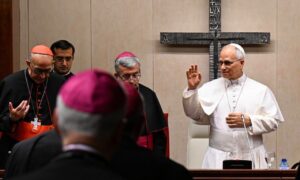






Copyright 2026 Catholic Online. All materials contained on this site, whether written, audible or visual are the exclusive property of Catholic Online and are protected under U.S. and International copyright laws, © Copyright 2026 Catholic Online. Any unauthorized use, without prior written consent of Catholic Online is strictly forbidden and prohibited.
Catholic Online is a Project of Your Catholic Voice Foundation, a Not-for-Profit Corporation. Your Catholic Voice Foundation has been granted a recognition of tax exemption under Section 501(c)(3) of the Internal Revenue Code. Federal Tax Identification Number: 81-0596847. Your gift is tax-deductible as allowed by law.