Eucharist Makes the Church (Part 1 of 2)
FREE Catholic Classes
Father Paul McPartlan on the Centrality of the Sacrament
LONDON, FEB. 25, 2005 (Zenit) - Theologian Henri de Lubac proposed that the first millennium was characterized by the idea that "the Eucharist makes the Church," whereas the second millennium held more to the idea that "the Church makes the Eucharist."
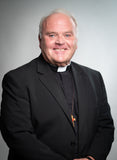
Father Paul McPartlan -- professor of dogmatic theology at the University of London, member of the Vatican's International Theological Commission and author of "Sacrament of Salvation: An Introduction to Eucharistic Ecclesiology" (T&T Clark/Continuum) -- agrees that both statements are still true today.
He shared with us the centrality, significance and evolution of the Eucharist's relationship with the Church.
Part 2 of this interview will appear Sunday.
Q: What role does the Eucharist play in the life of the Church?
Father McPartlan: The Eucharist is at the very core of the life of the Church and gives the Church its identity.
The Church is the Body of Christ, and, as St. Augustine taught, we receive the body of Christ in order to become the body of Christ: "Be what you see and receive what you are."
The whole mystery of Christ and of the Church as his body is what we receive in the Eucharist. This sacrament therefore renews our life together in Christ; in other words, it renews the Church.
 Hi readers, it seems you use Catholic Online a lot; that's great! It's a little awkward to ask, but we need your help. If you have already donated, we sincerely thank you. We're not salespeople, but we depend on donations averaging $14.76 and fewer than 1% of readers give. If you donate just $5.00, the price of your coffee, Catholic Online School could keep thriving. Thank you. Help Now >
"The Church draws her life from the Eucharist," as Pope John Paul II said at the start of his encyclical "Ecclesia de Eucharistia."
The life that we share in Christ is the life of the Trinity, because Christ is the Son of God incarnate, and that life is one of perfect communion. The phrase we use about receiving the Eucharist is really very significant; we say we are receiving Communion. There is such a lot of meaning concentrated in that phrase.
We are receiving Christ himself, but the life he shares with us is the communion life of the Trinity -- the very life that calls us out of our own individualism and draws us together as the Church.
The Eucharist renews the very gift that makes us to be the Church, and it follows that the community dimension of the Eucharist is of the utmost importance. It is really communities, and ultimately the Church as a whole, that receives the Eucharist, not just lots of individuals.
We should always be conscious of those with whom we receive; the Eucharist renews our life as brothers and sisters, caring for one another and working together to bear witness to the communion life of the Kingdom of God.
Our life in Christ begins, of course, with baptism, and people sometimes think that an emphasis on the Eucharist as making the Church detracts from the importance of baptism in making the Church. We must avoid any such impression.
Baptism and Eucharist are both given to us by Christ and therefore there can never be any rivalry between them. Rather we must understand how they fit together. What baptism begins in us, the Eucharist renews, strengthens and sustains.
For instance, in every Eucharist we are washed by the blood of the Lamb, as it says in Revelation 7:14; it is a washing that renews the washing in water that we received in baptism. We must never forget that there is forgiveness in the Eucharist, particularly expressed when we receive under both kinds and drink from the cup of the Lord.
In a sense, the Eucharist keeps the grace of our baptism fresh in us until the moment when it is consummated at our death. As we pray in the Mass for a deceased person: "In baptism she died with Christ, may she also share his resurrection."
Q: What does it mean that "the Church makes the Eucharist" and "the Eucharist makes the Church"?

Father McPartlan: These two phrases were coined by the great French Jesuit Henri de Lubac [1896-1991], who was a leading pioneer of the renewal of the Church at the Second Vatican Council and became a cardinal toward the end of his long life.
Both are true, of course. However, he thought that the first millennium, and especially the era of the Fathers of the early Church, was characterized by the idea that "the Eucharist makes the Church;" whereas the second millennium, the era of scholasticism, held more to the idea that "the Church makes the Eucharist."
It is clear from the title of the Pope's encyclical that we have returned in recent times, particularly after Vatican II thanks to the work of de Lubac and others, to a more patristic point of view.
The two phrases in fact tend to identify two rather different perceptions of the Church. If we say that the Eucharist makes the Church then we will readily understand that the Church is itself a family of Eucharistic communities, a communion of local churches, which was the patristic model.
However, de Lubac showed that the community dimension of the Eucharist suffered greatly as a result of Eucharistic controversy at the start of the second millennium. Much more attention was paid to the fact that bread and wine are changed into the body and blood of Christ than to the fact that the Church then receives these transformed gifts and is itself transformed in Christ.
The Eucharist ceased to shape the Church and became one of seven sacraments that the Church celebrates. Hence, the Church makes the Eucharist.
Juridical factors then began to shape the Church, and the standard picture of the Church in the scholastic era is that of an institutional pyramid, with the pope at the top. Vatican II grappled with how to integrate these two pictures of the Church and this is still an issue today.
Nevertheless, we can certainly say that the Council showed a strong desire to reinstate patristic perspectives. We naturally speak nowadays of the Church as a Eucharistic communion of local churches and this is of immense importance ecumenically.
Q: What progress has there been in ecumenical discussion of the Eucharist?
Father McPartlan: The Catholic Church joined the ecumenical movement as a result of the Second Vatican Council, largely through the insight that ecumenism is really the striving for catholicity, which is surely what the Catholic Church is all about. It was particularly the French Dominican Yves Congar [1904-1995], another great pioneer of the Council, who promoted this crucial insight.

Since the Council, a number of very important ecumenical agreed statements on the Eucharist have been produced, with a growing perception across the Christian family that the Eucharist is somehow a key to the mystery of the Church. If we are seeking Church unity, we must seriously consider the Eucharist.
While there is not yet full agreement on the Eucharist, we can certainly note progress toward a fuller and richer shared understanding of the sacrament.
It is striking that certain perspectives on the Eucharist that we have rather neglected in the recent past recur time and again in these agreed statements. It is as if the rediscovery of these perspectives is really promoting a growing consensus where previously there was only controversy.
The particular perspectives I would highlight are the links between the Eucharist and the Church community, the Holy Spirit and the future, respectively, all of which are profoundly scriptural and traditional.
If in the recent past we have tended to think of the Eucharist as the occasion when each of us as an individual meets Christ himself and is fed in a re-enactment of the past event of the Last Supper, we are learning now to extend and expand this rather limited picture.
In the Eucharist, Christ is feeding the Church, and each of us as members of the Church. It is also an occasion when the Holy Spirit is powerfully active, not only transforming the gifts of bread and wine but also transforming those who receive. Finally, it is not just a memorial of a past event; it is also a foretaste of the future kingdom.
One sentence from the 1982 Lima Report on "Baptism, Eucharist and Ministry" -- from the World Council of Churches' Faith and Order Commission, in which the Catholic Church fully participates -- is eloquent on these three points: "The Holy Spirit through the Eucharist gives a foretaste of the Kingdom of God: the Church receives the life of the new creation and the assurance of the Lord's return."
Another sentence shows important convergence on a proper understanding of the sacrificial aspect of the Eucharist: "The Eucharist is the sacrament of the unique sacrifice of Christ, who ever lives to make intercession for us."
[Sunday: Sharing in Christ's life]
Contact
Catholic Online
https://www.catholic.org
CA, US
Catholic Online - Publisher, 661 869-1000
info@yourcatholicvoice.org
Keywords
Eucharist, Church, McPartlan, Christ, Body, ecumenical

More Catholic PRWire
Showing 1 - 50 of 4,716
A Recession Antidote
Randy Hain
Monaco & The Vatican: Monaco's Grace Kelly Exhibit to Rome--A Review of Monegasque-Holy See Diplomatic History
Dna. Maria St. Catherine Sharpe, t.o.s.m., T.O.SS.T.
The Why of Jesus' Death: A Pauline Perspective
Jerom Paul
A Royal Betrayal: Catholic Monaco Liberalizes Abortion
Dna. Maria St.Catherine De Grace Sharpe, t.o.s.m., T.O.SS.T.
Embrace every moment as sacred time
Mary Regina Morrell
My Dad
JoMarie Grinkiewicz
Letting go is simple wisdom with divine potential
Mary Regina Morrell
Father Lombardi's Address on Catholic Media
Catholic Online
Pope's Words to Pontifical Latin American College
Catholic Online
Prelate: Genetics Needs a Conscience
Catholic Online
State Aid for Catholic Schools: Help or Hindrance?
Catholic Online
Scorsese Planning Movie on Japanese Martyrs
Catholic Online
2 Nuns Kidnapped in Kenya Set Free
Catholic Online
Holy See-Israel Negotiation Moves Forward
Catholic Online
Franchising to Evangelize
Catholic Online
Catholics Decry Anti-Christianity in Israel
Catholic Online
Pope and Gordon Brown Meet About Development Aid
Catholic Online
Pontiff Backs Latin America's Continental Mission
Catholic Online
Cardinal Warns Against Anti-Catholic Education
Catholic Online
Full Circle
Robert Gieb
We ask you, humbly: don't scroll away.
Hi readers, it seems you use Catholic Online a lot; that's great! It's a little awkward to ask, but we need your help. If you have already donated, we sincerely thank you. We're not salespeople, but we depend on donations averaging $14.76 and fewer than 1% of readers give. If you donate just $5.00, the price of your coffee, Catholic Online School could keep thriving. Thank you.Help Now >
Three words to a deeper faith
Paul Sposite
Relections for Lent 2009
chris anthony
Wisdom lies beyond the surface of life
Mary Regina Morrell
World Food Program Director on Lent
Catholic Online
Moral Clarity
DAN SHEA
Pope's Lenten Message for 2009
Catholic Online
A Prayer for Monaco: Remembering the Faith Legacy of Prince Rainier III & Princess Grace and Contemplating the Moral Challenges of Prince Albert II
Dna. Maria St. Catherine Sharpe
Keeping a Lid on Permissiveness
Sally Connolly
Glimpse of Me
Sarah Reinhard
The 3 stages of life
Michele Szekely
Sex and the Married Woman
Cheryl Dickow
A Catholic Woman Returns to the Church
Cheryl Dickow
Modernity & Morality
Dan Shea
Just a Minute
Sarah Reinhard
Catholic identity ... triumphant reemergence!
Hugh McNichol
Edging God Out
Paul Sposite
Burying a St. Joseph Statue
Cheryl Dickow
George Bush Speaks on Papal Visit
Catholic Online
Sometimes moving forward means moving the canoe
Mary Regina Morrell
Action Changes Things: Teaching our Kids about Community Service
Lisa Hendey
Easter... A Way of Life
Paul Spoisite
Papal initiative...peace and harmony!
Hugh McNichol
Proclaim the mysteries of the Resurrection!
Hugh McNichol
Jerusalem Patriarch's Easter Message
Catholic Online
Good Friday Sermon of Father Cantalamessa
Catholic Online
Papal Address at the End of the Way of the Cross
Catholic Online
Cardinal Zen's Meditations for Via Crucis
Catholic Online
Interview With Vatican Aide on Jewish-Catholic Relations
Catholic Online
Pope Benedict XVI On the Easter Triduum
Catholic Online
Holy Saturday...anticipation!
Hugh McNichol

Join the Movement
When you sign up below, you don't just join an email list - you're joining an entire movement for Free world class Catholic education.


 Daily Readings for Wednesday, April 24, 2024
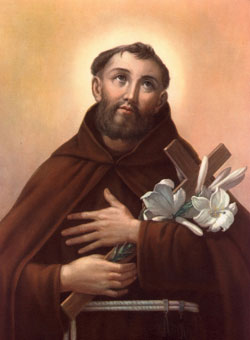 St. Fidelis of Sigmaringen: Saint of the Day for Wednesday, April 24, 2024
 A Prayer for Special Intentions: Prayer of the Day for Wednesday, April 24, 2024