We ask you, humbly: don't scroll away.
Hi readers, it seems you use Catholic Online a lot; that's great! It's a little awkward to ask, but we need your help. If you have already donated, we sincerely thank you. We're not salespeople, but we depend on donations averaging $14.76 and fewer than 1% of readers give. If you donate just $5.00, the price of your coffee, Catholic Online School could keep thriving. Thank you.Help Now >
Monk
FREE Catholic Classes
A monk may be conveniently defined as a member of a community of men, leading a more or less contemplative life apart from the world, under the vows of poverty, chastity, and obedience, according to a rule characteristic of the particular order to which he belongs. The word monk is not itself a term commonly used in the official language of the Church. It is a popular rather than a scientific designation, but is at the same time very ancient, so much so that its origin cannot be precisely determined. So far as regards the English form of the word, that undoubtedly comes from the Angle-Saxon munuc, which has in turn arisen from the Latin monachus , a mere transliteration of the Greek monachos . This Greek form is commonly believed to be connected with monos , lonely or single, and is suggestive of a life of solitude; but we cannot lose sight of the fact that the word mone , from a different root, seems to have been freely used, e.g. by Palladius, as well as monasterion , in the sense of a religious house (see Butler, "Palladius's Lausiac History" passim ). Be this as it may, the Fathers of the fourth century are by no means agreed as to the etymological significance of monachus . St Jerome writes to Heliodorus (P.L., XXII, 350), "Interpret the name monk, it is thine own; what business hast thou in a crowd, thou who art solitary?" St. Augustine on the other hand fastens on the idea of unity ( monas ) and in his exposition of Ps. cxxxii, extols the appropriateness of the words "Ecce quam bonum et quam jucundum habitare fratres in unum" when chanted in a monastery, because those who are monks should have but one heart and one soul (P.L., XXXVII, 1733). Cassian (P.L., XLIX, 1097) and Pseudo-Dionysius (De Eccl. Hier., vi) seem to have thought monks were so called because they were celibate.

In any case the fact remains that the word monachus in the fourth century was freely used of those consecrated to God, whether they lived as hermits or in communities. So again St. Benedict a little later (c. 535) states at the beginning of his rule that there are four kinds of monks ( monachi ):
- cenobites who live together under a rule or an abbot,
- anchorites or hermits, who after long training in the discipline of a community, go forth to lead a life of solitude (and of both of these classed he approves; but also
- "sarabites" and
- "girovagi" (wandering monks), whom he strongly condemns as men whose religious life is but a pretence, and who do their own without the restraint of obedience.

We ask you, humbly: don't scroll away.
Hi readers, it seems you use Catholic Online a lot; that's great! It's a little awkward to ask, but we need your help. If you have already donated, we sincerely thank you. We're not salespeople, but we depend on donations averaging $14.76 and fewer than 1% of readers give. If you donate just $5.00, the price of your coffee, Catholic Online School could keep thriving. Thank you.Help Now >
Join the Movement
When you sign up below, you don't just join an email list - you're joining an entire movement for Free world class Catholic education.




 Daily Readings for Thursday, April 25, 2024
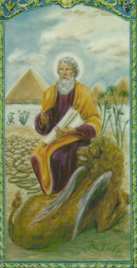 St. Mark: Saint of the Day for Thursday, April 25, 2024
 Prayer for Policemen: Prayer of the Day for Thursday, April 25, 2024