We ask you, humbly: don't scroll away.
Hi readers, it seems you use Catholic Online a lot; that's great! It's a little awkward to ask, but we need your help. If you have already donated, we sincerely thank you. We're not salespeople, but we depend on donations averaging $14.76 and fewer than 1% of readers give. If you donate just $5.00, the price of your coffee, Catholic Online School could keep thriving. Thank you.Help Now >
Bethlehem
FREE Catholic Classes
A titular see of Palestine. The early name of the city was Ephrata; afterwards Bethlehem, "House of Bread"; today Beith-Lahm, "House of Flesh." There died Rachel, Jacob's wife ( Genesis 35:19 ); David was born there ( 1 Samuel 17:12 ), and many other Biblical personages. There was enacted the gracious idyll of Ruth and Booz. There, above all, the Savior was born, a descendant of David, and from this fact the humble village has acquired unparalleled glory. It was at Bethlehem, also, that in the fourth century St. Jerome, St. Paula, and St. Eustochium fixed their residence. According to John Cassian, it was in a monastery of Bethlehem that the office of Prime was instituted. As early as the second century it was indicated by St. Justin Martyr, a native of Neapolis (Nablous), as the place of the Nativity. About A.D. 330 Constantine the Great built a basilica on this site. The present church appears to date from a later time -- either the fifth or the sixth century -- and has been repaired at still later periods. The Frankish kings were wont to come from Jerusalem to be crowned at Bethlehem, in memory of the coronation of David by Samuel. The greater part of the church is now shared by various communions, while the choir belongs to the Greeks alone, the Grotto of the Nativity is open to the Latins, the Greeks, and the Armenians, who hold services there each in turn.

The first Bishop of Bethlehem, Arnolfo (1099-1103), was appointed by the Crusaders. The see was not canonically erected until 1109, when the title was united with that of Ascalon, till then a Greek diocese (Revue de l'Orient latin, I, 141). The Diocese of Bethlehem-Ascalon existed from 1109-1378, but since the middle of the thirteenth century its bishops resided at Clamecy in France. The Diocese of Bethlehem-Clamecy was created in 1378, and suppressed by the Concordat between Napoleon and Pius VII, in 1801. The titular Bishoprics of Bethlehem and Ascalon, however, had existed separately from 1378 to 1603, when they were suppressed. From 1801 to 1840 both residential and titular sees, either of Bethlehem or Ascalon, were extinct. In 1840, Gregory XVI reunited the title of Bethlehem in perpetuum to the independent Abbey of St. Maurice d'Agaune in Switzerland. In 1867 the titular See of Ascalon was also re-established.
Bethlehem is today a little town with about 10,000 inhabitants, exclusive of foreigners (5,000 Latins, 100 Catholic, or Melchite, Greeks, 4,000 Greeks, a few Armenians and Mussulmans ). The inhabitants are very active and industrious. Besides agriculture, they are engaged in the fabrication of wooden, mother-of-pearl, and bituminous limestone objects, such as beads, crosses, etc. The women are remarkably beautiful and wear a peculiar costume which is very rich and of ancient pattern The Franciscans govern the Latin parish, a scholasticate, a primary school, and an asylum; the Christian Brothers have a novitiate for native young men; the Fathers of the Sacred Heart, or Betharramites, have a scholasticate for their missions in South America; the Salesians conduct an industrial school with an orphanage and an elementary school ; the Sisters of St. Joseph of the Apparition have two convents, a school, an orphanage, and an infant school ; the Sisters of Charity have a hospital and an orphanage ; the Carmelite nuns, a monastery. The Greek Catholic parish lately established has not yet a church. There are also Greek and Armenian monasteries, and schools conducted by Greeks, Armenians, and Protestants.

 Hi readers, it seems you use Catholic Online a lot; that's great! It's a little awkward to ask, but we need your help. If you have already donated, we sincerely thank you. We're not salespeople, but we depend on donations averaging $14.76 and fewer than 1% of readers give. If you donate just $5.00, the price of your coffee, Catholic Online School could keep thriving. Thank you. Help Now >
Join the Movement
When you sign up below, you don't just join an email list - you're joining an entire movement for Free world class Catholic education.


 Daily Readings for Thursday, April 25, 2024
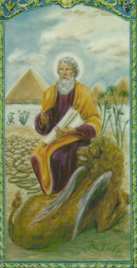 St. Mark: Saint of the Day for Thursday, April 25, 2024
 Prayer for Policemen: Prayer of the Day for Thursday, April 25, 2024