 Hi readers, it seems you use Catholic Online a lot; that's great! It's a little awkward to ask, but we need your help. If you have already donated, we sincerely thank you. We're not salespeople, but we depend on donations averaging $14.76 and fewer than 1% of readers give. If you donate just $5.00, the price of your coffee, Catholic Online School could keep thriving. Thank you. Help Now >
Upper Nile
FREE Catholic Classes
Vicariate apostolic ; separated from the mission of Nyanza, 6 July, 1894, comprises the eastern portion of Uganda, that is roughly east of a line from Fauvera on the Nile (about 2°13' N. lat.), north-east to the Kaffa mountains, and of a line south from Fauvera past Munynyu near Lake Victoria Nyanza to 1° S. lat. Of the native tribes, the Baganda, partly Caucasian, are much superior intellectually to the others. Their religion was spiritualistic, acknowledging a Divine Providence Katonda , who, being good, was neglected, while the loubalis , or demon, and mzimus , or departed souls, were propitiated. Totemism was prevalent, the mziro , or totem, being usually an animal, rarely a plant. The first Catholic missionaries, the White Fathers arrived in Uganda in 1878. Father Lourdel obtained leave from King Mtesa to enter; on 26 June, 1879, the fathers reached Roubaga.
On Easter Saturday, 27 March, 1880, the first catechumens were baptized ; two years later the Arabs induced Mtesa to expel the missionaries; they returned under his successor, Mwanga, 14 July, 1885. Religion spread rapidly, but the Protestants and Arabs stirred up the king to begin a persecution. Joseph Mkasa, chief of the royal pages, was the proto-martyr; on 26 May, 1886, thirty newly baptized Catholics, on refusing to apostatize, were burnt to death; soon more than seventy others were martyred. Then the Arabs plotted to depose Mwanga, but the Catholics by the advice of Father Lourdel remained loyal. The Arabs thereupon expelled the missionaries, who, however, returned in 1889: Father Lourdel endeavoured to induce Mwango to submit to the advancing British Company; on 12 May, 1890, worn out by his labours this pioneer of the Gospel died. His confrères continued to reap a rich harvest, but were opposed by Captain Luard, the British Company's agent. On 23 May, 1893, Uganda passed under the protection of the British Government and the Church gained comparative peace. Mgr Livinhac, now Superior General of the White Fathers, obtained the erection of the eastern portion of Uganda into a separate vicariate under the care of the English congregation of Foreign Missions, Mill Hill, London.

The first vicar Apostolic was Mgr. Henry Hanlon, b. on 7 Jan., 1862, consecrated titular Bishop of Teos in 1894, went to Uganda in 1895; after labouring there for seventeen years, he returned to England for the general chapter of his Society, and retired from active missionary work. He was succeeded (June, 1912) by Mgr. John Biermans, titular Bishop of Gargara. Coming to Uganda in 1896 he proved himself a valuable auxiliary to Mgr. Hanlon. The episcopal residence is at Mengo, Buganda, near Entebbe, capital of Uganda. In the mission there are 24 priests, 6 Missionary Franciscan Sisters of Mary; 15 churches ; 12 schools with 1649 pupils; and about 20,000 Catholics. The missionaries have recently compiled and printed in Uganda, a grammar phrase-book, and a vocabulary of a Nilotic language, Dhö Levo, spoken in Kavirondo. The language had not previously been reduced to writing. Some primers, catechisms, and prayer-books also in Dhö Levo have been printed.
 Hi readers, it seems you use Catholic Online a lot; that's great! It's a little awkward to ask, but we need your help. If you have already donated, we sincerely thank you. We're not salespeople, but we depend on donations averaging $14.76 and fewer than 1% of readers give. If you donate just $5.00, the price of your coffee, Catholic Online School could keep thriving. Thank you. Help Now >
Join the Movement
When you sign up below, you don't just join an email list - you're joining an entire movement for Free world class Catholic education.


 Daily Readings for Friday, April 19, 2024
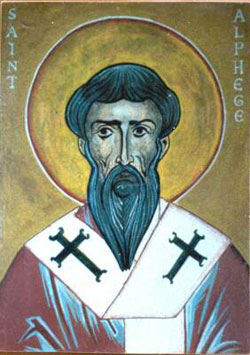 St. Alphege: Saint of the Day for Friday, April 19, 2024
 Stewardship Prayer: Prayer of the Day for Friday, April 19, 2024