Christians should make the living God visible to the world: Pope Benedict XVI, Chrism Mass
He opens our humanity for the gift of the Holy Spirit. The more we are united to Christ, the more we are filled with his Spirit, with the Holy Spirit. We are called "Christians": "anointed ones" - people who belong to Christ and hence have a share in his anointing, being touched by his Spirit. "I wish not merely to be called Christian, but also to be Christian", said Saint Ignatius of Antioch. Let us allow these holy oils, which are consecrated at this time, to remind us of the task that is implicit in the word "Christian", let us pray that, increasingly, we may not only be called Christian but may actually be such.

Highlights
Catholic Online (https://www.catholic.org)
4/25/2011 (1 decade ago)
Published in Lent / Easter
Keywords: Chrism Mass, Holy Oils, Pope Benedict XVI, Holy Thursday
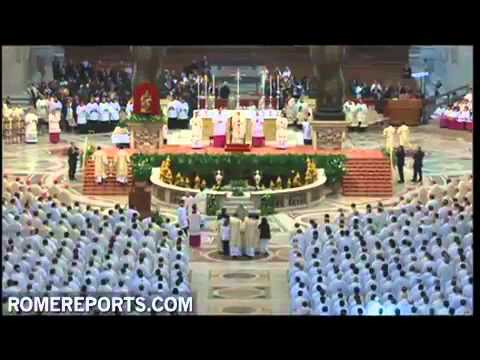
P>VATICAN CITY (Catholic Online) - On Holy Thursday morning, Pope Benedict XVI presided over the Chrism Mass where the Oils for use in the Sacraments are blessed and then distributed. We offer the complete text to our readers and viewers around the world. Once again, it demonstrates the extraordinary teaching gift of this wonderful Pope. We invite prayers for him and his ministry over these Holy Days. (Deacon Keith Fournier, Editor in Chief)
*****
Pope Benedict XVI's Homily at the Chrism Mass
Dear Brothers and Sisters,
At the heart of this morning's liturgy is the blessing of the holy oils - the oil for anointing catechumens, the oil for anointing the sick, and the chrism for the great sacraments that confer the Holy Spirit: confirmation, priestly ordination, episcopal ordination. In the sacraments the Lord touches us through the elements of creation. The unity between creation and redemption is made visible. The sacraments are an expression of the physicality of our faith, which embraces the whole person, body and soul.
Bread and wine are fruits of the earth and work of human hands. The Lord chose them to be bearers of his presence. Oil is the symbol of the Holy Spirit and at the same time it points us towards Christ: the word "Christ" (Messiah) means "the anointed one". The humanity of Jesus, by virtue of the Son's union with the Father, is brought into communion with the Holy Spirit and is thus "anointed" in a unique way, penetrated by the Holy Spirit. What happened symbolically to the kings and priests of the Old Testament when they were instituted into their ministry by the anointing with oil, takes place in Jesus in all its reality: his humanity is penetrated by the power of the Holy Spirit.
He opens our humanity for the gift of the Holy Spirit. The more we are united to Christ, the more we are filled with his Spirit, with the Holy Spirit. We are called "Christians": "anointed ones" - people who belong to Christ and hence have a share in his anointing, being touched by his Spirit. "I wish not merely to be called Christian, but also to be Christian", said Saint Ignatius of Antioch. Let us allow these holy oils, which are consecrated at this time, to remind us of the task that is implicit in the word "Christian", let us pray that, increasingly, we may not only be called Christian but may actually be such.
In today's liturgy, three oils are blessed, as I mentioned earlier. They express three essential dimensions of the Christian life on which we may now reflect. First, there is the oil of catechumens. This oil indicates a first way of being touched by Christ and by his Spirit - an inner touch, by which the Lord draws people close to himself. Through this first anointing, which takes place even prior to baptism, our gaze is turned towards people who are journeying towards Christ - people who are searching for faith, searching for God. The oil of catechumens tells us that it is not only we who seek God: God himself is searching for us. The fact that he himself was made man and came down into the depths of human existence, even into the darkness of death, shows us how much God loves his creature, man.
Driven by love, God has set out towards us. "Seeking me, you sat down weary ... let such labour not be in vain!", we pray in the Dies Irae. God is searching for me. Do I want to recognize him? Do I want to be known by him, found by him? God loves us. He comes to meet the unrest of our hearts, the unrest of our questioning and seeking, with the unrest of his own heart, which leads him to accomplish the ultimate for us. That restlessness for God, that journeying towards him, so as to know and love him better, must not be extinguished in us. In this sense we should always remain catechumens. "Constantly seek his face", says one of the Psalms (105:4). Saint Augustine comments as follows: "God is so great as to surpass infinitely all our knowing and all our being. Knowledge of God is never exhausted. For all eternity, with ever increasing joy, we can always continue to seek him, so as to know him and love him more and more."
"Our heart is restless until it rests in you", said Saint Augustine at the beginning of his Confessions. Yes, man is restless, because whatever is finite is too little. But are we truly restless for him? Have we perhaps become resigned to his absence, do we not seek to be self-sufficient? Let us not allow our humanity to be diminished in this way! Let us remain constantly on a journey towards him, longing for him, always open to receive new knowledge and love!
Then there is the oil for anointing the sick. Arrayed before us is a host of suffering people: those who hunger and thirst, victims of violence in every continent, the sick with all their sufferings, their hopes and their moments without hope, the persecuted, the downtrodden, the broken-hearted. Regarding the first mission on which Jesus sent the disciples, Saint Luke tells us: "he sent them out to preach the kingdom of God and to heal" (9:2). Healing is one of the fundamental tasks entrusted by Jesus to the Church, following the example that he gave as he travelled throughout the land healing the sick.
To be sure, the Church's principal task is to proclaim the Kingdom of God. But this very proclamation must be a process of healing: "bind up the broken-hearted", we heard in today's first reading from the prophet Isaiah (61:1). The proclamation of God's Kingdom, of God's unlimited goodness, must first of all bring healing to broken hearts. By nature, man is a being in relation. But if the fundamental relationship, the relationship with God, is disturbed, then all the rest is disturbed as well. If our relationship with God is disturbed, if the fundamental orientation of our being is awry, we cannot truly be healed in body and soul. For this reason, the first and fundamental healing takes place in our encounter with Christ who reconciles us to God and mends our broken hearts.
But over and above this central task, the Church's essential mission also includes the specific healing of sickness and suffering. The oil for anointing the sick is the visible sacramental expression of this mission. Since apostolic times, the healing vocation has matured in the Church, and so too has loving solicitude for those who are distressed in body and soul. This is also the occasion to say thank you to those sisters and brothers throughout the world who bring healing and love to the sick, irrespective of their status or religious affiliation. From Elizabeth of Hungary, Vincent de Paul, Louise de Marillac, Camillus of Lellis to Mother Teresa - to recall but a few names - we see, lighting up the world, a radiant procession of helpers streaming forth from God's love for the suffering and the sick.
For this we thank the Lord at this moment. For this we thank all those who, by virtue of their faith and love, place themselves alongside the suffering, thereby bearing definitive witness to the goodness of God himself. The oil for anointing the sick is a sign of this oil of the goodness of heart that these people bring - together with their professional competence - to the suffering. Even without speaking of Christ, they make him manifest.
In third place, finally, is the most noble of the ecclesial oils, the chrism, a mixture of olive oil and aromatic vegetable oils. It is the oil used for anointing priests and kings, in continuity with the great Old Testament traditions of anointing. In the Church this oil serves chiefly for the anointing of confirmation and ordination. Today's liturgy links this oil with the promise of the prophet Isaiah: "You shall be called the priests of the Lord, men shall speak of you as the ministers of our God" (61:6). The prophet makes reference here to the momentous words of commission and promise that God had addressed to Israel on Sinai: "You shall be to me a kingdom of priests and a holy nation" (Ex 19:6).
In and for the vast world, which was largely ignorant of God, Israel had to be as it were a shrine of God for all peoples, exercising a priestly function vis-Ă -vis the world. It had to bring the world to God, to open it up to him. In his great baptismal catechesis, Saint Peter applied this privilege and this commission of Israel to the entire community of the baptized, proclaiming: "But you are a chosen race, a royal priesthood, a holy nation, God's own people, that you may declare the wonderful deeds of him who called you out of darkness into his marvellous light. Once you were no people but now you are God's people" (1 Pet 2:9f.)
Baptism and confirmation are an initiation into this people of God that spans the world; the anointing that takes place in baptism and confirmation is an anointing that confers this priestly ministry towards mankind. Christians are a priestly people for the world. Christians should make the living God visible to the world, they should bear witness to him and lead people towards him. When we speak of this task in which we share by virtue of our baptism, it is no reason to boast. It poses a question to us that makes us both joyful and anxious: are we truly God's shrine in and for the world?
Do we open up the pathway to God for others or do we rather conceal it? Have not we - the people of God - become to a large extent a people of unbelief and distance from God? Is it perhaps the case that the West, the heartlands of Christianity, are tired of their faith, bored by their history and culture, and no longer wish to know faith in Jesus Christ? We have reason to cry out at this time to God: "Do not allow us to become a 'non-people'! Make us recognize you again! Truly, you have anointed us with your love, you have poured out your Holy Spirit upon us. Grant that the power of your Spirit may become newly effective in us, so that we may bear joyful witness to your message!
For all the shame we feel over our failings, we must not forget that today too there are radiant examples of faith, people who give hope to the world through their faith and love. When Pope John Paul II is beatified on 1 May, we shall think of him, with hearts full of thankfulness, as a great witness to God and to Jesus Christ in our day, as a man filled with the Holy Spirit. Alongside him, we think of the many people he beatified and canonized, who give us the certainty that even today God's promise and commission do not fall on deaf ears.
I turn finally to you, dear brothers in the priestly ministry. Holy Thursday is in a special way our day. At the hour of the last Supper, the Lord instituted the new Testament priesthood. "Sanctify them in the truth" (Jn 17:17), he prayed to the Father, for the Apostles and for priests of all times. With great gratitude for the vocation and with humility for all our shortcomings, we renew at this hour our "yes" to the Lord's call: yes, I want to be intimately united to the Lord Jesus, in self-denial, driven on by the love of Christ. Amen.
---
'Help Give every Student and Teacher FREE resources for a world-class Moral Catholic Education'
Copyright 2021 - Distributed by Catholic Online

Come Grow With Us
Sign up and walk the Catholic journey with millions around the world.
Receive inspiring emails on saints, daily readings, and free faith-building resources—no cost, ever.
Sister Sara Has One Message for Every Catholic Family This June
- Easter / Lent
- 5 Lenten Prayers
- Ash Wednesday
- 7 Morning Prayers
- Mysteries of the Rosary
- Litany of the Bl. Virgin Mary
- Popular Saints
- Popular Prayers
- Female Saints
- Saint Feast Days by Month
- Stations of the Cross
- St. Francis of Assisi
- St. Michael the Archangel
- The Apostles' Creed
- Unfailing Prayer to St. Anthony
- Pray the Rosary






Copyright 2026 Catholic Online. All materials contained on this site, whether written, audible or visual are the exclusive property of Catholic Online and are protected under U.S. and International copyright laws, © Copyright 2026 Catholic Online. Any unauthorized use, without prior written consent of Catholic Online is strictly forbidden and prohibited.
Catholic Online is a Project of Your Catholic Voice Foundation, a Not-for-Profit Corporation. Your Catholic Voice Foundation has been granted a recognition of tax exemption under Section 501(c)(3) of the Internal Revenue Code. Federal Tax Identification Number: 81-0596847. Your gift is tax-deductible as allowed by law.