We ask you, urgently: don't scroll past this
Dear readers, Catholic Online was de-platformed by Shopify for our pro-life beliefs. They shut down our Catholic Online, Catholic Online School, Prayer Candles, and Catholic Online Learning Resources essential faith tools serving over 1.4 million students and millions of families worldwide. Our founders, now in their 70's, just gave their entire life savings to protect this mission. But fewer than 2% of readers donate. If everyone gave just $5, the cost of a coffee, we could rebuild stronger and keep Catholic education free for all. Stand with us in faith. Thank you.Help Now >
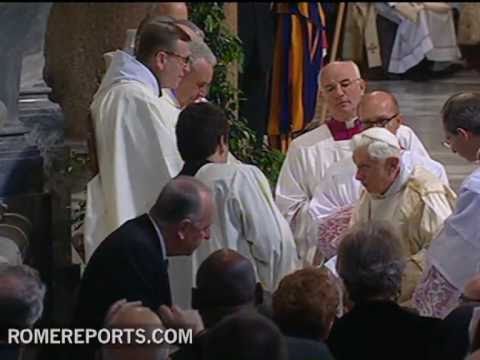
Lord, awaken in us the desire for you: Holy Thursday Homily of Pope Benedict XVI
"I have eagerly desired to eat this Passover with you". Lord, you desire us, you desire me. You eagerly desire to share yourself with us in the Holy Eucharist, to be one with us. Lord, awaken in us the desire for you. Strengthen us in unity with you and with one another. Grant unity to your Church, so that the world may believe. Amen. - The great teacher Pope, Benedict XVI, instructs the faithful on how to grow in a living faith rooted in a true desire for the God who desires us.

Highlights
Catholic Online (https://www.catholic.org)
4/22/2011 (1 decade ago)
Published in Lent / Easter
Keywords: Lord's Supper, Eucharist, Holy Thursday, Pope Benedict XVI, Triduum
P>VATICAN CITY (Catholic Online) - As we enter into the Great Triduum, the Three Days, we share the homily given by the Successor of Peter, Pope Benedict XVI, at the Holy Thursday evening Mass of the Lord's Supper at the Basilica of St. John Lateran. We pray for all throughout the world who read and view Catholic Online, that you and those whom you love will receive all of the graces offered in the Liturgies of the Triduum. (Deacon Keith Fournier, Editor in Chief)
*****
Holy Thursday Homily of Pope Benedict XVI, Mass of the Lord's Supper
Dear Brothers and Sisters!
"I have eagerly desired to eat this Passover with you before I suffer" (Lk 22:15). With these words Jesus began the celebration of his final meal and the institution of the Holy Eucharist. Jesus approached that hour with eager desire. In his heart he awaited the moment when he would give himself to his own under the appearance of bread and wine. He awaited that moment which would in some sense, be the true messianic wedding feast: when he would transform the gifts of this world and become one with his own, so as to transform them and thus inaugurate the transformation of the world.
In this eager desire of Jesus we can recognize the desire of God himself - his expectant love for mankind, for his creation. A love which awaits the moment of union, a love which wants to draw mankind to itself and thereby fulfill the desire of all creation, for creation eagerly awaits the revelation of the children of God (cf. Rom 8:19). Jesus desires us, he awaits us. But what about ourselves? Do we really desire him? Are we anxious to meet him? Do we desire to encounter him, to become one with him, to receive the gifts he offers us in the Holy Eucharist? Or are we indifferent, distracted, busy about other things?
From Jesus' banquet parables we realize that he knows all about empty places at table, invitations refused, lack of interest in him and his closeness. For us, the empty places at the table of the Lord's wedding feast, whether excusable or not, are no longer a parable but a reality, in those very countries to which he had revealed his closeness in a special way. Jesus also knew about guests who come to the banquet without being robed in the wedding garment - they come not to rejoice in his presence but merely out of habit, since their hearts are elsewhere. In one of his homilies Saint Gregory the Great asks:
"Who are these people who enter without the wedding garment? What is this garment and how does one acquire it? He replies that those who are invited and enter do in some way have faith. It is faith which opens the door to them. But they lack the wedding garment of love. Those who do not live their faith as love are not ready for the banquet and are cast out. Eucharistic communion requires faith, but faith requires love; otherwise, even as faith, it is dead."
From all four Gospels we know that Jesus' final meal before his passion was also a teaching moment. Once again, Jesus urgently set forth the heart of his message. Word and sacrament, message and gift are inseparably linked. Yet at his final meal, more than anything else, Jesus prayed. Matthew, Mark and Luke use two words in describing Jesus' prayer at the culmination of the meal: "eucharĂstesas" and "eulĂłgesas" - the verbs "to give thanks" and "to bless". The upward movement of thanking and the downward movement of blessing go together.
The words of transubstantiation are part of this prayer of Jesus. They are themselves words of prayer. Jesus turns his suffering into prayer, into an offering to the Father for the sake of mankind. This transformation of his suffering into love has the power to transform the gifts in which he now gives himself. He gives those gifts to us, so that we, and our world, may be transformed. The ultimate purpose of Eucharistic transformation is our own transformation in communion with Christ. The Eucharist is directed to the new man, the new world, which can only come about from God, through the ministry of God's Servant.
From Luke, and especially from John, we know that Jesus, during the Last Supper, also prayed to the Father - prayers which also contain a plea to his disciples of that time and of all times. Here I would simply like to take one of these which, as John tells us, Jesus repeated four times in his Priestly Prayer. How deeply it must have concerned him! It remains his constant prayer to the Father on our behalf: the prayer for unity. Jesus explicitly states that this prayer is not meant simply for the disciples then present, but for all who would believe in him (cf. Jn 17:20). He prays that all may be one "as you, Father, are in me and I am in you, so that the world may believe" (Jn 17:21).
Christian unity can exist only if Christians are deeply united to him, to Jesus. Faith and love for Jesus, faith in his being one with the Father and openness to becoming one with him, are essential. This unity, then, is not something purely interior or mystical. It must become visible, so visible as to prove before the world that Jesus was sent by the Father. Consequently, Jesus' prayer has an underlying Eucharistic meaning which Paul clearly brings out in the First Letter to the Corinthians: "The bread that we break, is it not a sharing in the body of Christ? Because there is one bread, we who are many, are one body, for we all partake of the one bread" (1 Cor 10:16ff.).
With the Eucharist, the Church is born. All of us eat the one bread and receive the one body of the Lord; this means that he opens each of us up to something above and beyond us. He makes all of us one. The Eucharist is the mystery of the profound closeness and communion of each individual with the Lord and, at the same time, of visible union between all. The Eucharist is the sacrament of unity. It reaches the very mystery of the Trinity and thus creates visible unity. Let me say it again: it is an extremely personal encounter with the Lord and yet never simply an act of individual piety. Of necessity, we celebrate it together.
In each community the Lord is totally present. Yet in all the communities he is but one. Hence the words "una cum Papa nostro et cum episcopo nostro" are a requisite part of the Church's Eucharistic Prayer. These words are not an addendum of sorts, but a necessary expression of what the Eucharist really is. Furthermore, we mention the Pope and the Bishop by name: unity is something utterly concrete, it has names. In this way unity becomes visible; it becomes a sign for the world and a concrete criterion for ourselves.
Saint Luke has preserved for us one concrete element of Jesus' prayer for unity: "Simon, Simon, behold, Satan demanded to have you, that he might sift you like wheat, but I have prayed for you, that your faith may not fail; and when you have turned again, strengthen your brethren" (Lk 22:31). Today we are once more painfully aware that Satan has been permitted to sift the disciples before the whole world. And we know that Jesus prays for the faith of Peter and his successors. We know that Peter, who walks towards the Lord upon the stormy waters of history and is in danger of sinking, is sustained ever anew by the Lord's hand and guided over the waves. But Jesus continues with a prediction and a mandate. "When you have turned again.".
Every human being, save Mary, has constant need of conversion. Jesus tells Peter beforehand of his coming betrayal and conversion. But what did Peter need to be converted from? When first called, terrified by the Lord's divine power and his own weakness, Peter had said: "Go away from me, Lord, for I am a sinful man!" (Lk 5:8). In the light of the Lord, he recognizes his own inadequacy. Precisely in this way, in the humility of one who knows that he is a sinner, is he called. He must discover this humility ever anew.
At Caesarea Philippi Peter could not accept that Jesus would have to suffer and be crucified: it did not fit his image of God and the Messiah. In the Upper Room he did not want Jesus to wash his feet: it did not fit his image of the dignity of the Master. In the Garden of Olives he wielded his sword. He wanted to show his courage. Yet before the servant girl he declared that he did not know Jesus. At the time he considered it a little lie which would let him stay close to Jesus. All his heroism collapsed in a shabby bid to be at the centre of things.
We too, all of us, need to learn again to accept God and Jesus Christ as he is, and not the way we want him to be. We too find it hard to accept that he bound himself to the limitations of his Church and her ministers. We too do not want to accept that he is powerless in this world. We too find excuses when being his disciples starts becoming too costly, too dangerous. All of us need the conversion which enables us to accept Jesus in his reality as God and man. We need the humility of the disciple who follows the will of his Master. Tonight we want to ask Jesus to look to us, as with kindly eyes he looked to Peter when the time was right, and to convert us.
After Peter was converted, he was called to strengthen his brethren. It is not irrelevant that this task was entrusted to him in the Upper Room. The ministry of unity has its visible place in the celebration of the Holy Eucharist. Dear friends, it is a great consolation for the Pope to know that at each Eucharistic celebration everyone prays for him, and that our prayer is joined to the Lord 's prayer for Peter. Only by the prayer of the Lord and of the Church can the Pope fulfill his task of strengthening his brethren - of feeding the flock of Christ and of becoming the guarantor of that unity which becomes a visible witness to the mission which Jesus received from the Father.
"I have eagerly desired to eat this Passover with you". Lord, you desire us, you desire me. You eagerly desire to share yourself with us in the Holy Eucharist, to be one with us. Lord, awaken in us the desire for you. Strengthen us in unity with you and with one another. Grant unity to your Church, so that the world may believe. Amen.
---
'Help Give every Student and Teacher FREE resources for a world-class Moral Catholic Education'
Copyright 2021 - Distributed by Catholic Online
Come Grow With Us
Sign up and walk the Catholic journey with millions around the world.
Receive inspiring emails on saints, daily readings, and free faith-building resources—no cost, ever.
Sister Sara Has One Message for Every Catholic Family This June
- Easter / Lent
- 5 Lenten Prayers
- Ash Wednesday
- 7 Morning Prayers
- Mysteries of the Rosary
- Litany of the Bl. Virgin Mary
- Popular Saints
- Popular Prayers
- Female Saints
- Saint Feast Days by Month
- Stations of the Cross
- St. Francis of Assisi
- St. Michael the Archangel
- The Apostles' Creed
- Unfailing Prayer to St. Anthony
- Pray the Rosary









Copyright 2026 Catholic Online. All materials contained on this site, whether written, audible or visual are the exclusive property of Catholic Online and are protected under U.S. and International copyright laws, © Copyright 2026 Catholic Online. Any unauthorized use, without prior written consent of Catholic Online is strictly forbidden and prohibited.
Catholic Online is a Project of Your Catholic Voice Foundation, a Not-for-Profit Corporation. Your Catholic Voice Foundation has been granted a recognition of tax exemption under Section 501(c)(3) of the Internal Revenue Code. Federal Tax Identification Number: 81-0596847. Your gift is tax-deductible as allowed by law.
